
Entering and editing spans
The "Spans" menu at the top of the program interface contains the following options for entering and editing the spans in the installation.

New
This allows you to insert a new span into the workspace. This can be done:
- By selecting two previously created nodes from "Nodes", "New",
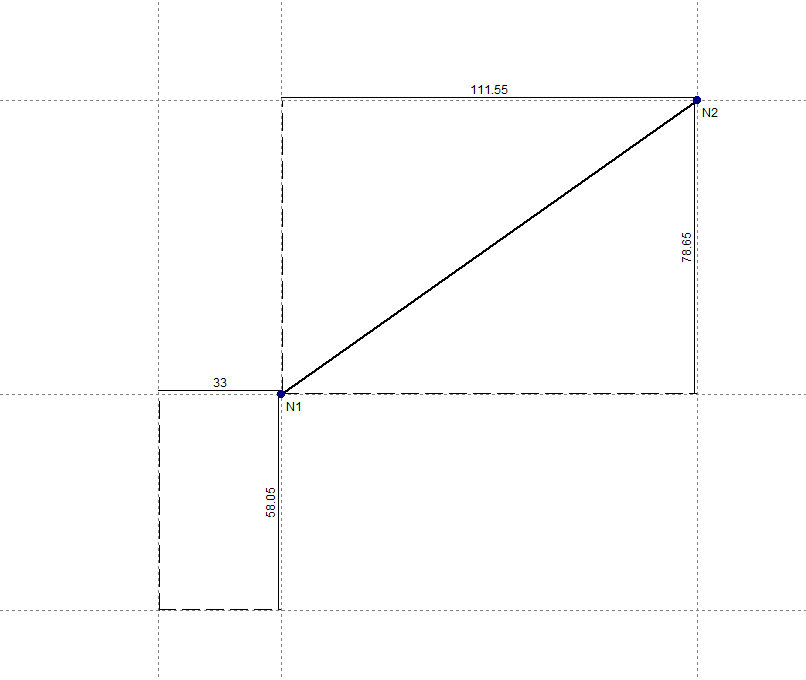
- Or by simply selecting two points on the workspace, which will define the end nodes of the segment. This means there is no need to enter the nodes defining the segment beforehand. When doing this, you must specify the absolute or relative coordinates of each node or capture points from a template, just as you would when adding new nodes.
In addition, the following is taken into account:
- If, when creating a new span, it crosses an existing span, a new node will be created at that intersection.
- If, when you insert a segment, the mouse pointer is positioned over the centre of a node, the end of the segment will be that node. Otherwise, a new node will be created at that point.
- You can also click on a previously entered span to start from there and create a node at the desired point.
The end nodes of the inserted segments are created by default as transition nodes; that is, nodes with no load that allow changes in direction whilst maintaining the segment’s unit in the dimensioning. They can subsequently be edited via “Nodes”, “Edit analysis data”.
| Note: |
|---|
| The installation must be interconnected; in other words, all nodes entered in the project must be connected by spans belonging to the same network. Two separate networks cannot be entered in the same file, but a single network with one or more supply points can be entered. |
Delete
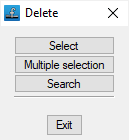
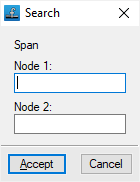
This allows you to delete the selected segment. You can use the left mouse button to draw a rectangular selection area on the screen to delete multiple segments. Furthermore, clicking the right mouse button brings up options to "Select" a single segment, perform a "Multiple selection" segment by segment, or "Search" for a segment using the coordinates of its endpoints.
When a segment is deleted, the end nodes are also removed if they belong solely to the deleted segment.
Edit analysis data
This allows you to edit the selected span. You can use the left mouse button to draw a rectangular selection area on the screen to edit multiple spans, selecting the fields you wish to edit. Furthermore, clicking the right mouse button brings up options to "Select" a single span, perform a "Multiple selection" span by span, or "Search" for a span using the coordinates of its endpoints.
In the edit window that appears, enter the details of the span:
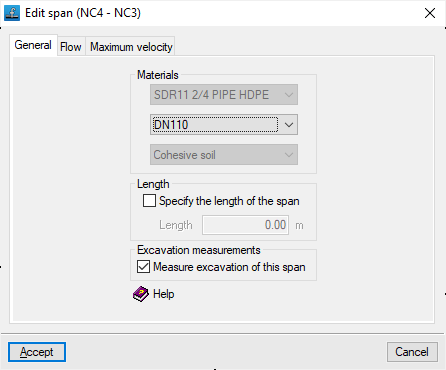
- "General" tab
- Materials
- Span material
Determines the range of diameters available for the span, both for manual selection and for preliminary design. In the latter case, the program will attempt to find a diameter that meets the requirements without changing the span material. - Pipe diameter:
This determines the main design parameters for the pipe span. During preliminary design, the diameter that best fits the existing network is selected from among those defined for the material chosen for the pipe span. - Span terrain:
The terrain where the trench through which the span runs is excavated. This parameter does not appear if no terrain has been selected for the project.
- Span material
- Length
The program allows you to determine the length of the span based on the drawing provided or to enter the value directly. In the first case, the "Specify the length of the span" checkbox remains unchecked, and the length of the span is analysed based on the coordinates of the end nodes (including their elevation). In the second case, the "Specify the length of the span" checkbox is enabled, and the length value used to calculate that span is entered. This option allows you to enter diagrams that do not need to be drawn to scale.- Specify the length of the span (optional)
- Excavation measurements
- Measure excavation of this span (optional)
- Materials
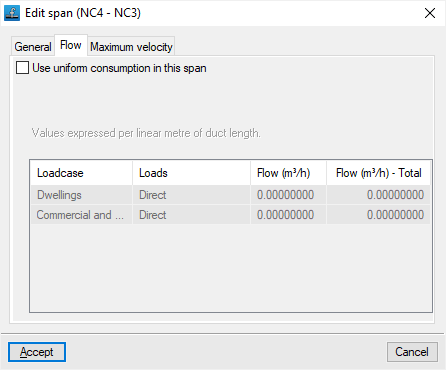
- "Flow rate" or "Maximum velocity" tab
These allow you to define a uniform gas consumption along the span, whether as a flow rate or a heat output, depending on the data entry mode defined in the "Parameters" tab, under "General data", "Edit general project data". The values are expressed per linear metre of pipeline length.- Use uniform consumption for this span (optional)
When this box is ticked, the program displays a table at the bottom that allows you to define the flow rate for each loadcase. This table contains the following columns:- Loadcase
- Loads
Loads can be defined in two ways:- Direct
- By assigned flow
- Flow rate / Power
The flow rate or power per linear metre of pipeline is defined by entering the value directly if the "Direct" option has been selected, or by entering a value for "Rating" and the "Number of units" to be taken into account if the "Per rating" option has been selected. - Total flow rate / Total capacity
Displays the total flow rate or total heat output per linear metre of pipework.
- Use uniform consumption for this span (optional)
- "Maximum velocity" tab
This allows you to enter specific maximum speed limits for the span being edited, for each of the scenario combinations shown in the table.- Use specific limit (optional)

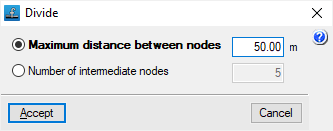
Divide a span into parts
This allows you to select a span and split it into several spans, automatically creating nodes along the span. This can be done by specifying the "Maximum distance between nodes" or the "Number of intermediate nodes".
Assign analysis data
This allows you to quickly assign data to spans.
When you click on the option, a small window opens in the top-left corner of the screen. At the same time, the selected span will be highlighted in yellow, starting with the one with the lowest node references. You can review and edit the span’s details (such as length, material and diameter). You can navigate through all the spans using the relevant buttons.

Information
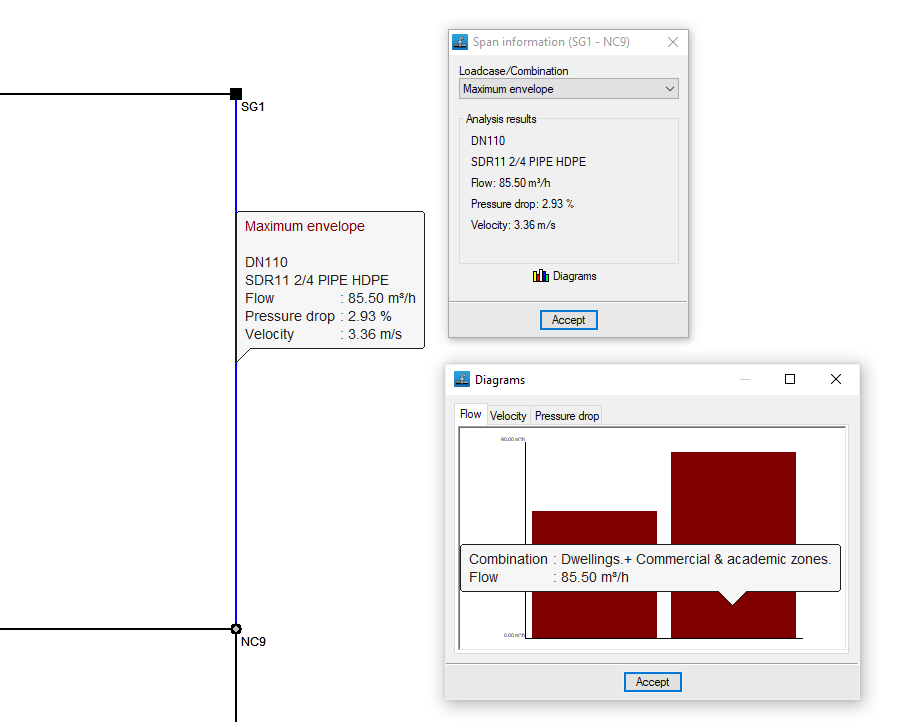
This allows you to view the data entered in the span.
If the structure has been analysed, the analysis results for the span under the currently selected loadcase are also displayed. Furthermore, clicking on the span will open a window where you can view the results for any loadcase, combination, envelope and oscillation, both analytically and graphically: the "Graphs" button displays the "Flow rate", "Velocity" and "Pressure drop" graphs for the different combinations.