
In previous versions, AcoubatBIM by CYPE could only be installed in English and French. As of the 2018.j version, AcoubatBIM by CYPE can also be installed in Spanish, Italian and Portuguese.
Design summary
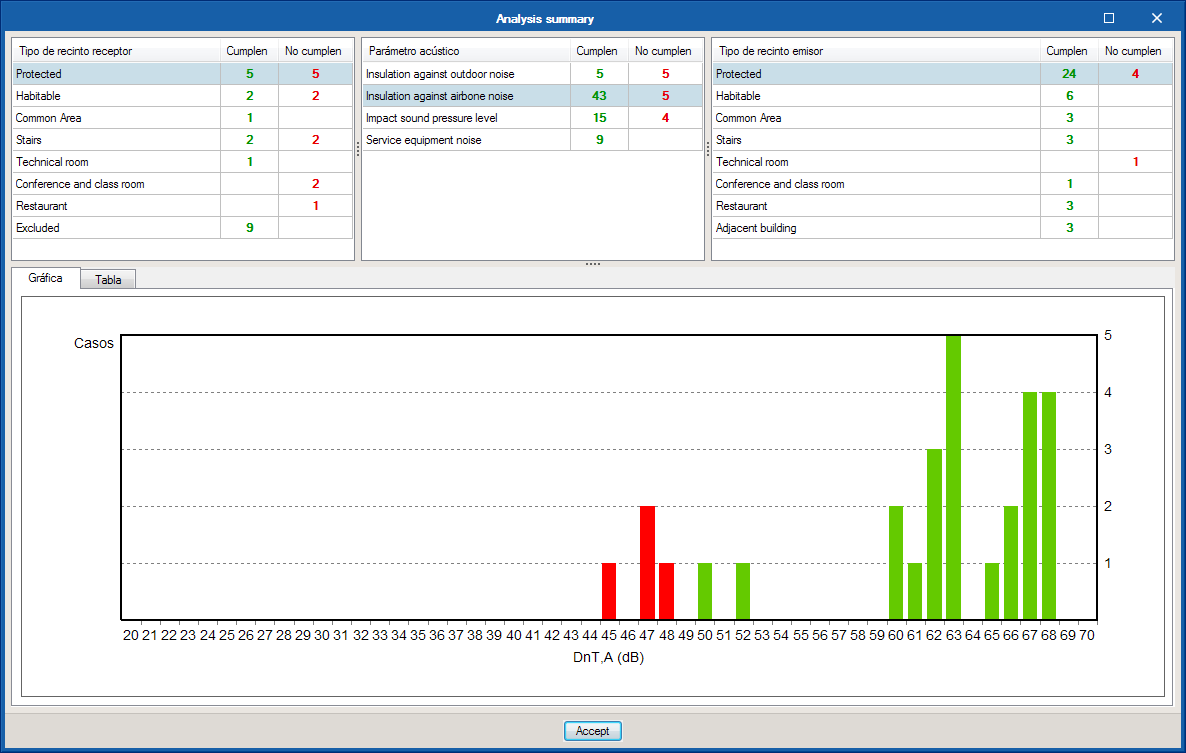
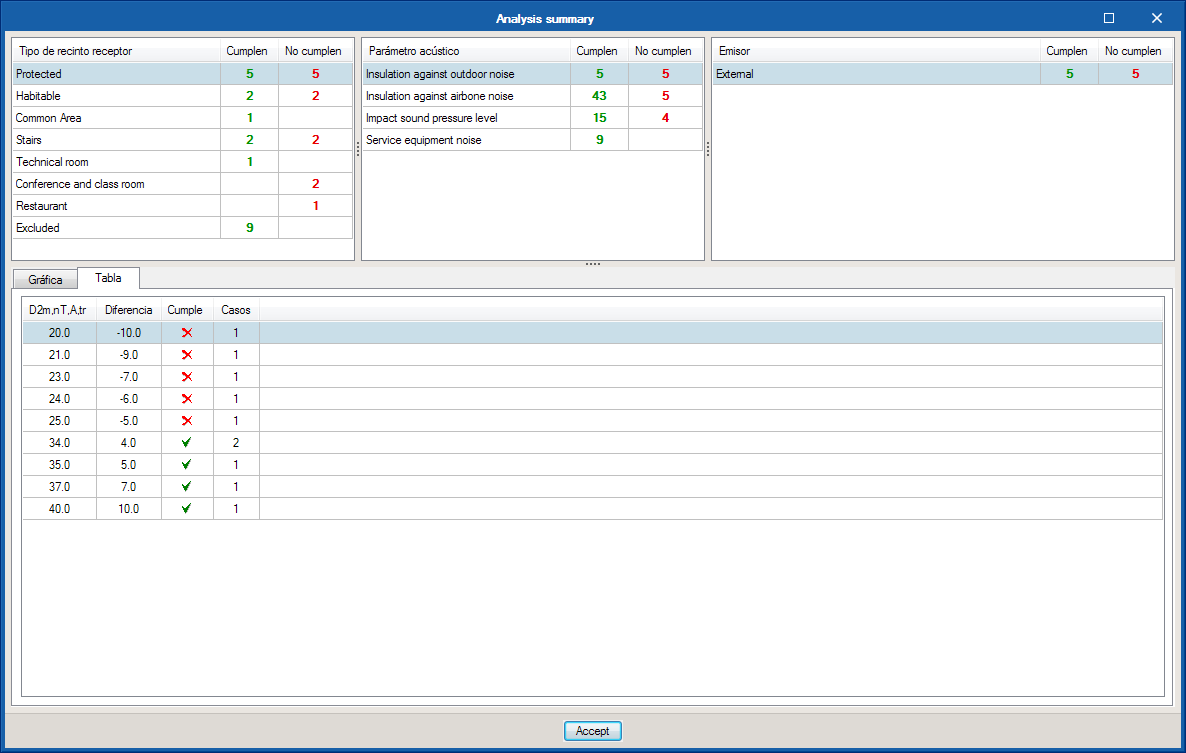
The histogram the program shows once the program has finished the design process has been improved to offer a greater level of information on the global acoustic behaviour of the building. Now it is possible to inspect the receptor spaces of each class and show the results of each acoustic parameter separately.
As well as the graph, a table containing the values that are obtained has been added.
Brazilian acoustic standard (NBR 15575)
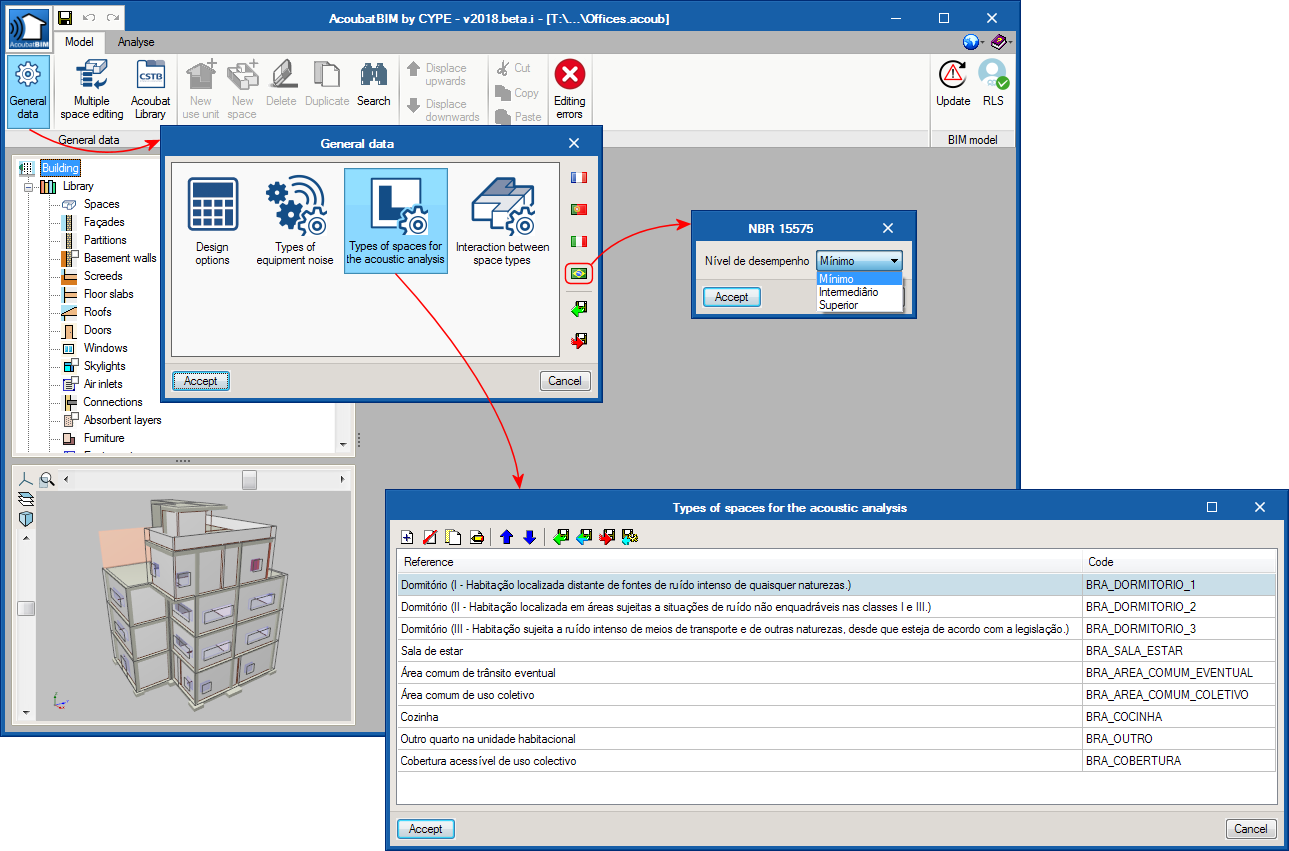
As of the 2018.i version, AcoubatBIM by CYPE allows users to import the configuration of the acoustic limits stated in the NBR 15575 code (Edificações habitacionais – Desempenho). As well as the obligatory compliance levels, users can choose whether to verify one of the acoustic performance levels described in the annex of the code (minimum, intermediate or superior).
Updating the acoustic tests database
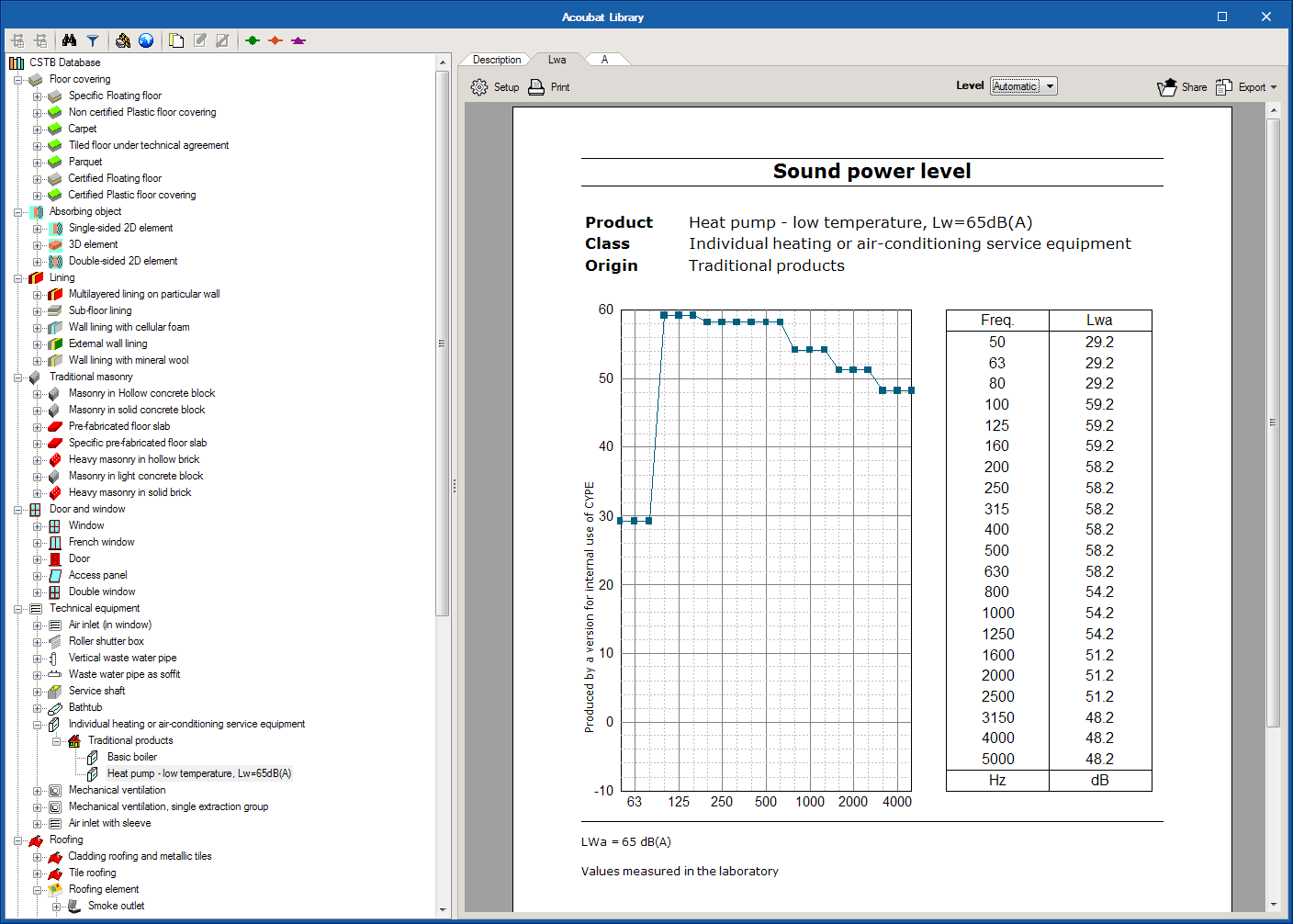
The acoustic test database of the CSTB has been updated to add new products to the Technical equipment class.
- Technical equipment
- Individual heating or air-conditioning service equipment
- Traditional products
- Heat pump – low temperature, Lw=65dB(A)
- Traditional products
- Mechanical ventilation, single extraction group
- Traditional products
- Extraction fan, Lw=64dB(A)
- Extraction fan, Lw=71dB(A)
- Traditional products
- Individual heating or air-conditioning service equipment
Types of equipment noise
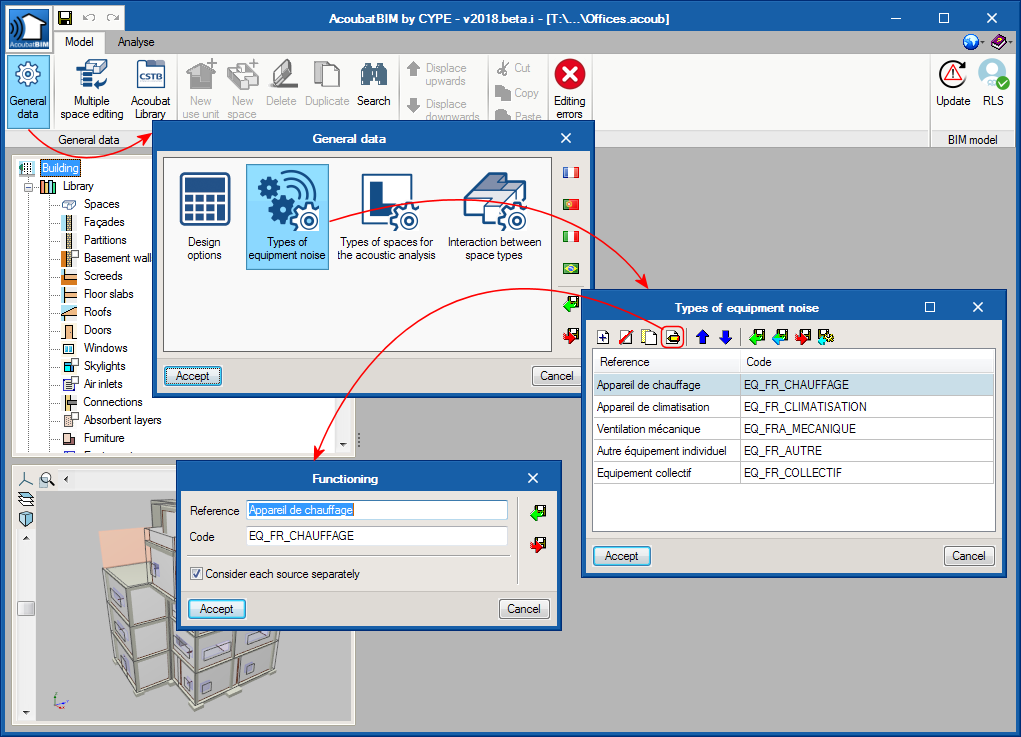
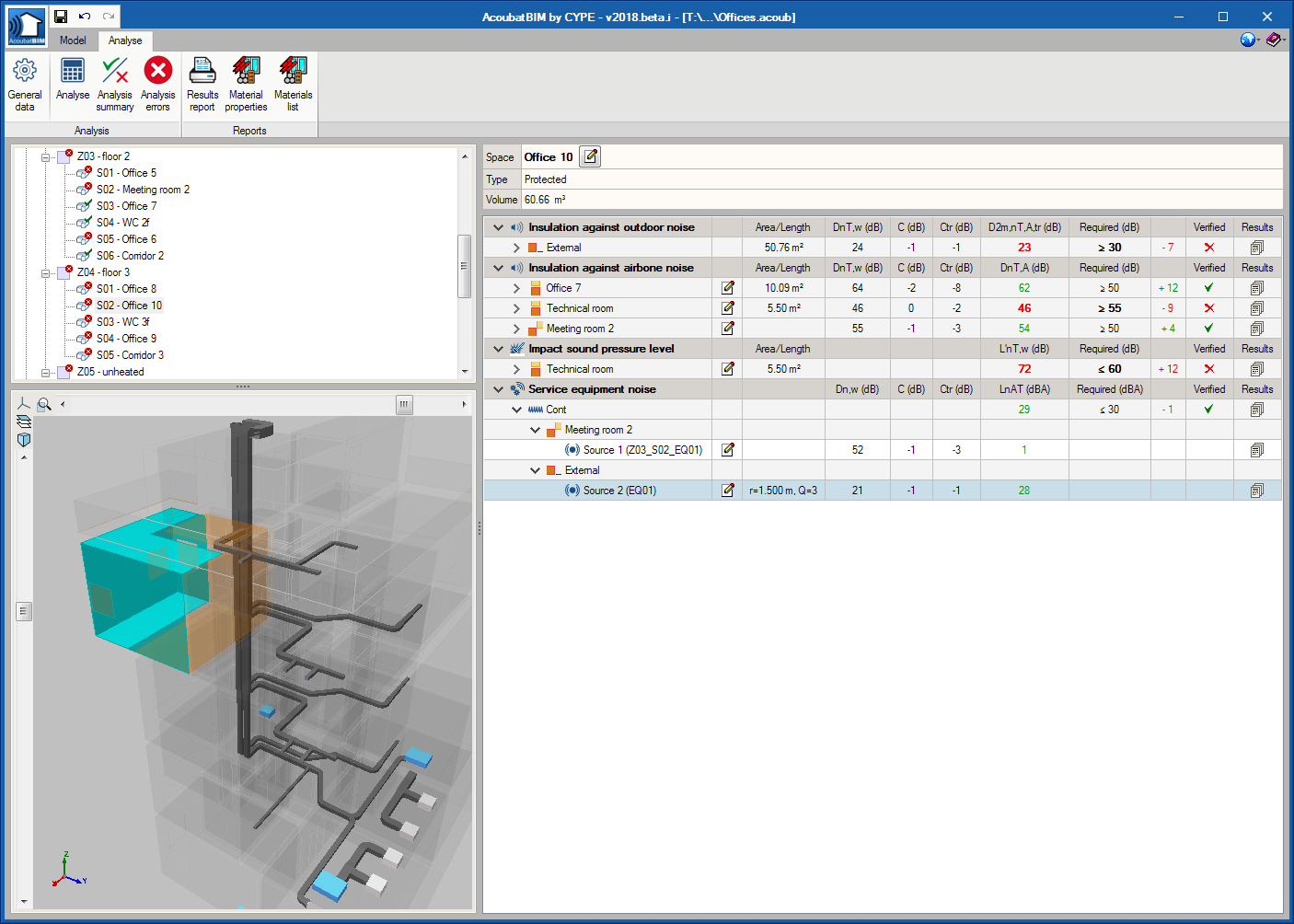
Now, instead of selecting the operation of each type of equipment (continuous, intermittent or emergency), users can define these options. This way, the application can carry out a more exact interpretation of the different acoustic codes. Additionally, for each type of specific noise, users can indicate if the noise produced by each source is to be evaluated individually (heating or air-conditioning equipment) or collectively (grilles or diffusers of the ventilation system).
Acoustic index for equipment noise
The configuration of the acoustic index that is used to measure noise generated by the equipment of the building has been included in the design options, amongst the general parameters of the project. Users can select one of the following global sound pressure level indices:
- LA: Sound pressure level in a space, [dBA]
- LnA: Normalized sound pressure level in a space, [dBA]
- LnAT: Standardized sound pressure level in space, [dBA]
Furthermore, users can indicate how the absorption of the emitter space is to be calculated. This can be carried out in the design options panel or in each space of the project. If it is carried out in the latter manner, it will prevail over what is indicated in the design options. Users can choose one of the following alternatives:
- T = T0 = 0.5s (A = 0.16•V/T0)
- A = A0 = 10m2
- Use real absorption
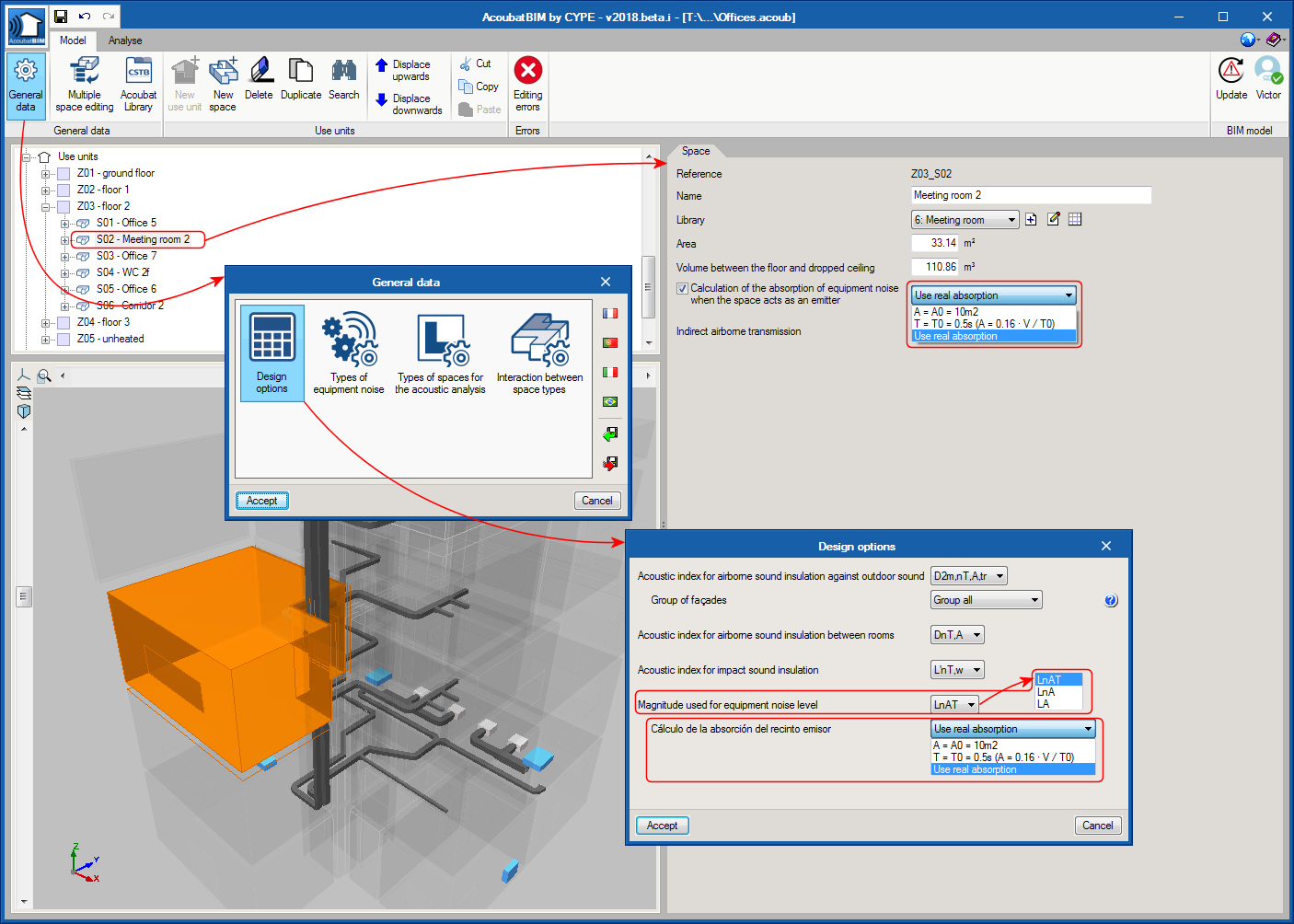
Calculation of the sound pressure level produced by outdoor equipment
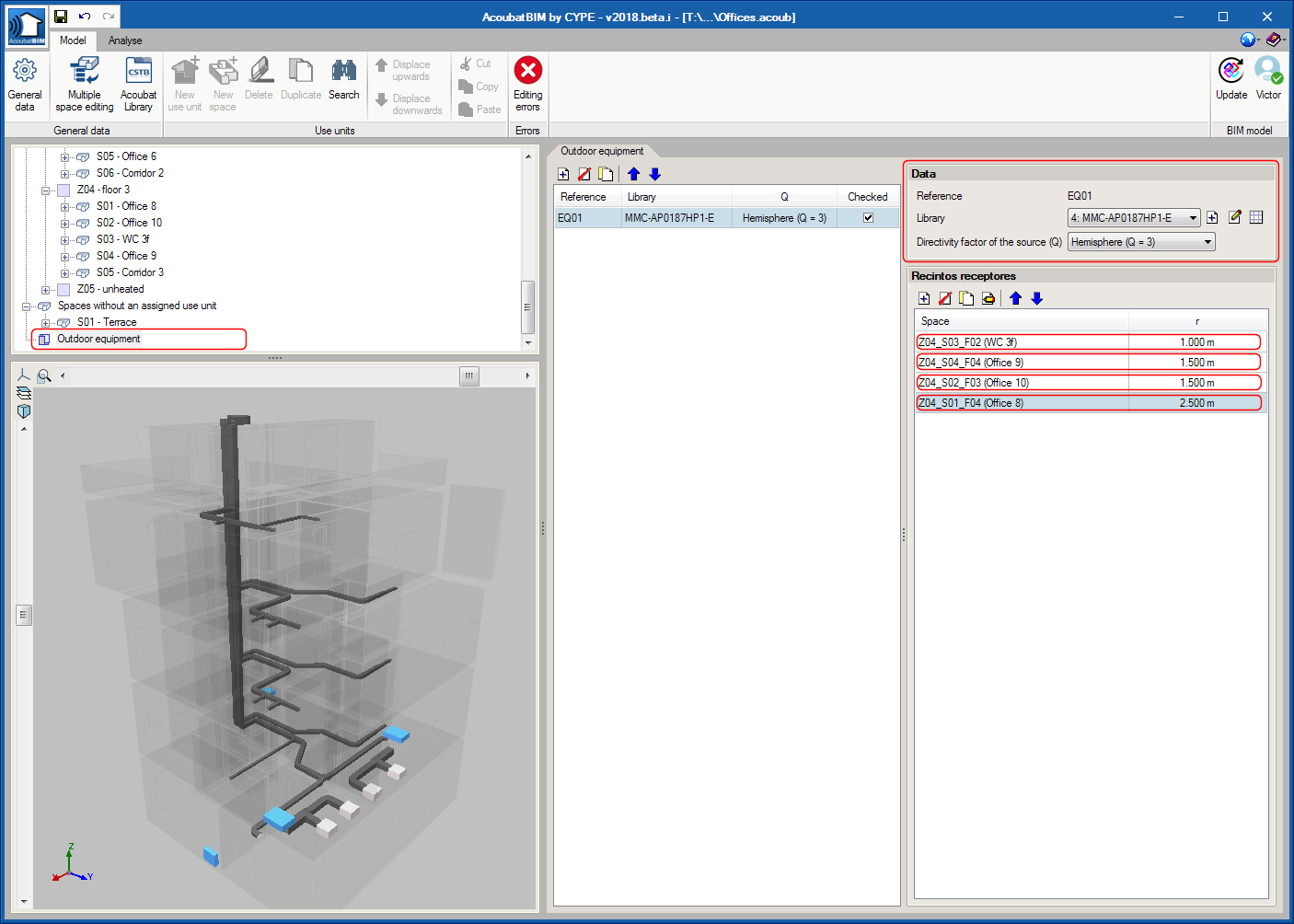
As of the 2018.i version, AcoubatBIM by CYPE allows users to define sources of outdoor noise, which generally correspond to the equipment installed in the building. A product from the Acoubat database can be assigned to each type of source and users must indicate the type of noise of the machine, depending on the classes defined in the general parameters of the project.
For each outdoor equipment set, users must indicate the distance between the source and the closest enclosure of each affected space (r). Depending on the surfaces close to the source, the value of the directivity factor (Q) of the machine must be established.
New parameters for the advanced search of the database
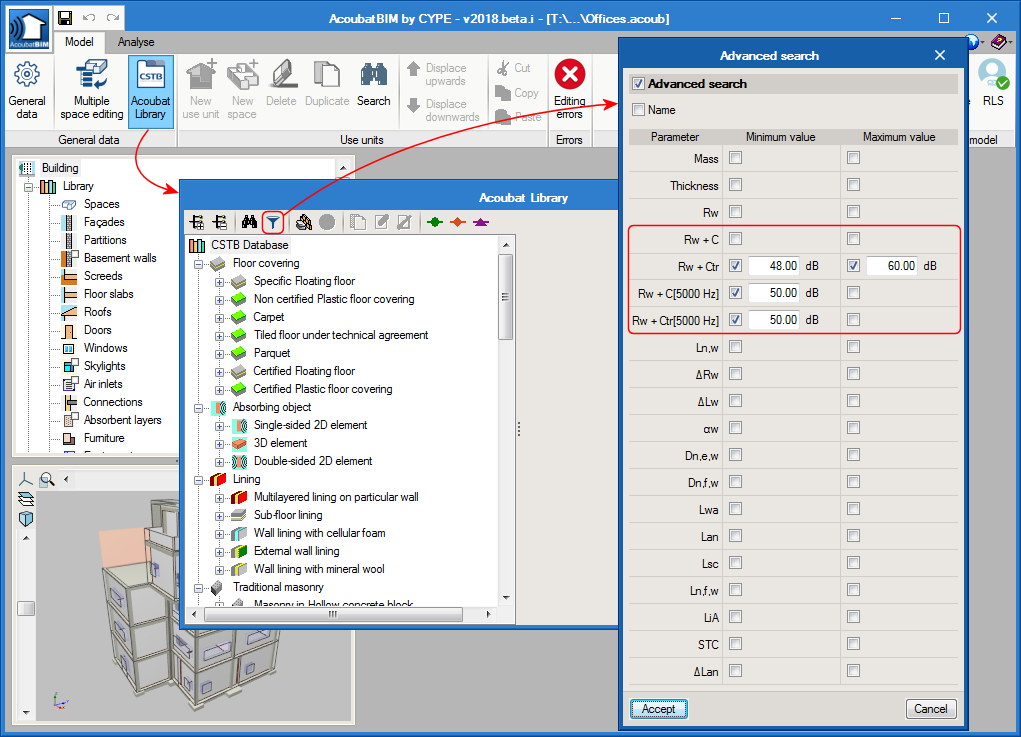
The following acoustic indices have been added to the advanced search tool of the database:
- Rw + C: Sound reduction index of an element, A-weighted [dB].
- Rw + Ctr: Sound reduction index of an element for urban traffic noise, A-weighted [dB].
- Rw + C [5000 Hz]: Sound reduction index of an element, A-weighted, broadened to 5000 Hz [dB].
- Rw + Ctr [5000 Hz]: Sound reduction index of an element for urban traffic noise, A-weighted, broadened to 5000 Hz [dB].
Portuguese sound code RRAE
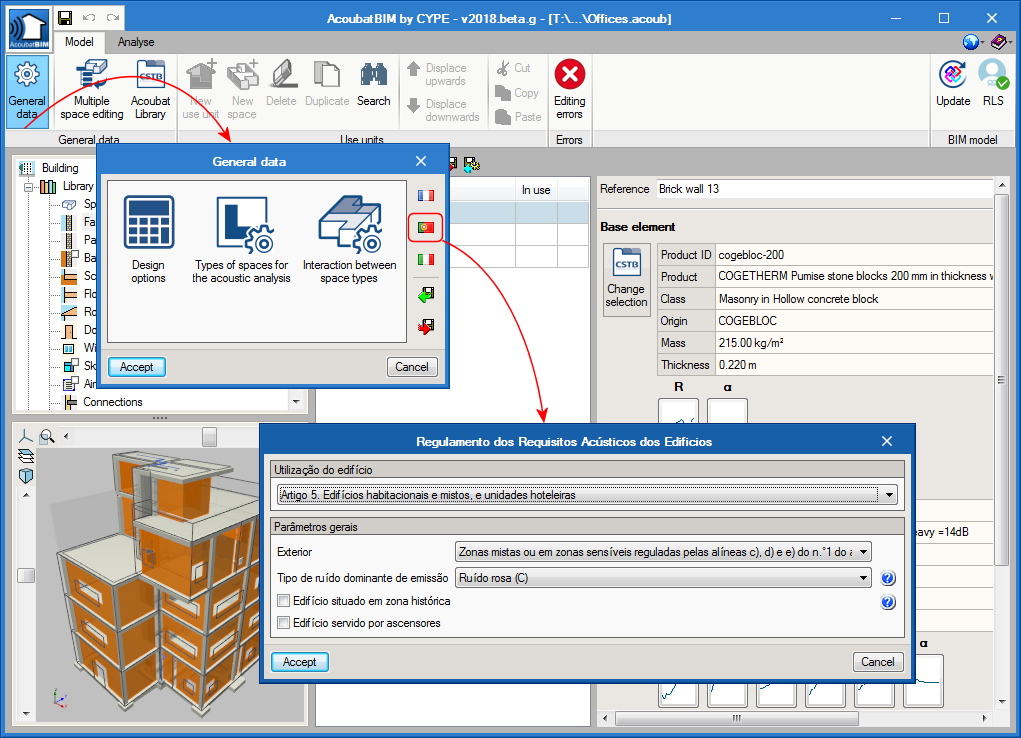
As of version 2018.g, AcoubatBIM by CYPE allows users to import the configuration of the acoustic limits included in the different articles of the "Regulamento dos Requisitos Acústicos dos Edifícios".
More specifically, the following project types have been implemented:
- Artigo 5. Edifícios habitacionais e mistos, e unidades hoteleiras.
- Artigo 6. Edifícios comerciais e de serviços, e partes similares em edifícios industriais.
- Artigo 7. Edifícios escolares e similares, e de investigação.
- Artigo 8. Edifícios hospitalares e similares.
- Artigo 9. Recintos deportivos.
- Artigo 10. Estações de transporte de passageiros.
- Artigo 10-A. Auditórios e salas.
New parameters for the advanced search of the database
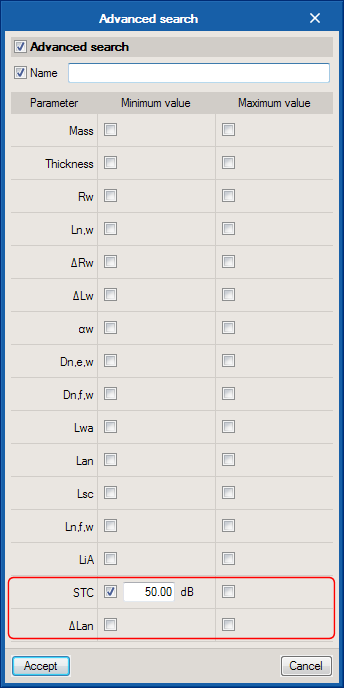
In the previous version (2018.f) acoustic indices were added to the advanced search tool of the database. In the 2018.g version, two more acoustic indices have been added to this search tool:
- STC: Sound transmission class (dB)
- ΔLan: Normalized sound pressure level reduction (dB)