

Update history​​

CYPE 3D

As of version 2026.b, project files are automatically associated with the corresponding CYPE app in the Windows environment. This means that you simply double-click on the file to open it directly in the appropriate program, without having to select it manually. This improvement streamlines the workflow and provides a smoother and more efficient user experience.

In CYPECAD, CYPE 3D and Foundation elements, it is now possible to define several stirrup sections, check the structural limit, and perform checks according to the CIRSOC 103 standard in Argentina.

The NLT module for tension-only bars has been extended to also include compression-only bars. This feature offers greater versatility in structural modelling.

CYPE 3D now connects to the Open BIM Database to incorporate intumescent mortars, and the fireproof coating reports and drawings have been improved, including the "Summary of fireproof coatings".

Version 2026.b expands the international scope of CYPE software with the implementation of new standards:

    • CYPECAD (Turkish wind standard TS 498: 2021);

    • CYPECAD and CYPE 3D (Algerian earthquake standard RPA 2024);

    • CYPECAD, CYPE 3D and Portal frame generator (Romanian rolled steel standard SR EN 1993-1-1);

    • CYPECAD, CYPE 3D and Portal frame generator (Romanian standard SR EN 1993-1-3 and Indian standard IS 801 - 1975 (Rf 1995) for shaped steel);

    • StruBIM Steel and CYPE Connect (Australian standards for anchors AS 3600: 2018 and AS 5216: 2021).

As of version 2026.a, CYPE 3D will include a modal vibration analysis module, an essential feature for evaluating how a structure responds to dynamic loads such as wind, traffic or earthquakes. The program carries out a modal analysis of the structure, showing detailed and visual results that optimise the design to ensure that it remains within acceptable limits.

As of version 2026.a, CYPE 3D will include the option of considering seismic action by means of a spectral modal analysis when launching a non-linear analysis. Non-linear combinations (NLC) involving seismic loads can be defined. Once the analyses have been carried out, we can consult the Justification of seismic action report, and view the groups of combinations generated and the results of the spectral modal analysis for each of them.

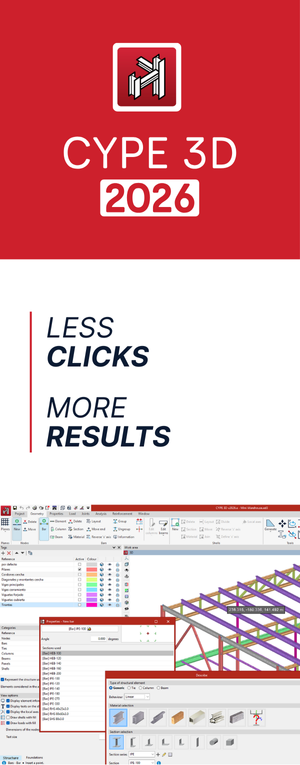
In CYPE 3D, a new interface has been implemented with a ribbon at the top, replacing the previous interface based on drop-down menus. This streamlines access to the different tools in the program and improves the user experience. The options visible in the ribbon depend on which tab is open.

It is now possible to consult the ground bearing pressure diagrams at the base of the footings in CYPECAD and CYPE 3D. As a result, the suitability of the solution adopted for the foundation can be assessed, as well as the distribution of loads on the ground and the behaviour of each footing.

New options have been implemented to configure the references of the elements (nodes, bars, parts and shells) according to the user's preference. In addition, the references of previously entered elements are maintained when deleting or adding new elements.

Should the modal spectral analysis be selected to consider the effect of earthquake, the maximum response of the structure in the seismic load is estimated by combining the results of the modes of vibration by means of the Complete Quadratic Combination (CQC). In versions prior to 2026.a, only seismic load stresses, reactions, displacements, etc. could be checked for the seismic scenario by mode. This is now also possible for the CQC modal combination.

Two options are provided for automatic saving of the work (Configuration menu > Auto Save Options). Two modes can be activated individually or simultaneously: "Automatically save every ... minutes", which saves the job automatically every time an action occurs in the environment and the specified time interval elapses, and "Save after analysing or designing", which saves the job automatically if the structure is designed. Neither of the two options is activated by default, so users must activate the desired options.