

Entering notional loads
The program can consider the initial imperfections of the structure by means of notional loads. A notional load is a small horizontal load used to represent the initial imperfections when assessing structural stability, defined in terms of the vertical load acting on each storey.
Load combinations that include notional loads are generated automatically based on the directions to be considered. This feature extends the capabilities of second-order structural analysis (P-Δ and P-δ) using the OpenSees analysis engine.
General information
When carrying out an analysis that takes the P-Delta effect into account, initial imperfections play a significant role, as they determine the direction of displacement. In this case, the effect of the initial imperfections must be taken into account. This can be done in the program in two different ways:
- By directly modelling the initial imperfections,
- By applying virtual loads, which can be used to simulate the effects of such initial imperfections.
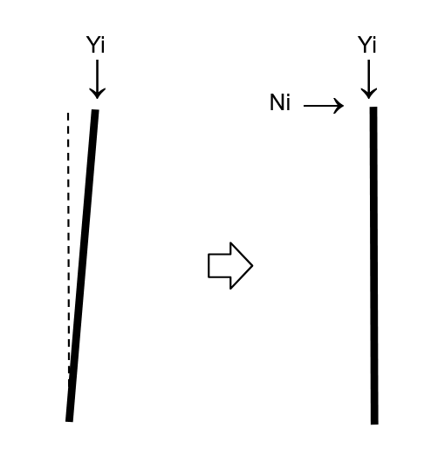
In structures that support gravitational loads primarily via columns, walls or vertical frames, notional loads can be used to represent the effects of the system’s initial imperfections on the positions of the bars’ intersection points, as shown below. Notional loads shall be applied to the structure, based on its nominal geometry, as lateral loads at all storeys.
For example, according to AISC standards, the magnitude of the notional loads is given by the following equation:
Ni = 0.002αYi
Where:
- α = 1.0 (LRFD); α = 1.6 (ASD)
- Ni = notional load applied at level i
- Yi = gravitational load applied at level i
The value 0.002 is the notional load coefficient based on an initial collapse ratio between storeys of 1/500. In the case of the Eurocode, the coefficient varies depending on the structure. You can modify this factor when defining notional loads in CYPE 3D.
How it works
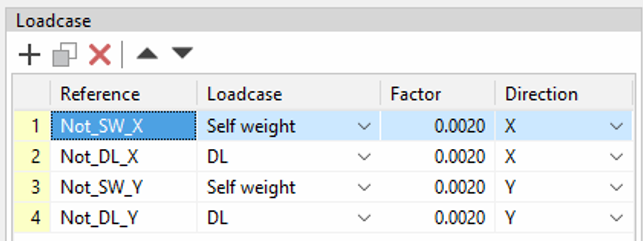
In the "General data" panel (on the "Project" tab), under the "Loads" section, you can access the "Notional load cases" option.
The notional loads corresponding to each basic load case are defined in this table, together with the factor corresponding to each notional load. In 3D models, the notional loads must be defined separately for the X and Y axes. Furthermore, if a wind load case exists, its direction must be specified to orient the generation of load combinations containing notional loads.
The "P-Δ *" option, in the "Non-linear combinations" panel (on the "Calculation" tab), generates combinations that include notional load terms.
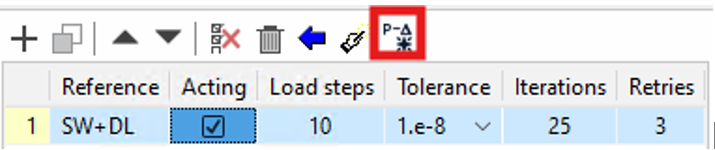
Given a non-linear combination containing gravitational loads for which notional loads have been defined in the X and Y directions, this button automatically generates four combinations that incorporate these gravitational loads together with the notional loads corresponding to the X+, X−, Y+ and Y− directions.
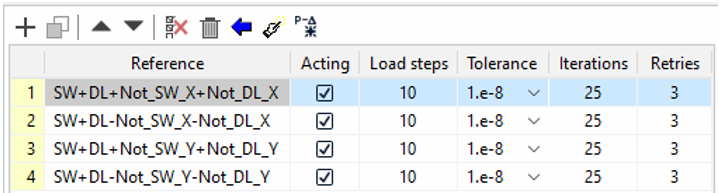
Once a wind direction has been specified for a wind load case, only the combination that includes the notional load in the same direction as the wind load is generated, taking into account the most unfavourable effect of initial imperfections on structural stability.