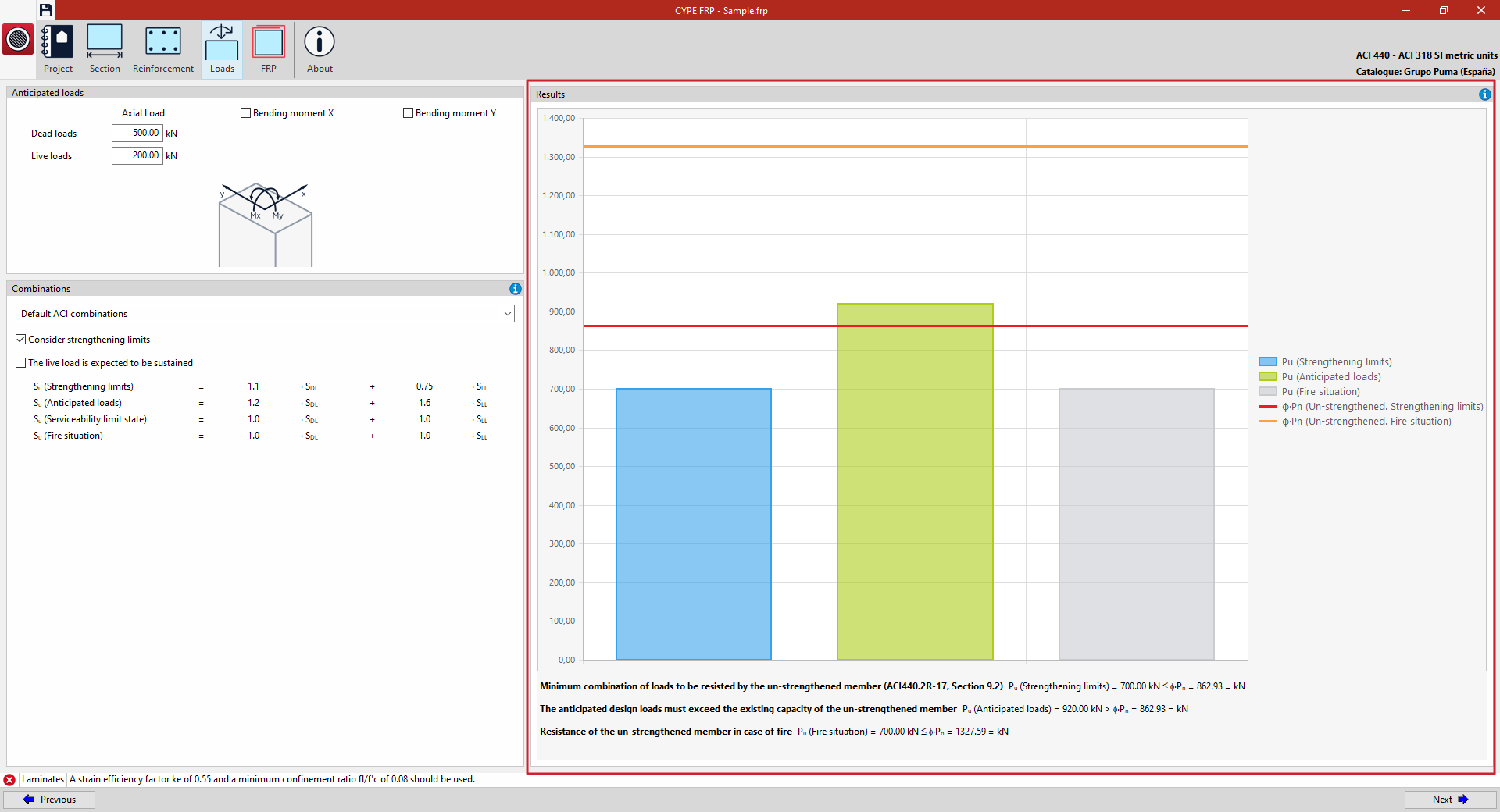

Checking analysis results
In the "Results" panel, to the right of the "Loads" section, which can be accessed from the top of the interface, you can view the results of the analysis carried out on the defined cross-section.
Example: analysis of results for a column subjected to axial load without moments (analysis in accordance with ACI 440 – ACI 318)
In the "Results" panel, the program displays a graph containing the following information, which is updated based on the data entered previously:
- The columns show the values calculated for the load applied to the element in the different combinations ("Pu (Strengthening limits)", "Pu (Anticipated loads)" and "Pu (Fire situation)").
- The lines show the resistance of the unreinforced element when the reduction factor is applied in the different cases ("ϕ·Pn (Unreinforced. Strengthening limits)" and "ϕ·Pn (Unreinforced. Fire situation)").
The program carries out the following checks, which are displayed at the bottom:
- Minimum combination of loads to be resisted by the un-strengthened member (ACI 4402.R-17, Section 9.2)
Pu (Reinforcement limits) ≤ ϕ·Pn (Unreinforced. Reinforcement limits)
The unreinforced member must be capable of withstanding a certain combination of expected loads, without the contribution of the FRP. If this condition is not met, the member will not be able to achieve the required reinforcement ratio.
- The anticipated design loads must exceed the existing capacity of the un-strengthened member Pu (Design loads) > ϕ·Pn (Unreinforced. Reinforcement limits)
The user must enter a combination of design loads that exceed the load-bearing capacity of the existing unreinforced member.
- Resistance of the un-strengthened member in case of fire
Pu (Fire scenario) ≤ ϕ·Pn (Unreinforced. Fire scenario)
In the event of loss of the FRP due to high temperatures, the residual resistance of the unreinforced member must be greater than the fire load combination. Otherwise, the FRP must be protected against fire. This check does not assess the change in the existing member’s strength over the course of the fire; this must be determined in accordance with current standards.
When the anticipated loads exceed the strength of the unreinforced member, the program will enable the "FRP" section, where the FRP reinforcement is defined and/or analysed.