
Entering loads
In the "Loads" section, accessible from the top of the interface, the loads and load combinations to be used in the analysis are defined.
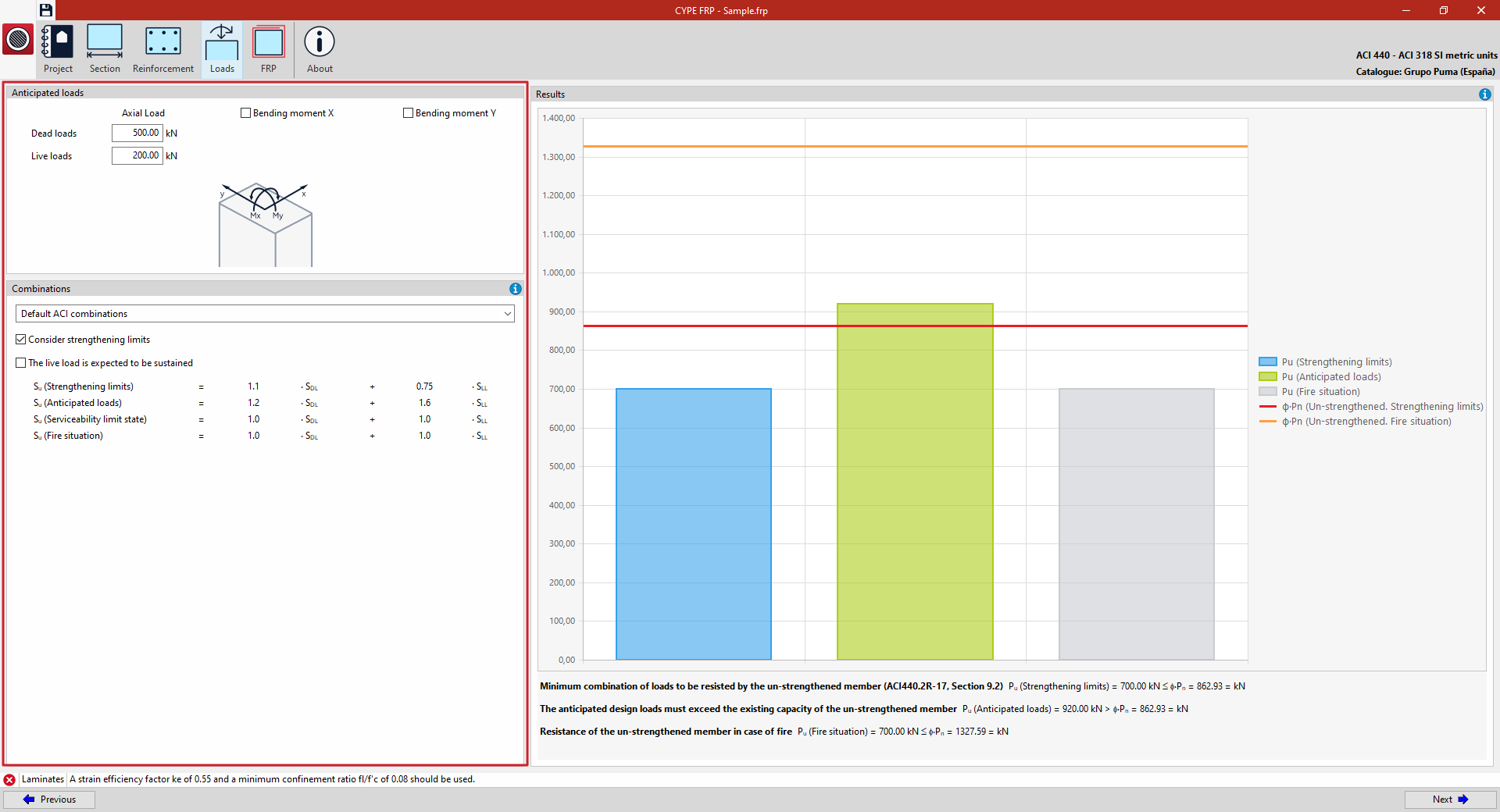
Example: applying loads to a column (analysis in accordance with ACI 440 – ACI 318)
The following details are defined in the "Loads" section:
- Under "Anticipated loads", for the "Dead loads" and/or "Live loads" load cases (in both cases, without any increase and as expected following the reinforcement), enter the value for the "Axial load" and, optionally, for the "X-moment" and the "Y-moment". The program displays a diagram showing the sign convention for these moments with respect to the section axes.
- Under "Combinations", you can choose whether to use the "Default ACI combinations" or the "User-defined combinations". At the bottom, the factors applied (which can be modified if "User combinations" are selected) to the two SLL and SDL load cases (live loads and dead loads) are displayed for the following combinations:
- Su (Strengthening limits)
This combination of loads corresponds to the minimum value that the unreinforced member must be able to withstand. - Su (Anticipated loads)
This combination of loads corresponds to the design load that the reinforced member must withstand. - Su (Serviceability limit state)
This combination of loads corresponds to the value to be used to assess the behaviour of the reinforced member in service. - Su (Fire situation)
This combination of loads corresponds to the value to be taken into account in the event of a fire.
- Su (Strengthening limits)
- In addition, the following options are available under "Combinations":
- Consider strengthening limits
The FRP reinforcement limitation is imposed to safeguard the structure against collapse in the event that the FRP is damaged as a result of an impact, vandalism or other causes, by limiting the maximum reinforcement ratio. This verification confirms that the remaining reinforced concrete section is capable of withstanding a certain level of loads on its own. By disabling this option, the users agree to provide the necessary protection for the FRP to prevent the possibility of this type of damage. - The live load is expected to be sustained
This option should be selected if the live load acting on the structural element is highly likely to be present for prolonged periods (such as in storage areas or bookshops), and it adjusts the factor to equal one.
- Consider strengthening limits