



CQC. Modal combination of results
How can we combine the maximum values of the modal responses (Ri) to determine the probable maximum value of the total seismic response (R)? The exact value of R cannot be determined from the Ri values because, in general, the modal responses peak at different instants of time, which also does not coincide with the instant at which the combined response R peaks.
There are different methods to approximate the combination of the maximum modal responses. Some of these methods are the Absolute Sum (ABSSUM), the Square Root of Sum of Squares (SRSS) or the Complete Quadratic Combination (CQC). We will detail the latter, which is the one that our programs apply.
Complete quadratic combination (CQC)
The CQC combination rule [1] is defined as follows:
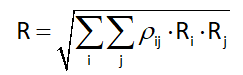
Where the correlation or simultaneity coefficient:

Is:
 , el ratio entre periodos de los modos ‘i’ y ‘j’
ζ: damping ratio (we assume the same for all modes)
R: resultant combined response (stress, displacement, reaction, etc.)
Ri, Rj: response (stress, displacement, reaction, etc.) corresponding to modes “i” and “j”.
Some points concerning the complete quadratic combination are set out below.
The double sum terms within the root of the equation [Eq. 1] can be positive or negative, depending on whether the corresponding modal responses have the same sign or the opposite sign.
The correlation coefficient ρij takes into account the distribution of the natural frequencies of the structure, whether they are well differentiated or not. This coefficient takes values between 0 and 1. The closer the periods or frequencies of two modes are, i.e. when r tends to 1, the value of ρij tends to 1. However, the value of ρij decreases rapidly as the frequencies move away from each other.
The result of the CQC combination is positive. In our programs, once the combination has been made, we apply the sign of the dominant modal response to the combined R value.
Equivalent linear combination
The CQC rule can be applied as an equivalent linear combination. In the CYPE programs, the formulation proposed by Katz [2] is applied for this purpose:
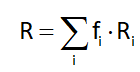 , where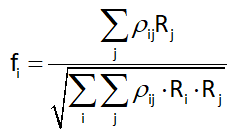
This equivalent approach to applying the CQC rule enables the consistent management of seismic results.
All maximum responses need not occur at the same time. This is important for some checks, e.g. the normal stress check of a cross-section involving N, Mx and My. Depending on the case, the maximum of all the forces acting at the same time may lead to an uneconomical or even incorrect solution, since the worst case situation need not occur for the maximum of the three forces.
CYPE applies this consideration on the consistency of seismic results with a given maximum, which is reflected in the expansion of seismic combinations in our programs.
References
[1] Der Kiureghian, Several.
[2] C. Katz. “Anmerkung zur Überlargerung von Antwortspektren”. D-A-CH Mitteilungsblatt, 2009.
