


Defining static seismic loads
To define static seismic loads in the program, you must manually create seismic loadcases and then draw and assign loads to them.
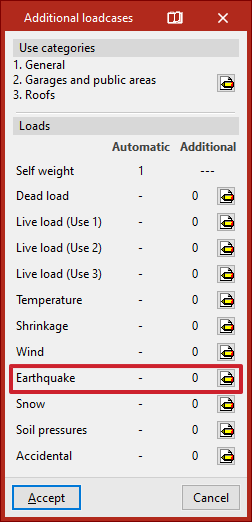
To manually create static seismic loads, go to "Job" > "General data", and deactivate the "With dynamic earthquake" checkbox (as static seismic loads cannot be used together with dynamic earthquake analysis). Then, under "Additional loadcases", within the "Earthquake" section, click the edit button on the right.
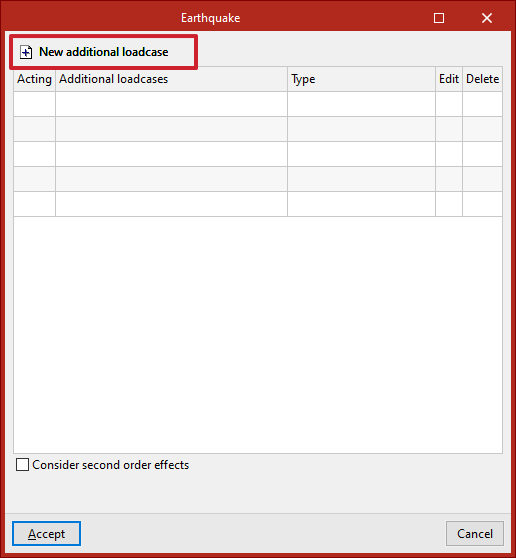
In the window that appears, click "New additional loadcase".
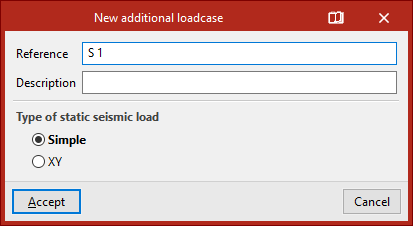
From this point, there are two methods for defining additional static seismic loads: "Simple" or "XY".
Each option is detailed below.
Simple type of static seismic load
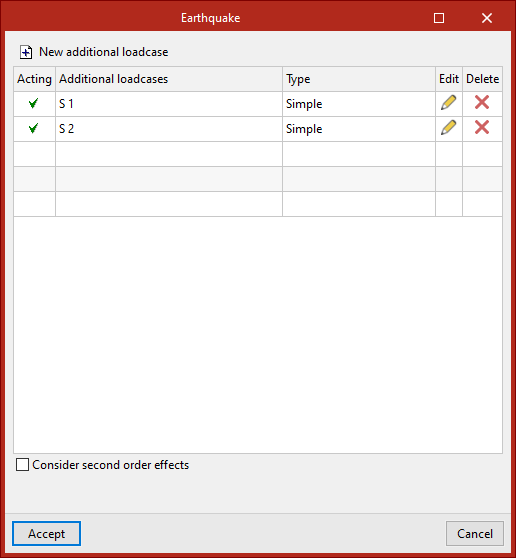
You can create two cases, e.g. S1 and S2, both "Simple".
Then, using the relevant options, draw and assign seismic loads to the model, applying them to the appropriate case. For example:
- In case S1, assign 100% of the loads in X and 30% in Y
- In case S2, assign 30% of the loads in X and 100% in Y
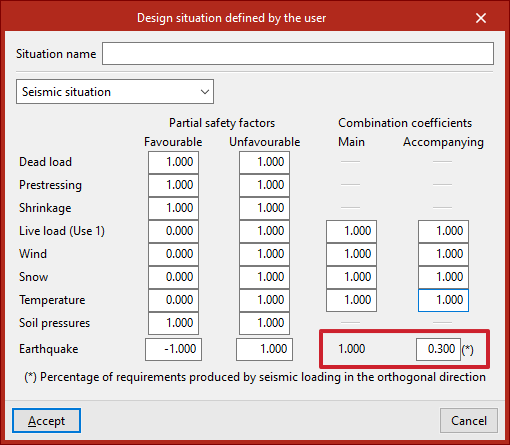
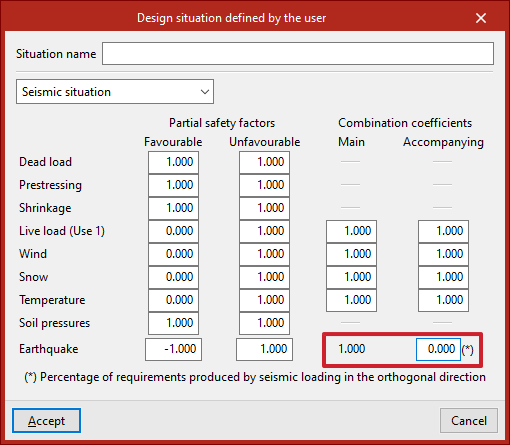
From "Job" > "General data" > "Limit states (combinations)", under the "Earthquake" row in a "Seismic situation", you can define the combination coefficients for these two earthquake cases.
In this scenario, you should use 1 and 0 as the main and accompanying combination coefficients — these are the default values.
This way, no additional loads are added to those already drawn.
XY type of static seismic load
Alternatively, you can enter a single type "XY" loadcase.
In this case, when loads are drawn and/or assigned to a loadcase, the user will find two automatically generated seismic loads, S1 (X) and S1 (Y), which are generally orthogonal to each other. For example:
- In case S1 (X), assign 100% of the loads in X.
- In case S1 (Y), assign 100% of the loads in Y.
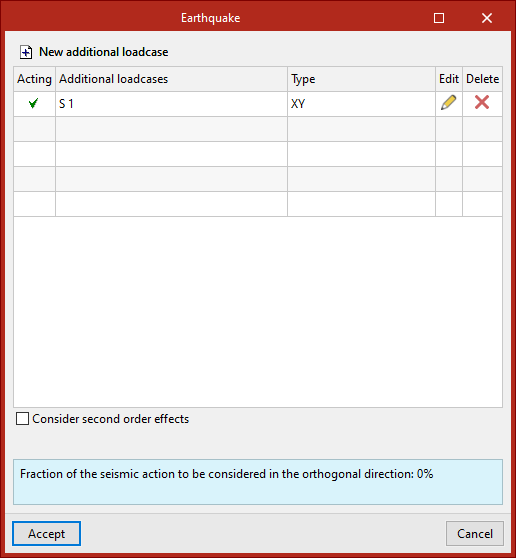
In this case, from "Job" > "General data" > "Limit states (combinations)", in the "Earthquake" row of a "Seismic situation", you must modify the main and accompanying combination coefficients — for instance, to 1 and 0.3.
This last figure represents the "Percentage of requirements produced by seismic loading in the orthogonal direction", which is usually defined by the relevant seismic code.
As a result, 30% of the loads are automatically added in the other direction in each loadcase.