

Deflection between two points in two-way slabs
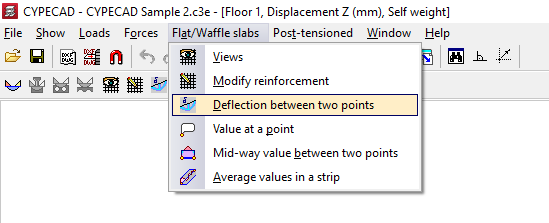
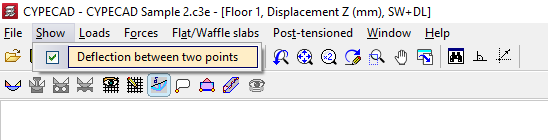
To view the arrow between two points on slabs and grid slabs in CYPECAD, open the "Contour plots" tab after analysing the structure and navigate to the desired group. Next, open the "Flat/Waffle slabs" menu at the top of the interface and click on "Deflection between two points".
The program will open the "Deflection between two points" dialogue box, where you can configure the options relating to the arrow. To hide or show this box, open the "View" menu and toggle the "Deflection between two points" option on or off.
In addition, the contour plot diagram corresponding to the instantaneous elastic displacements along the Z-axis of the slabs and grid-type floor slabs in the group is displayed on screen for the combination selected from the drop-down menus. Each colour in the graph represents a different displacement value.
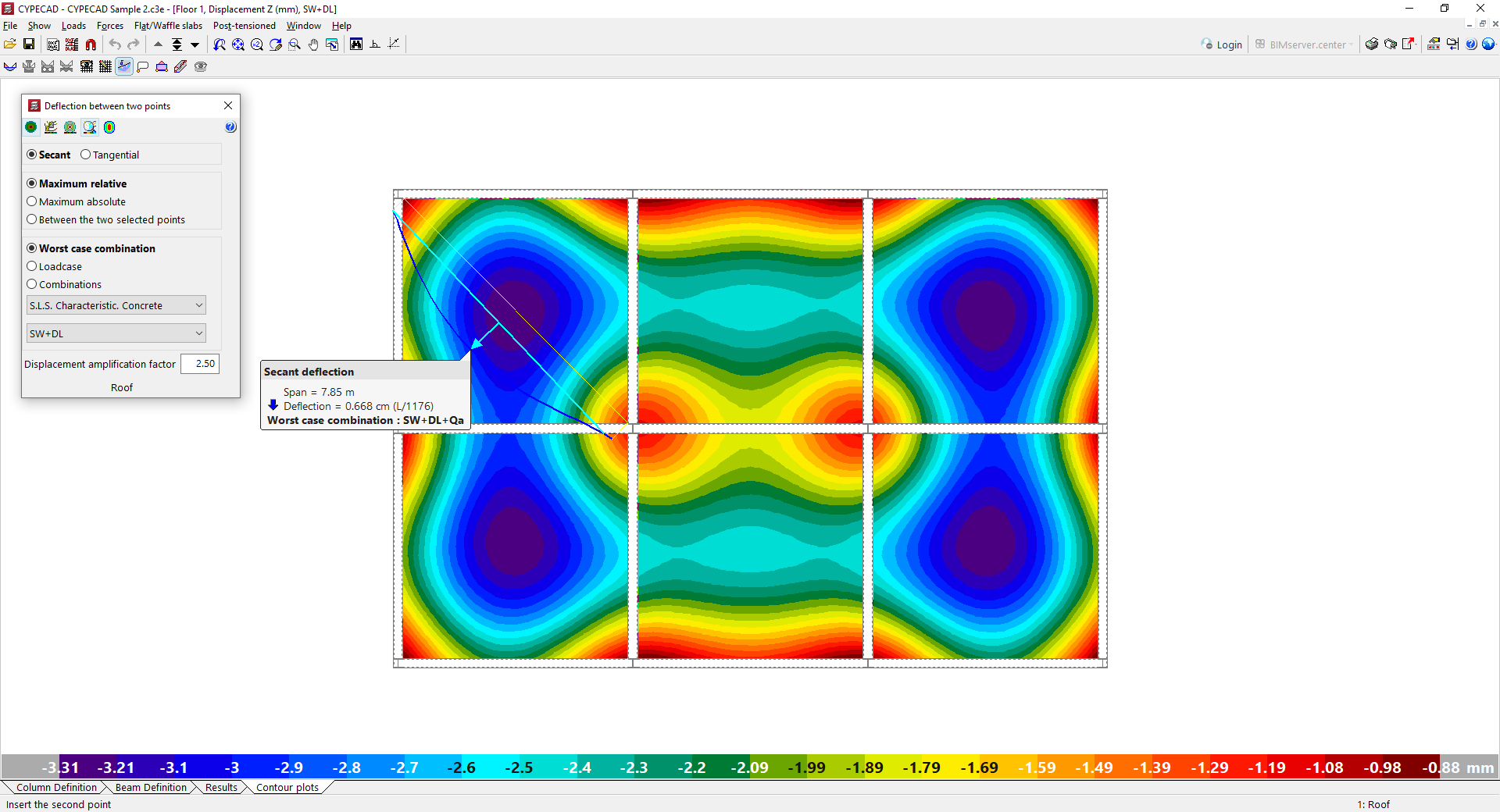
Options in the "Deflection between two points" dialogue box
The following tools appear at the top of this dialogue box:
- The "View contour plots", "View contour plots with values" and "View contour plots without values" options allow you to customise the display of this information.
- It is also possible to "Automatically adjust the scale when zooming" so that the colours, lines and values displayed on screen are adjusted according to the visible area when zooming.
- The "View loads" option allows you to view the loads that have been entered.
Next, select the "Secant" option if you wish to examine the deflection of an internal span, or "Tangent" if it is a cantilever:
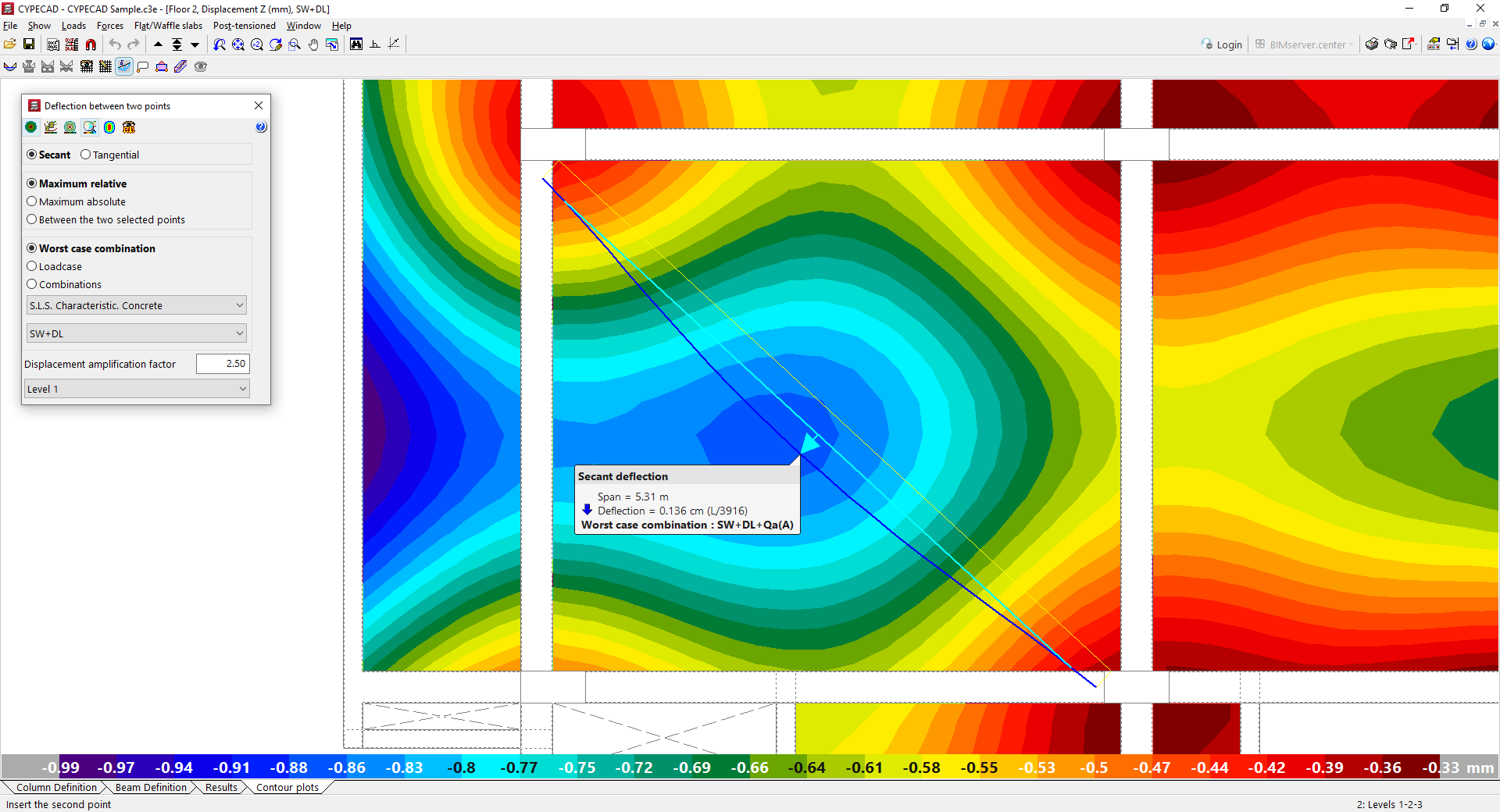
- The "Secant" is calculated as the distance between the deformed coordinate of a point and the line connecting the deformed coordinates of the two endpoints of the segment.
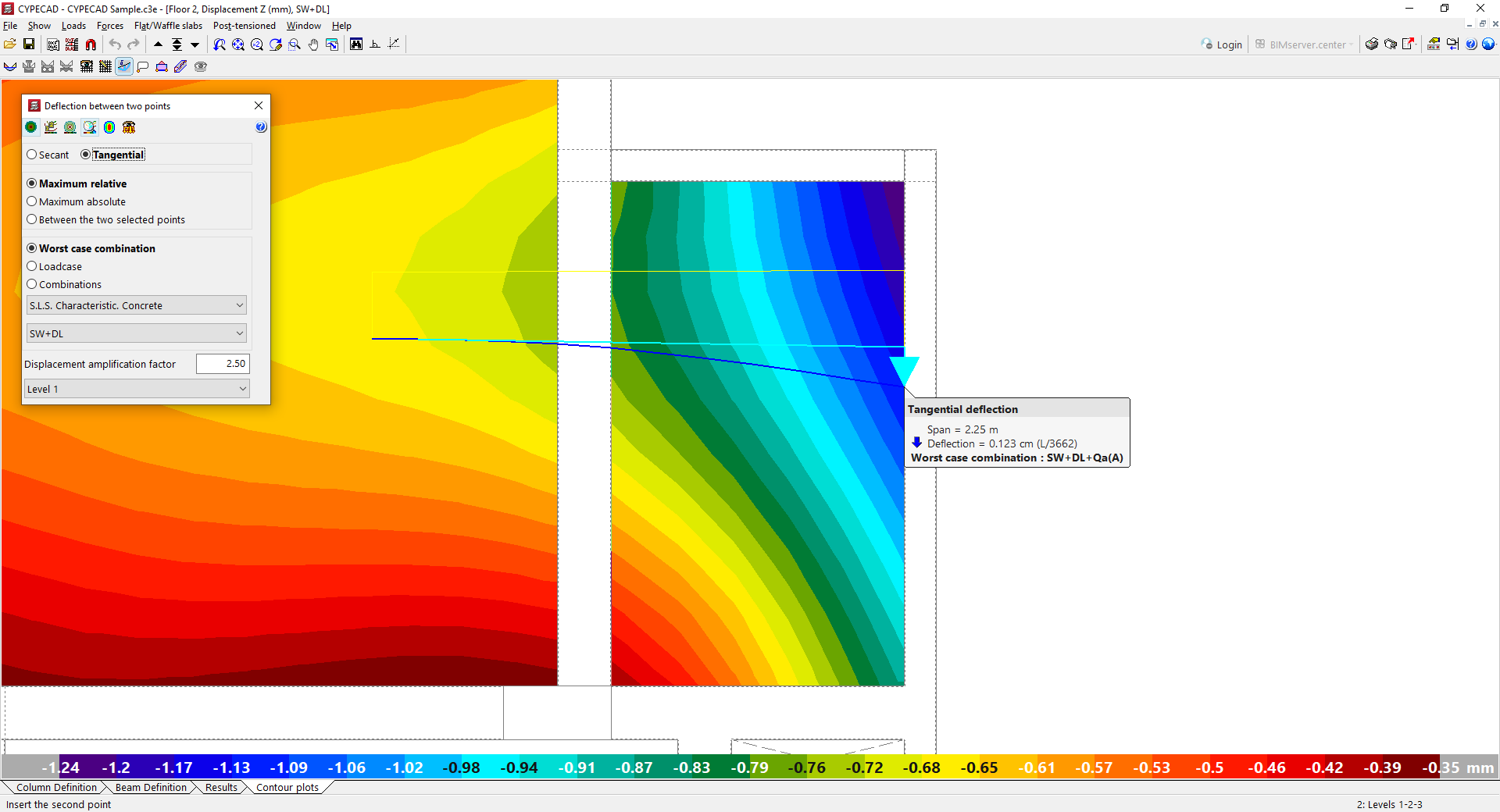
- The "Tangent" deflection is the distance between the deformed line at a given point and the line tangent to the deformed line at the starting point of the span. In this case, to calculate the relative deflection, a span length equal to twice the length of the span is taken into account.
Next, select the type of arrow:
- Select "Relative maximum" or "Absolute maximum" if you wish to obtain the section where the maximum relative deflection or absolute deflection, respectively, occurs along the line connecting the two points marked on the screen.
- The "Between the selected points" option allows you to obtain the line segment between two marked points. This is not necessarily the section where the maximum value occurs.
Use the drop-down menu below to select the combination or loadcase you wish to view:
- If you select "Worst-case combination", the value of the arrow displayed will be the maximum among all combinations in the group selected in the first drop-down menu. In this case, the combination selected in the second drop-down menu is irrelevant. The worst-case scenario will then be shown in the information message that appears when the arrow is drawn on the screen.
- By selecting "Loadcase" or "Combination", you can display the arrow value for a single loadcase or for a specific combination of loadcases selected from the drop-down menus at the bottom. This also allows you to view on screen the contour plot and contour line diagrams corresponding to the selected loadcase or combination.
Finally, the value entered in "Displacement amplification factor" multiplies the instantaneous vertical elastic displacements obtained from the structural analysis to estimate the probable value of the deformation used to calculate the deflection. By adjusting this value, you can approximate the value of the active deflection, the total deflection over an infinite time span, or the instantaneous overload deflection. By default, the program uses a factor of 2.50.
Checking the deflection between two points on a floor plan
Once you have configured the above parameters, you can view the deflection of a slab or waffle slab on the floor plan.
- It is recommended that a preliminary analysis of displacement contour plots be carried out for the various design loadcases in order to identify the areas where maximum deflection may occur. These areas typically coincide with the most concave sections of the mid-span or the ends in the case of cantilevers.
- To do this, mark two points on the plan by left-clicking on the first point and moving the cursor to another point to measure the deflection between them. This will display a preview of the deflection data. If you left-click on the second point, the information will be fixed on the screen. It is possible to mark points outside the geometry of the slab or grid slab:
- If it is a "Secant" arrow, mark two points with a slight downward slope, like two columns, ensuring that the secant line to the curved line connecting them passes through the areas of greatest concavity.
- If the arrow is a "Tangent" arrow, mark the point of contact and the tip of the arrow, ensuring that the line tangent to the deformed line remains horizontal.
- The program therefore provides the following information:
- A solid yellow line connecting the two points is displayed.
- Below this, the deformed curve is plotted, tracing a dark blue curve consisting of the vertical displacements of all the points. This deformed curve corresponds to the hypothesis, combination or worst-case combination selected in the panel, and takes into account the amplification of displacements specified therein.
- The segment of the secant or tangent line to the deformed curve is drawn in cyan, and perpendicular to it, a line also in cyan with an arrow pointing towards the maximum descent according to the selected parameters.
- The information text indicates whether it is a "Secant" or a "Tangent", the "Span" or distance between the marked points, the absolute "Distance" in units of length and, in brackets, the relative distance, In addition, the "Loadcase" or "Combination" being queried is shown, or, where applicable, the "Worst-case combination", specifying which one it is.
- It is not possible to determine a priori whether the arrow drawn and displayed on screen is the maximum of all possible arrows between the pairs of points that make up the slab or grid-type floor. It is therefore advisable to draw several arrows connecting different pairs of points in other directions using the left mouse button until you are satisfied that the information displayed is correct.
- To clear the information from the screen, use the middle mouse button to zoom out (if the information is pinned to the screen) or use the right-click button (if you are previewing the information). Finally, use the right-click button to exit the option.