


Modal spectral analysis in CYPE 3D's non-linear analysis
As of version 2026.a, CYPE 3D includes an option for considering seismic action by means of a modal spectral analysis when launching a non-linear analysis. Non-linear combinations (NLC) involving seismic loadcases can also be defined.
The following points explain this feature in more detail.
1. Design model for the modal analysis
To carry out a modal analysis of a structure, users must know the starting design model on which the eigenvalue and eigenvector analysis is to be applied, i.e. with which stiffness and mass matrices the modes of vibration are to be analysed.
Once the structure has been entered into the program, the geometry and properties of the structure can be determined. Regarding the latter, possible non-linearities may have been incorporated into the model: elastic supports that only work in tension or compression, bars only in tension, plates with a subgrade modulus subject to compression or with plastic hinges.
The next step is to look at the defined non-linear seismic combinations, i.e. combinations that include seismic loadcases. For each combination, the behaviour of the non-linear elements of the model must be studied by analysing whether they work or not.
Stiffness matrix
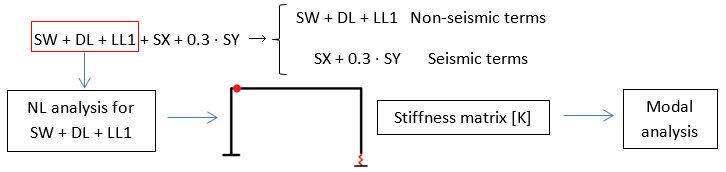
With a non-linear combination including automatic seismic loads (modal spectral analysis), users have to look at the non-seismic terms of the combination. The program carries out a non-linear analysis of the structure subjected to the loads of this non-seismic part of the NLC. At the last load step, the behaviour of the non-linear elements is analysed and it is studied whether the non-linearities are activated or not and, in the case of plastic hinges, in which state they work. It replaces the non-linear elements by their equivalent linear element, and obtains an equivalent ‘linearised’ model, which is the starting model for the modal analysis that provides the required stiffness matrix.
Mass matrix
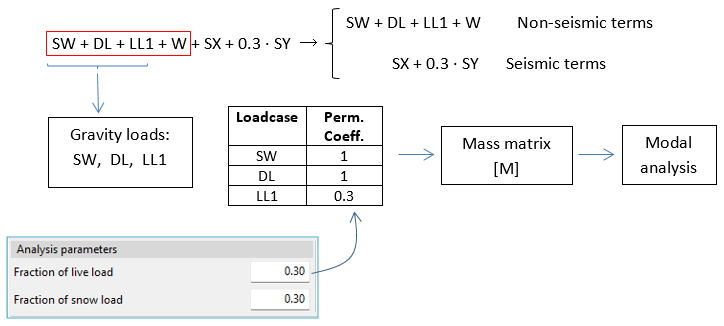
To analyse the seismic mass of the structure, the gravity loads acting on the structure in a given non-linear combination are analysed:
- It considers 100 % of the self-weight and dead load; and
- the percentage of the use and snow loads that are considered as permanent; the percentage that is established in the seismic panel of the program.
Therefore, given a seismic NLC of actions, users must look at the gravity loads involved and construct the mass matrix taking this into account.
2. Groups of non-linear combinations for modal spectral analysis
In order not to perform a modal spectral analysi for each non-linear seismic combination, the program carries out a preliminary study of the NLCs before starting the analyses. It generates groups of combinations from the combinations in which the behaviour of the non-linear elements is the same.
Analysing the non-seismic part, all those combinations involving the same loads with the same combination coefficients can be grouped together since, applying what was explained in the previous section, they would all start from the same design model for the modal analysis.
Analysing the non-seismic part, all those combinations involving the same loads with the same combination coefficients can be grouped together since, applying what was explained in the previous section, they would all start from the same design model for the modal analysis.
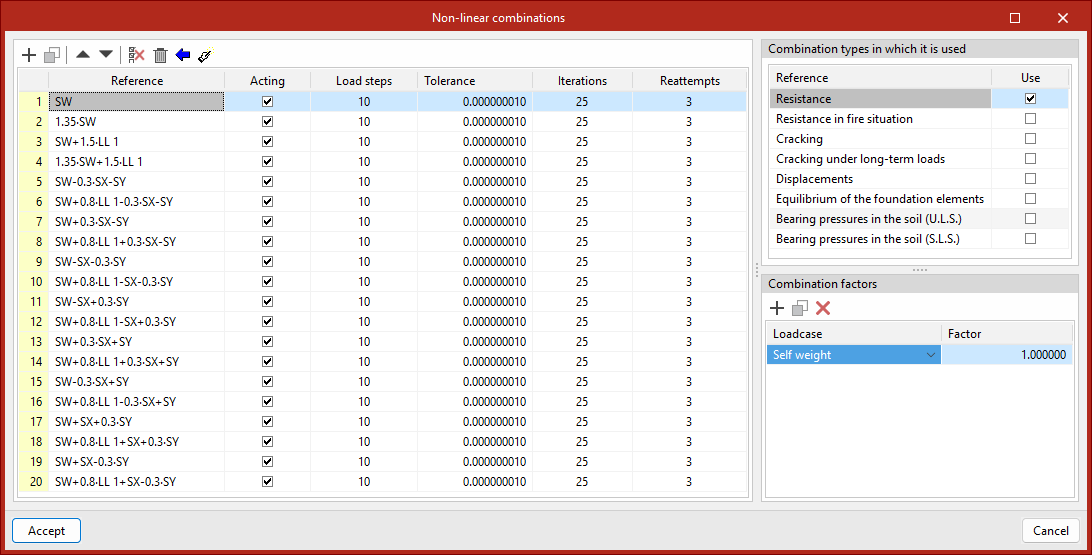
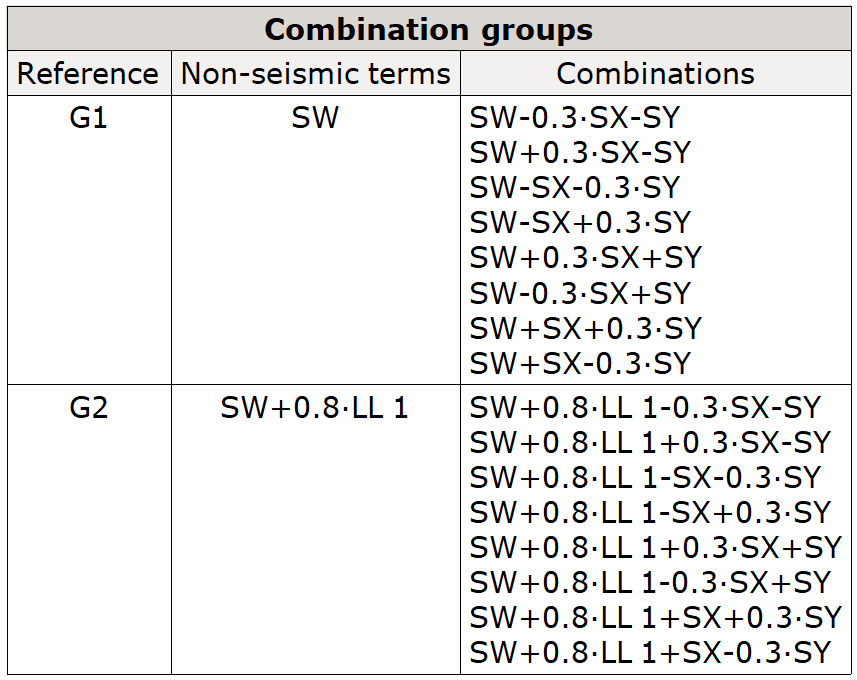
By analysing the non-seismic loads of the combination, the program automatically generates two sets of NLCs. That is, it performs two modal analyses, obtaining two sets of modes for two different starting design models, e.g. if the following non-linear combinations have been generated:
For each NLC group, a set of seismic results is obtained. For each combination of the group, these results are combined with the results of the non-linear analysis of the rest of the actions involved according to the corresponding combination coefficients.
In the first group of combinations, considering only the non-seismic terms, only the self-weight acts with a combination coefficient of 1.
The behaviour of the structure at the end of a non-linear calculation for the ‘1-PP’ combination is analysed, analysing which non-linear elements work and how to obtain an equivalent linear model whose stiffness matrix is the starting point for the spectral modal analysis.
For the analysis of the seismic mass, from which the mass matrix is generated, only the self-weight with a permanent coefficient of 1 is taken into account.
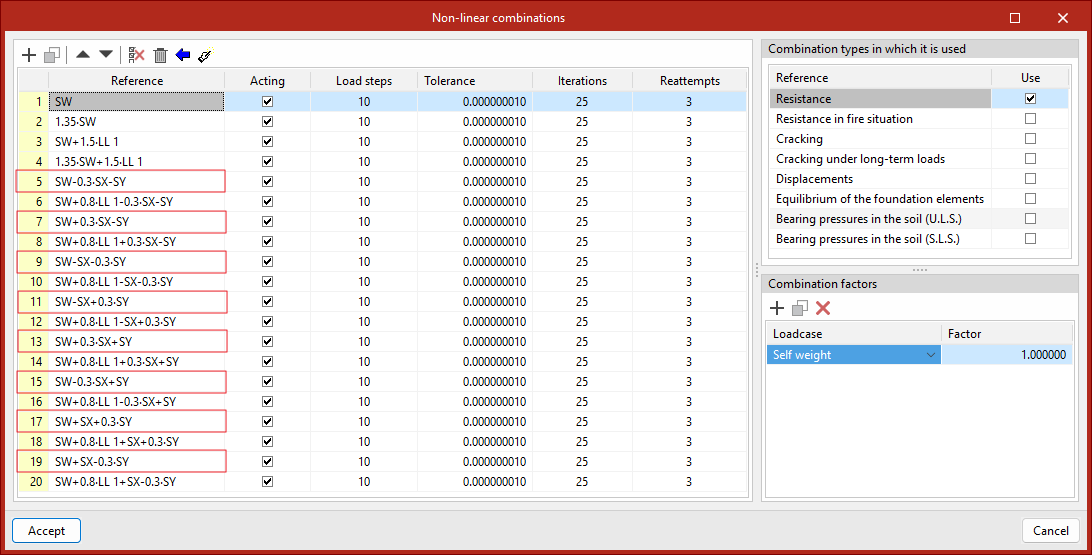
In the second group of combinations, looking only at the non-seismic loads, the self-weight SW, with a combination coefficient of 1, and the serviceability overload Q1, with a combination coefficient of 0.8, can be observed.
The behaviour of the structure is analysed for the non-linear combination ‘1-SW+0.8Q1’ and the starting stiffness matrix for the modal spectral analysi.
For the analysis of the seismic mass, it is analysed which loads of gravity nature are involved: the self-weight and the serviceability surcharge. The permanent coefficient of these is 1 for the self-weight and 0.3 for the serviceability surcharge Q1 (value specified in the earthquake panel). It should be noted here that the permanent coefficient is independent of the combination coefficient of the scenario. It is the percentage of load that is considered as permanent for the computation of the seismic mass.
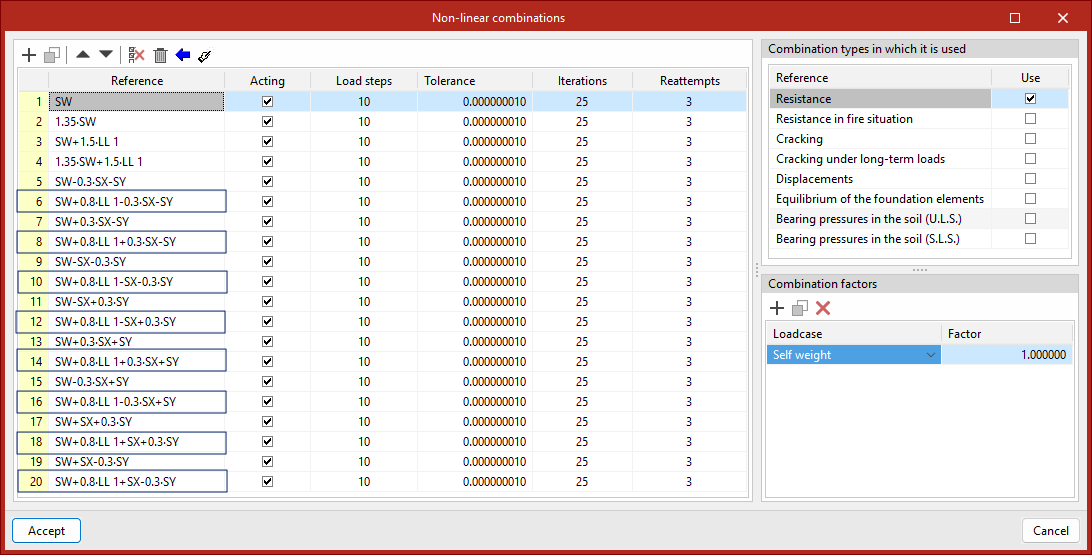
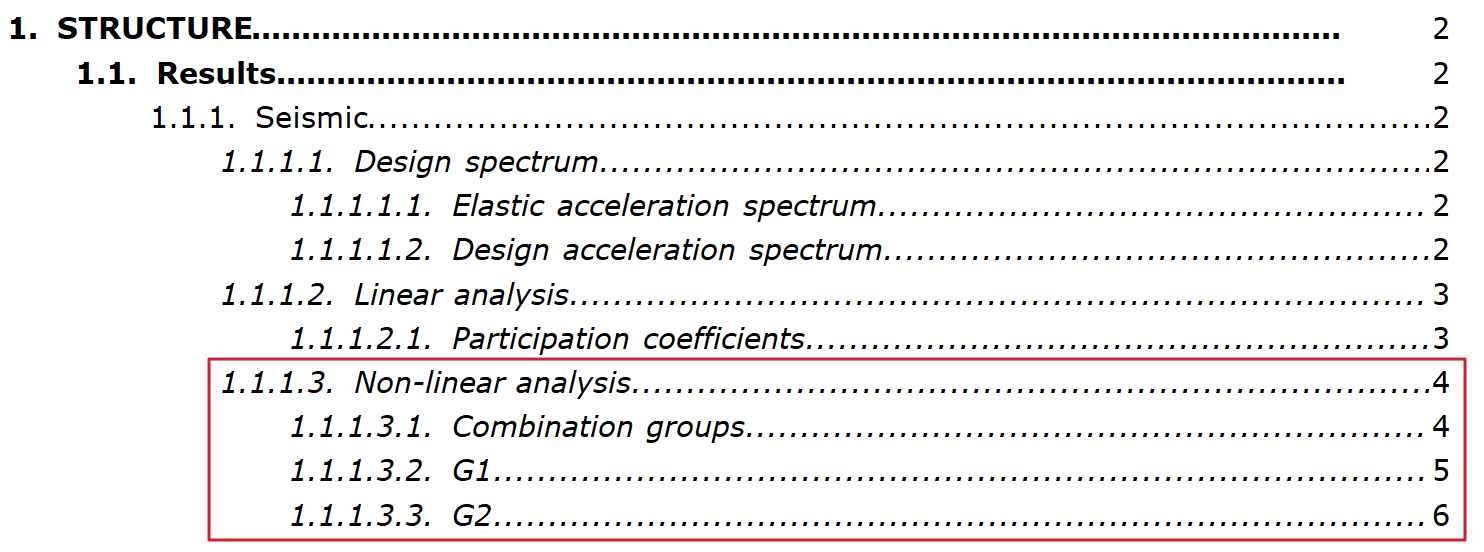
Once the analyses have been carried out, the "Justification of seismic action" report can be consulted, and the groups of combinations generated and the results of the modal spectral analysis for each of them can be viewed.
| Note: |
|---|
| In the following link, you can find the differences between the modal spectral analysis for the nonlinear analysis and the modal vibration analysis carried out by the program. |
