

Update history​​

CYPEFIRE Hydraulic Systems

As of version 2026.b, project files are automatically associated with the corresponding CYPE app in the Windows environment. This means that you simply double-click on the file to open it directly in the appropriate program, without having to select it manually. This improvement streamlines the workflow and provides a smoother and more efficient user experience.

CYPEFIRE Hydraulic Systems automatically detects fire hose reels and allows you to enter inlets and outlets for dry and wet standpipes from the architectural model.

Sprinkler placement now follows the perimeter of each space and takes into account false ceilings, improving the automatic adjustment of the design in CYPEFIRE Hydraulic Systems.

The system checks for clashes between system elements and the structure (columns and beams), ensuring the viability of the project.

The program can now be used to install dry risers in the model. For this purpose, the "Dry riser" group has been added to the top toolbar, with the options for entering its components (inlets, outlets and pipes).

Plus, the possibility of defining checks for wet risers has been incorporated. These are accessible in the new "Code configuration" option in the "Project" group.

In version 2025.d, all the equipment that can be used in CYPEFIRE Hydraulic Systems comes from manufacturers' catalogues, allowing users to enter any equipment required for the installation of the different hydraulic systems.

The "Prescription options" tool has been included in the "General options" menu to configure the documents generated by the program (reports, material schedule, export to .ifc, .gltf, .bc3, etc.), establishing the criteria for the generation of equipment descriptions according to the following:

  • Commercial prescription of the product
  • Prescription with the possibility of an equivalent product
  • Unspecified description of the commercial product

To ensure the continuity of projects created in previous versions of CYPEFIRE Hydraulic Systems, all previously defined equipment will be automatically added to the "CYPE LEGACY" catalogue when those projects are opened in version 2025.d.
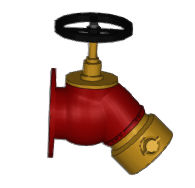
In version 2025.d, another new element for the hydraulic analysis has been added: the wet riser outlet.

This new element functions in the same way as a sprinkler, fire hydrant or emitter, and is connected at any point of the system and is assigned to the desired analysis hypotheses to obtain the flow rate and pressure resulting from the analysis.

To enter these elements, the equipment included in the Open BIM Database can be downloaded. In version 2025.d, the wet riser outlets are considered as design elements, like the emitters, for which no standard check is carried out.

As of version 2025.d, the design tool has been optimised to allow partial design of the model to be carried out in addition to the total design that has been carried out up to now.

In the selection window, the type of design desired is defined; for a partial design, once the panel has been accepted, a control point must be selected. The design will be carried out from that point downstream.

For version 2025.d of CYPEFIRE Hydraulic Systems, the manufacturer catalogues for seismic bracing have been included and the analysis and checking of the bracing has been improved.

Some of the improvements to the analysis that have been incorporated are as follows:

  • Detection of the start and end of collectors for entering the corresponding bracing.

  • Detection of the start and end of uprights for entering the corresponding bracing.

  • Analysis of the distribution of the bracings along the pipes.

  • Detection of non-earthquake-protected sections of the system.

As of version 2025.d, the "Project selection" window in the apps connected to BIMserver.center incorporates a new notification system to inform users about the latest new features on the platform.

This space displays relevant messages about new features, enhancements and recommendations related to BIMserver.center. In addition, direct links to documents, tutorials and additional resources will be included to facilitate the adoption of these new features.