


Introduction
CYPE Water Supply is a program developed for the analysis, design, checking and automatic sizing of water supply networks in urban infrastructures, whether they are meshed, branched or mixed.
The aim in the design of these networks is to deliver water to each consumption point. To this end, the data and positions of the consumption and supply points are defined, as well as the layout of the network. In the analysis, the appropriate diameters of the water pipes are obtained and a check is made as to whether the installation complies with the design limitations imposed.
| Note: |
|---|
| Together with other urban infrastructure programs such as CYPE Sewerage and CYPE Gas Supply, all aspects related to system design for housing estates can be solved. |
Workflows supported by the program
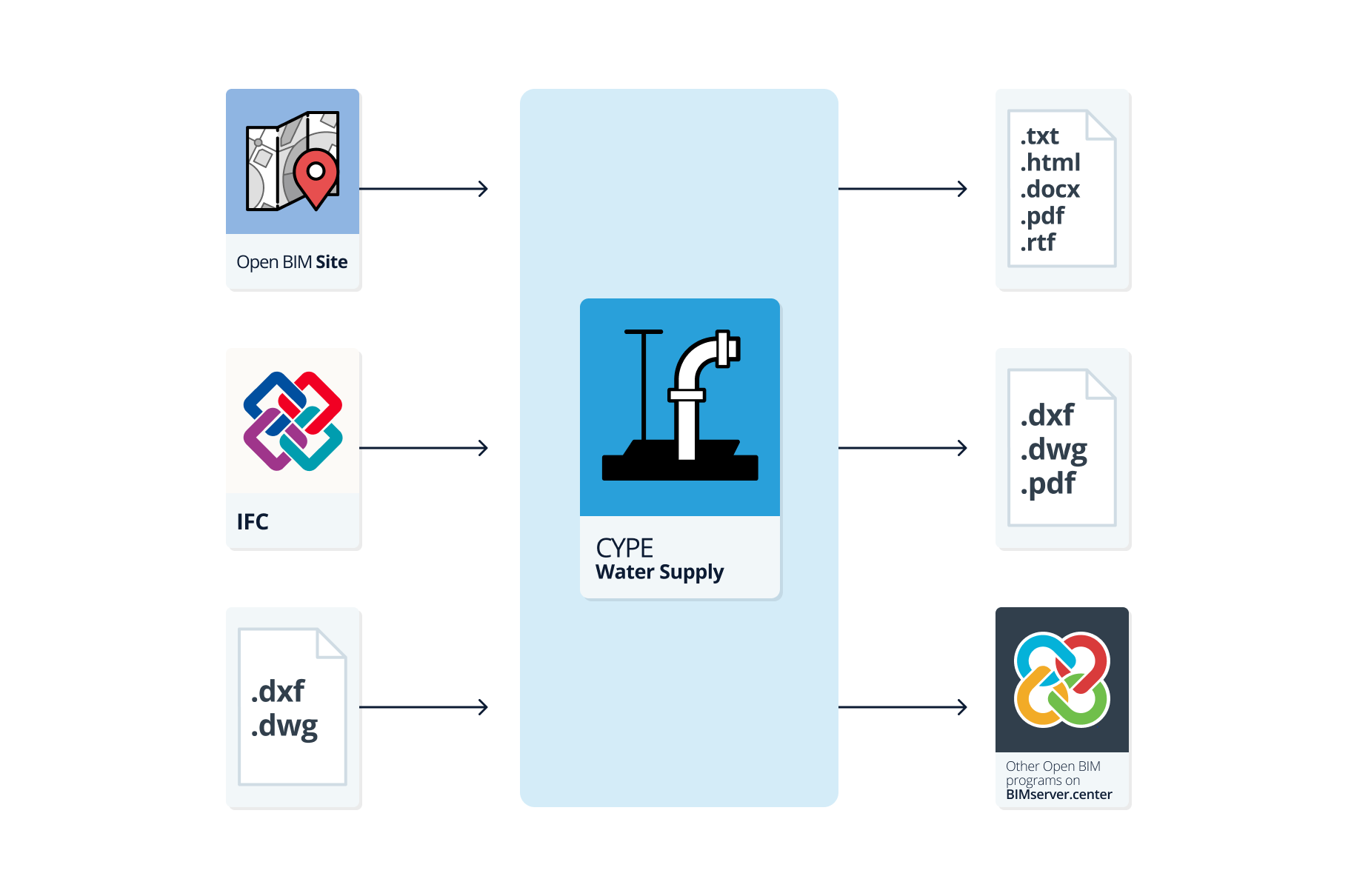
As CYPE Water Supply is an Open BIM tool and is connected to the BIMserver.center platform, it offers different possibilities in its workflow.
Data entry
Free design
- Free design of the network by manually entering the coordinates of the nodes and the layout of the sections that make up the system in CYPE Water Supply.
- Free design of the network by entering the nodes and sections using DXF-DWG, DWF templates or images (.jpeg, .jpg, .bmp, .wmf) imported into CYPE Water Supply.
Automatic generation of the system geometry from DXF/DWG files
- Imports a DXF or DWG file from "Import", "Geometry", and automatically generates the system geometry from the information contained therein. This file must have the metre as the drawing unit, and the network must be close to the origin of coordinates. In this option, only the layers containing the sections to be used for generation must be activated.
Importing data from BIMserver.center
If the CYPE Water Supply job is linked to a BIM project on the BIMserver.center platform, the following actions can be carried out:
- Importing terrain topography information if the BIM model contains an IFC file with the appropriate entities. This makes it possible to visualise the topography in the CYPE Water Supply 3D view, to display the contour lines in plan in the work area of the general interface, and to rely on the imported topography in the data entry process, automatically identifying the values of the elevations of the new nodes entered on the topography. Among the available options are the following:
- Importing topographic models in IFC format generated by Open BIM Site.
- Importing topographic models in IFC format generated by other programs (such as Aplitop's TcpMDT applications available in BIMserver.center) and uploaded to the BIMserver.center project via the web platform. The terrain data must be defined in an entity of type IfcGeographicElement in a file in IFC4 format.
Data output
- Exporting reports to HTML, DOCX, PDF, RTF and TXT formats.
- Exporting drawings to DXF, DWG and PDF formats.
- Exporting information generated with CYPE Water Supply to the BIMserver.center platform using IFC and GLTF formats. This allows it to be viewed by authorised project participants.
Work environment
The program has a simple work environment allowing the network design to be carried out quickly by entering and distributing the elements in a single work area on the floor plan.
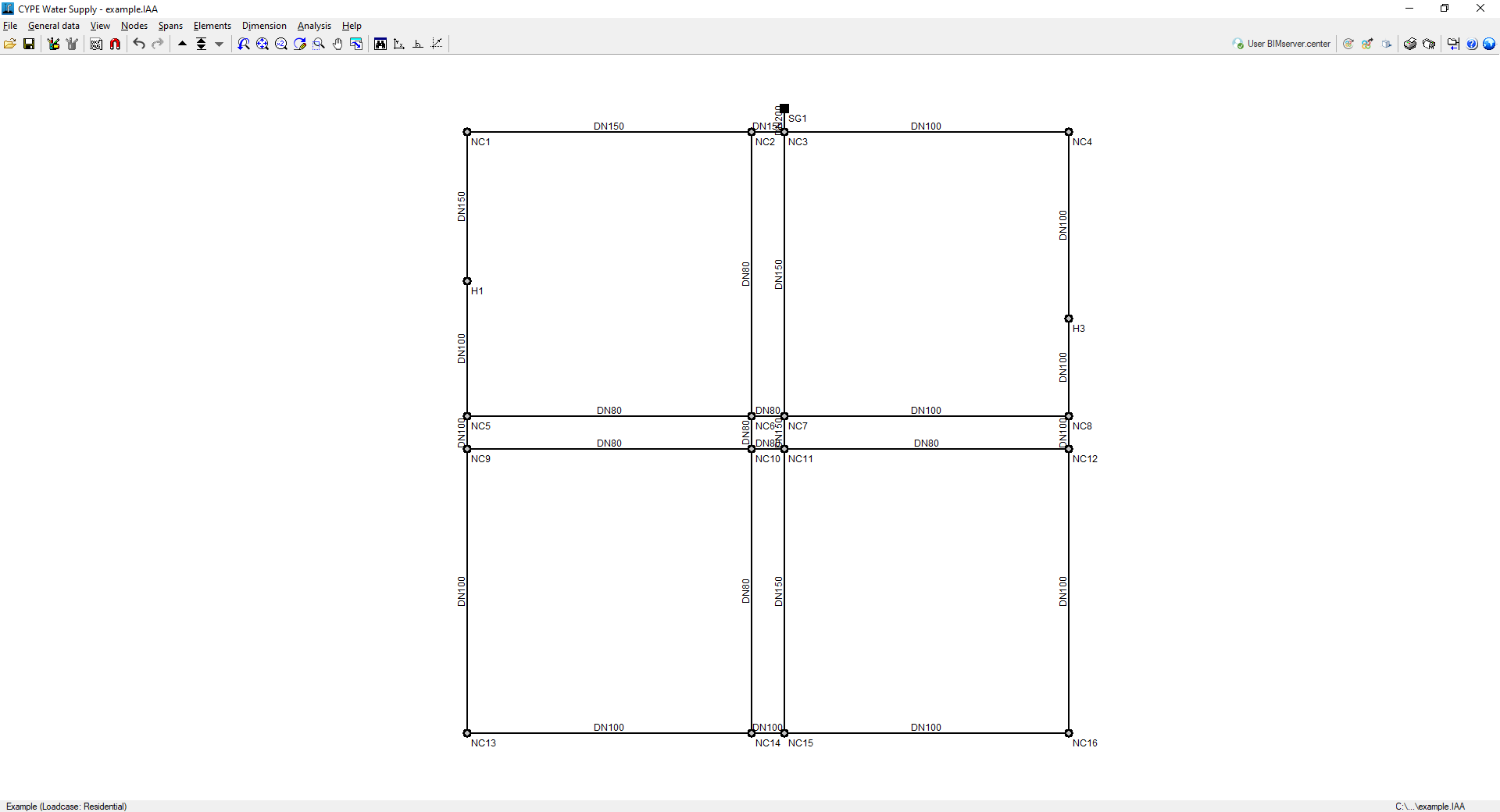
The interface displays:
- The menus at the top, where there are tools for:
- accessing the "File" menu;
- configuring the general data;
- controling the display of the model;
- entering and editing nodes, sections and other elements;
- accessing the dimensioning options;
- analysing and designing the network;
- and accessing to the "Help" menu.
- The options in these menus also appear in the drop-down options bar, which by default is hidden on the right-hand side.
- An auxiliary horizontal bar, under the menus at the top, where you can find the tools for:
- accessing the file manager and save the job;
- accessing the editing resources;
- managing drawings and snaps;
- undoing and redoing;
- navigating through the different combinations of hypotheses;
- modifying the drawing views;
- displaying the complete drawing map, rotating it, activating orthogonality and controlling the coordinate input tools;
- consulting and managing the connection with BIMserver.center;
- displaying the 3D view of the installation;
- printing the reports and drawings of the job;
- showing or hiding the side drop-down bar of options;
- accessing the available help;
- and accessing the general configuration options.
- Finally, in the central work area, which occupies most of the interface, the elements that make up the network are entered, edited and displayed, as well as the topographic curves, if a model with terrain information has been imported.
Data input and output sequence for the design and analysis of water supply systems
The design and analysis of a water supply system can be carried out in the program using the following input and output sequence:
- Creation of a new job (from "File", "New").
- (Optional) Link to BIMserver.center and import of topographic data from the BIM model.
- Configuration of general data of the system (in the wizard for the creation of a new job or in "General data", "Edit general data of the job"), including the definition of materials and terrains.
- Defining loadcases and combinations (from "General data", "Edit loadcases", and from "General data", "Edit combinations").
- (Optional) Import of DXF-DWG/DWF templates or images (from "Edit templates").
- Entering nodes (from "Nodes", "New").
- Entering spans between nodes (from "Sections", "New").
- (Optional) Entering other elements in the system (from "Elements", "New").
- Analysis and/or design of the system (from "Analysis", "Analysis/Design").
- Review of the compliance status of the checks carried out (from the "Next combination/Select combination/Previous combination" options) and of the analysis results (from "Nodes", "Information", and "Sections", "Information").
- Printing reports and drawings of the job (from "File", "Reports/Drawings").
- (Optional) Exporting to BIMserver.center (from "BIMserver.center", "Share").
Creating a new job, linking to a project and importing data
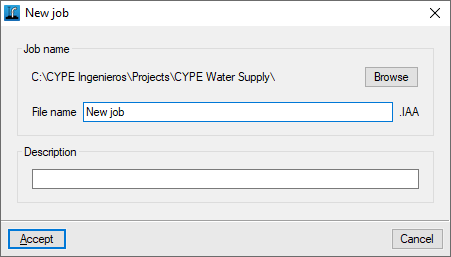
When starting the application and clicking on "New", a "New job" can be created. After entering the "File name" and its "Description", the job can then be integrated into an existing project in BIMserver.center.
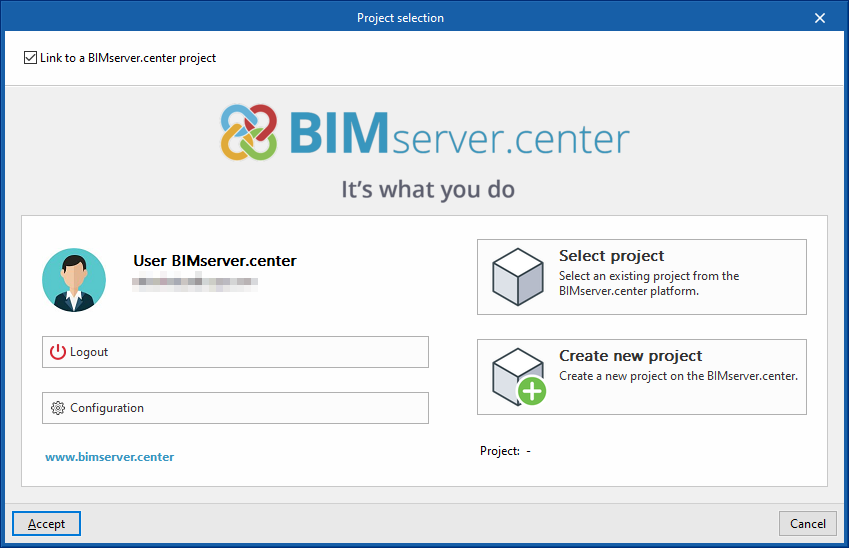
This is done in the "Project selection" window, which presents the following options:
- On the left side users can log in with a BIMserver.center account.
- On the right-hand side there is the "Select project" option to select an existing project. There is also the possibility to "Create a new project". In this case, the created project will be visible from BIMserver.center from that moment on.
- There is the option to start the project without being linked to the BIMserver.centre platform. To do this, simply uncheck the "Link to a BIMserver.center project" box at the top left.
Importing BIM models
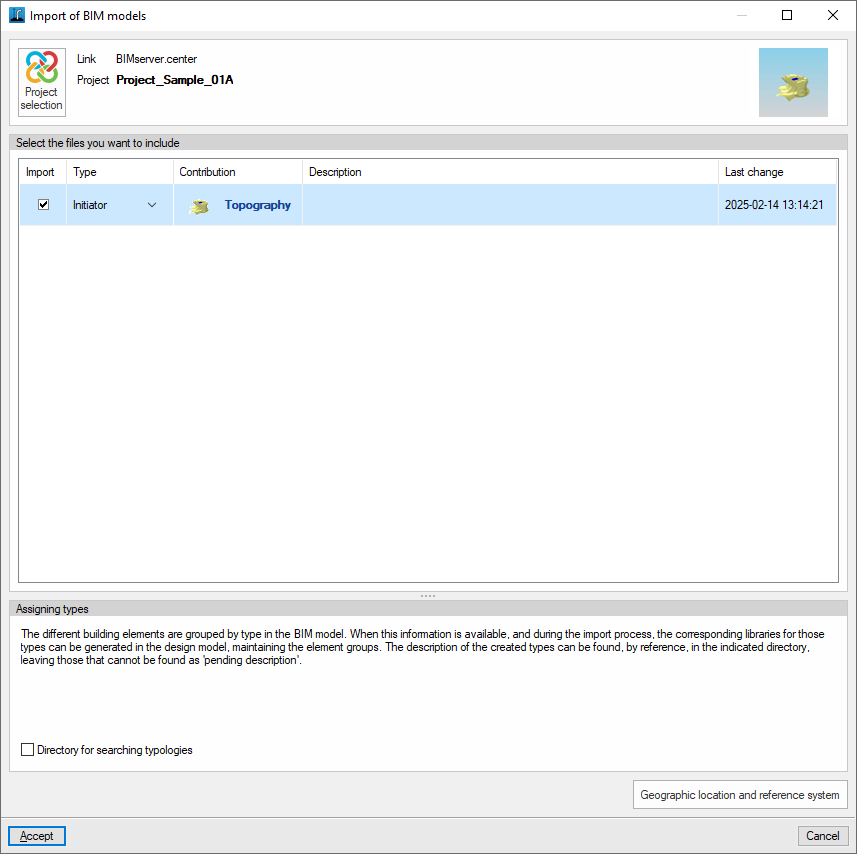
When creating a new job, if a project hosted on the BIMserver.center platform has been selected from "Select project", the "Import BIM models" window appears, which shows the files contained in the project in IFC format.
To include the information from a given project file, check the "Import" box and accept it.
Setting the system's general data
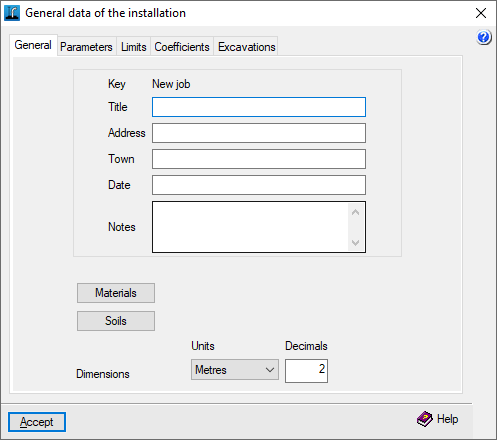
In the process of creating a new job, the program opens the "General data of the installation" window to ensure its insertion, including the definition of materials and terrains.
The configuration of this data can be accessed again at any time via the "Edit general job data" option in the "General data" menu at the top of the screen.
Once this window is accepted, the program's general interface is accessed.
Import results
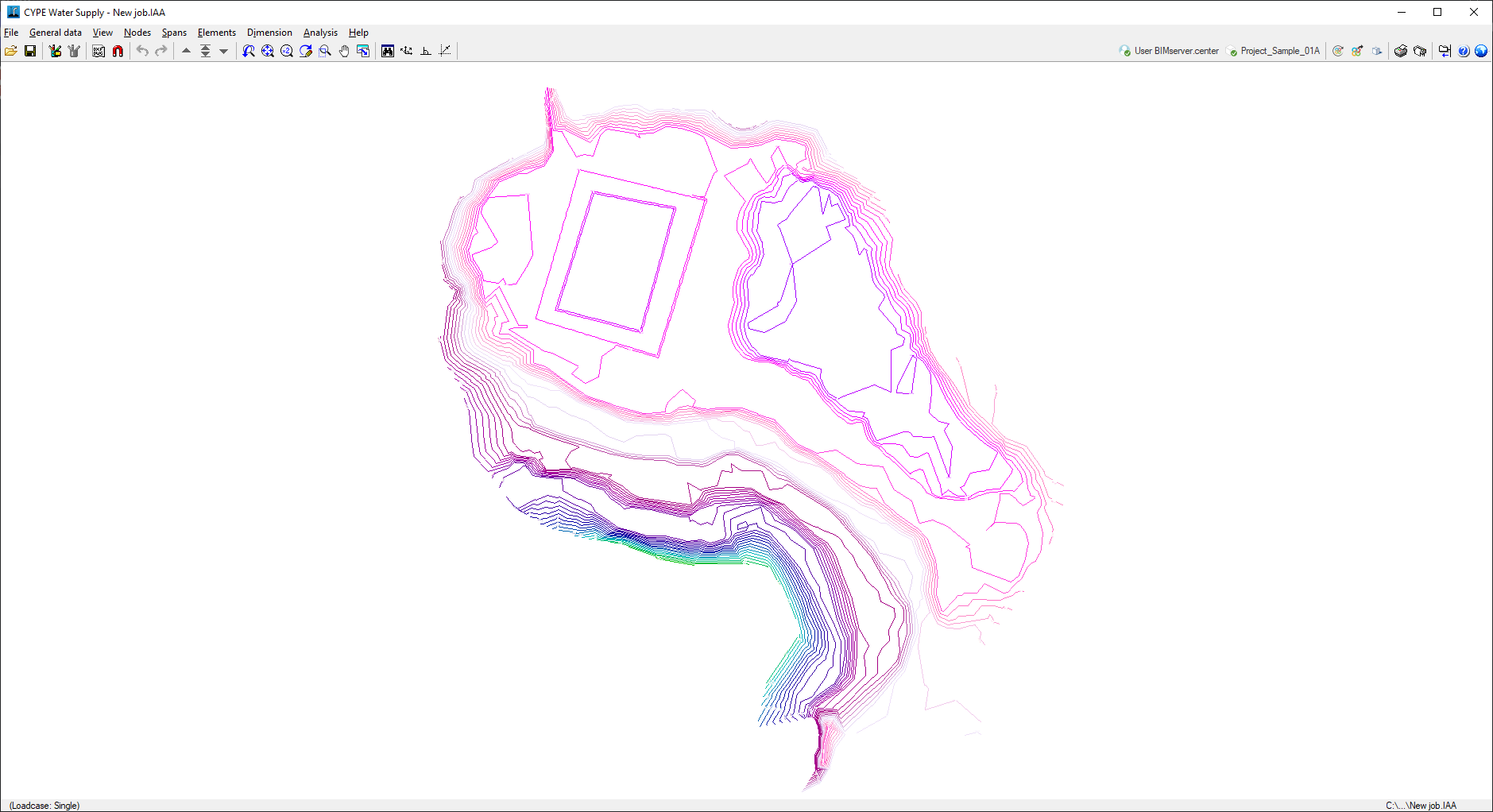
If an IFC has been imported with the terrain information with the appropriate characteristics in the process of creating a new work, the program will represent it by showing the contour lines on the screen (their visualisation can be controlled from the "Show/hide topographic profile lines" option in the "View" menu). When entering nodes, the program will take the data of the terrain elevation where they are located.
In addition, the 3D view will display the models included in the BIM project and imported into the job.
General job data settings
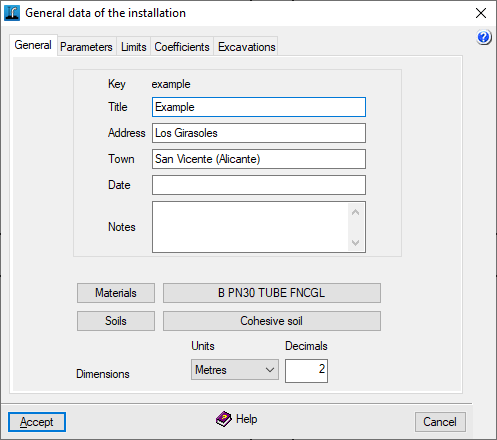
The "General data" menu at the top of the page contains the "Edit general data of the job" option, which allows users to enter general data of the installation, such as materials and soils, parameters, limits and coefficients used in the analysis or excavation data.

The following options are available:
"General" tab
The following general data can be entered, which will appear in the analysis reports, within the description of the installation:
- Key
Name of the job. To modify it, go to "File", "Save as". - Title
- Address
- Town
- Date
- Notes
In addition, the following options are available:
- Materials
Accesses the management of materials. - Soils
Accesses the soil management. - Dimensions
Sets the units and the number of decimals used.
Materials management
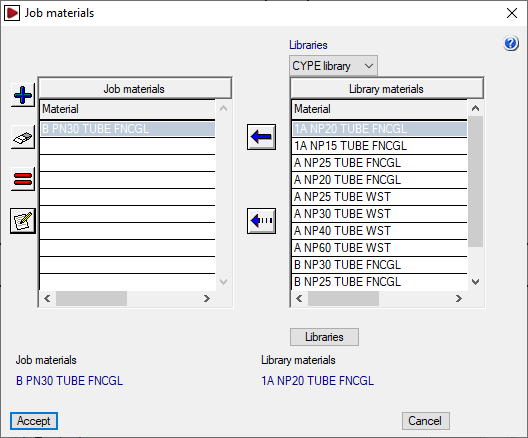
By clicking on the "Materials" option, users can manage the materials of the pipelines of the job, as well as the available material libraries. Two lists are displayed in the window that appears:
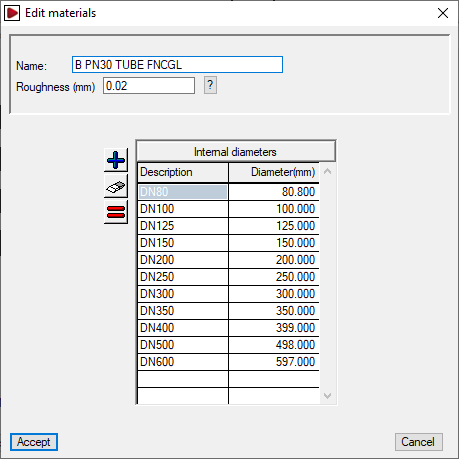
- The report on the left represents the "Job materials". It is possible to create a material manually using the tools on the left, or to import it from the library materials. When adding or editing a material from the job, the name, roughness and associated bore series are indicated in the corresponding sections.
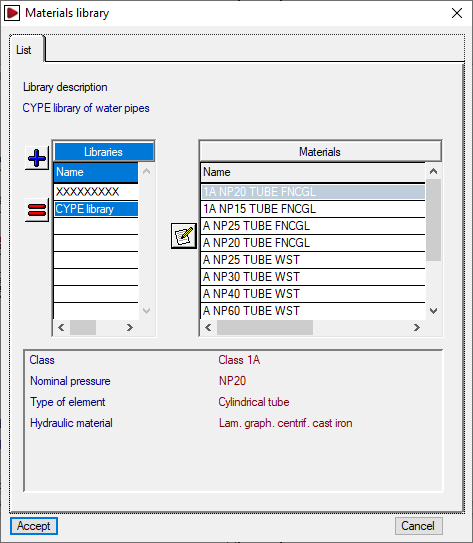
- The report on the right shows the "Library materials". The library to be displayed is selected at the top. The program incorporates a default library. The internal data of each library can be consulted by clicking on the "Libraries" button at the bottom; there the "Library description" and its "Abbreviation" are defined, and for each material included, the "Name" and "Roughness" are shown, as well as the series of associated "Internal diameters".
The first button between the two lists is used to create a job material by importing the information from one of the materials available in the library. The second button is used to add the series of the library material selected on the right to the job material selected on the left.
Soils management
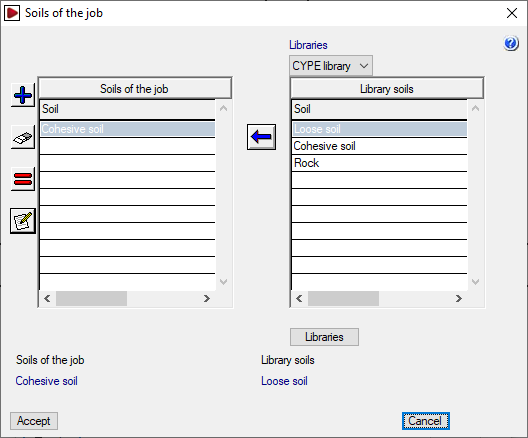
By clicking on the "Soils" button, the soil of the job, as well as the available soil libraries, can be managed. Two lists are displayed in the window that appears
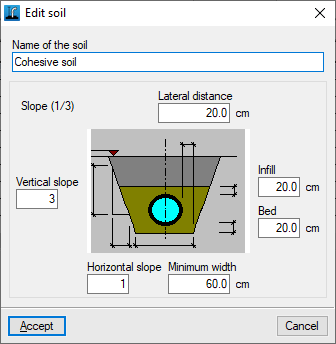
- The list on the left shows the "Soils of the job". Soils can be created manually with the tools on the left, or imported from the soils library. When adding or editing soils of the job, the "Name of the soil" and the following geometric parameters are indicated: "Side distance", "Fill", "Bed", "Minimum width", and "Vertical slope" and "Horizontal slope" (which form the "Slope" relationship shown next to the graph).
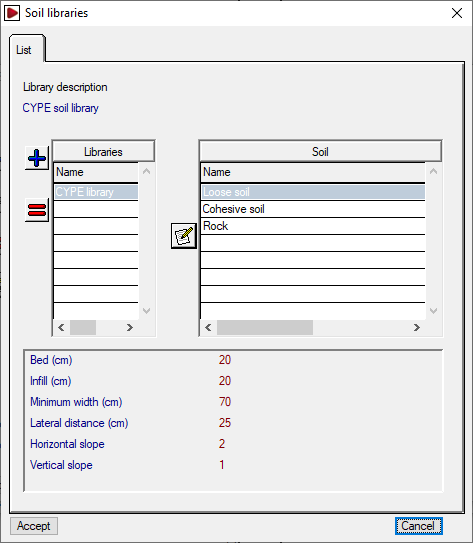
- The list on the right shows the "Library soils". At the top, you select the library you want to display. The program incorporates a default library. It is possible to consult the internal data of each library by clicking on the "Libraries" option at the bottom; there the "Library description" and its "Abbreviation" are defined, and for each soil included, the "Soil name" and the geometric parameters mentioned are displayed.
The first button between the two lists is used to create a soil for the job, importing the information from one of the available soils in the library. The second button adds the series from the soils in the library selected on the right to the soil of the job selected on the left.
To continue creating a new job, at least one material and one soil must be created.
The materials and soils will be available when editing each section from "Spans", "Edit analysis data".
"Parameters" tab
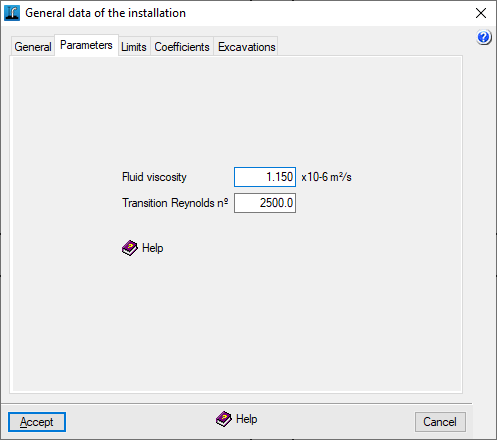
The following hydraulic parameters can be defined. These values must not be changed except in exceptional cases and with full knowledge of their implications.
- Fluid viscosity
Kinematic viscosity of the fluid; by default, the value 1.15 x 10⁻⁶ m2/s is displayed (1 m2/s=10000 Stokes). - Transition Reynolds nº
Transition Reynolds number between laminar and turbulent regime. This value is taken as the boundary for the application of the formulation and is usually set between 2000 and 4000. By default, the value 2500 is shown.
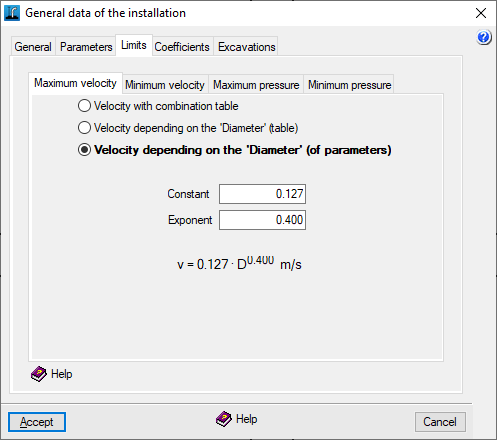
"Limits" tab
These limits are set for velocities and pressures in the installation. These limits act in two ways:
- If the "Analysis" option of the "Analysis" menu is used, a warning is displayed on the elements of the installation that do not reach the minimum values or that exceed the maximum values;
- If the "Design" option of the "Analysis" menu is used, in the case of speeds, the program restricts the operation of the installation to the values between the minimum and maximum values defined, whenever possible, as design limits; and in the case of pressures, they act as range limitations in the pressure of the nodes, so that the program looks for the solution that allows the greatest number of nodes in that range.
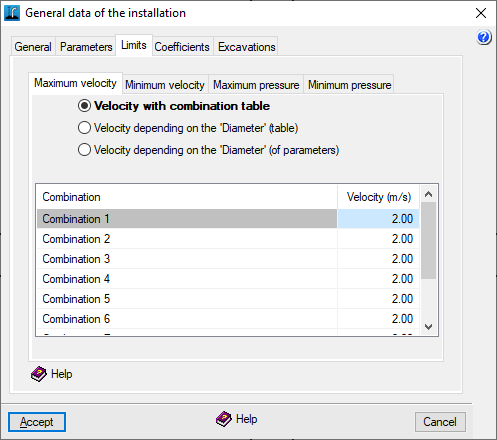
The different tabs define the "Maximum speed" and "Minimum speed" in the sections, and the "Maximum pressure" and "Minimum pressure" in the nodes.
This can be done:
- By combination table
- Each entry defines the velocity or pressure limit for each combination defined in "General data", "Edit combinations".
- Depending on 'Diameter' (table) (for "Maximum velocity" and for "Minimum velocity")
- Each entry defines the velocity limit applied to pipes with diameters equal to or smaller than the indicated diameter. For larger diameters than those indicated, the limit of the largest diameter in the table is applied.
- As a function of 'Diameter' (parametric) (for "Maximum velocity")
- Expresses the velocity v as a function of the diameter D by defining the constant C and the exponent E, such that v = C - DE (m/s).
"Coefficients" tab
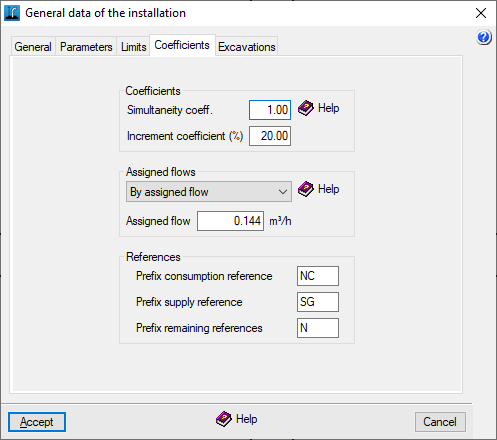
Coefficients
Two coefficients can be defined which are applied in the analysis in a general way to the whole job:
- Simultaneity coefficient
Increases or reduces consumption. It is defined on a per unit basis and applies to water consumption in all combinations. This makes it possible to simulate operation at different times of the day or seasonal changes. By default, a value equal to unity is set. - Length increment coefficient (%)
This acts as an additional percentage of the resistant length of the sections. This enables the simulation of head losses due to special elements such as valves, elbows or branches. By default, a value of 20 % is set.
Assigned flows
Defines whether the consumption node loads are defined by default directly or assigned.
- Direct
Consumption shall be entered directly in flow rate units. - By assigned flow
Consumption shall be entered based on a flow rate value per allocation (corresponding to the value indicated in the "Allocation" field) and the corresponding number of units.
The values of the loads and their type of definition can be edited later in the editing panel of each node.
References
Establishes the prefixes that automatically make up the references of the installation's nodes when they are entered in the work area, whether they are consumption nodes, general supply nodes or the rest of the nodes:
- Prefix consumption reference
- Prefix supply reference
- Prefix remaining references
The references can be edited later in the editing panel of each node.
"Excavations" tab
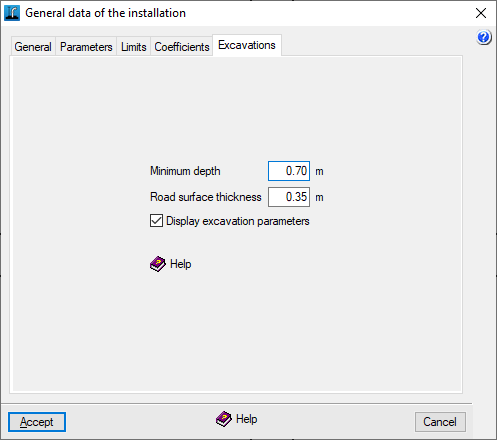
Defines the following parameters related to the excavations of the installation:
- Minimum depth
Sets an alarm to warn when any point of the installation falls below this value (in the "Analysis results" report that appears after using the "Analysis" menu options). The minimum depth is measured from the level to the upper edge of the inside face of the conduit. - Road surface depth
Indicates the default distance between the grade and the modified terrain. This value is subtracted by default from the grade elevation (entered in the "Edit node" panel) to obtain the terrain elevation without having to type it in. Additionally, if the terrain elevation is changed in this panel, a warning will be given if the established road surface thickness is not complied with. - Display excavation parameters (optional)
The program can calculate the excavation volumes of the installation if at least one terrain has been defined and the dimensions and depths of the nodes have been provided. If this information is not required or if there is no need to calculate the excavation, it is possible to deactivate this option: this way, the nodes will only require the entry of the value of the "Elevation".
| Note: |
|---|
| When there are several road thicknesses in the job, if the value of the "Road surface thickness" is changed in this section, new nodes entered from this point onwards will be designed with the new thickness, but for the previously entered nodes the old thickness will be retained. |
Defining loadcases and combinations
The "General data" menu at the top of the page contains the following options, which are used to define the loadcases and combinations of the job.

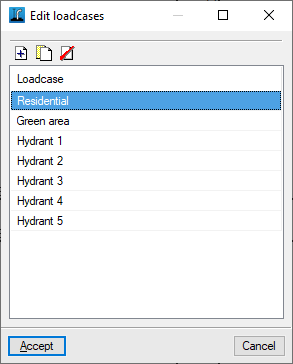
Edit loadcase
Used to define the simple loadcases in the installation.
To do this, elements are entered into the list and their names are typed in.
After defining the loadcases, consumptions can be assigned to each of them via "Nodes", "Edit calculation data". The coefficients corresponding to the scenario combinations must also be defined from the "Edit loadcases," option in the "General data".
Edit combinations
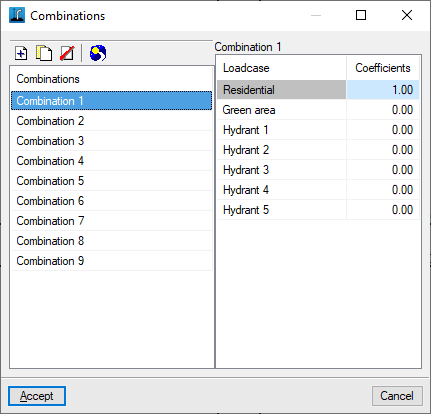
Used to define the combinations of loadcases.
To do this, enter elements in the list on the left and enter their names. Then, in the right-hand list, the combination coefficients assigned to each loadcase in the selected combination are indicated as a percentage of one.
The loadcases must have been previously entered from "General data", "Edit loadcases".
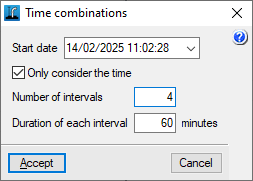
The program also has a utility to automatically create "Time combinations" indicating a certain "Number of intervals" together with the "Duration of each interval" from a "Start date". By activating the "Consider only the time" option, only the time, and not the date, is incorporated in the reference of the generated combinations.
Options in the "View" menu
The following options can be accessed from the "View" menu at the top of the interface.

Viewing options
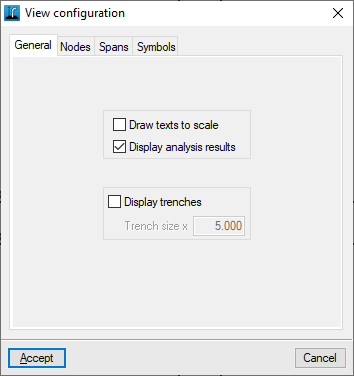
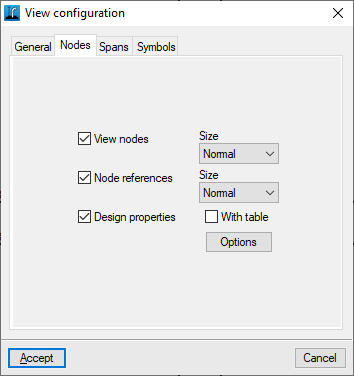
Controls the display of the diagram elements on the screen. The following options are available:
- "General" tab
- Draw texts to scale (optional)
- Display analysis results (optional)
- Display trenches (optional)
- Trench size x (valor)
- "Nodes" tab
- View nodes (optional)
- Node references (optional)
- Design properties
- Options: Data to view at nodes
- With table (optional)
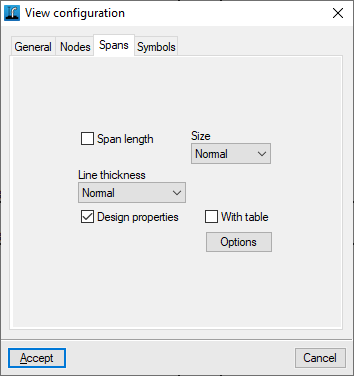
- "Spans" tab
- Span length (optional)
- Line thickness
- Design properties (optional)
- Options: Data to view at nodes
- With table (optional)
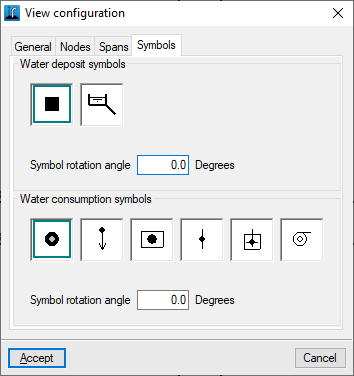
- "Symbols" tab
- Water deposit symbols
- Symbol rotation angle
- Water consumption symbols
- Symbol rotation angle
- Water deposit symbols
3D view
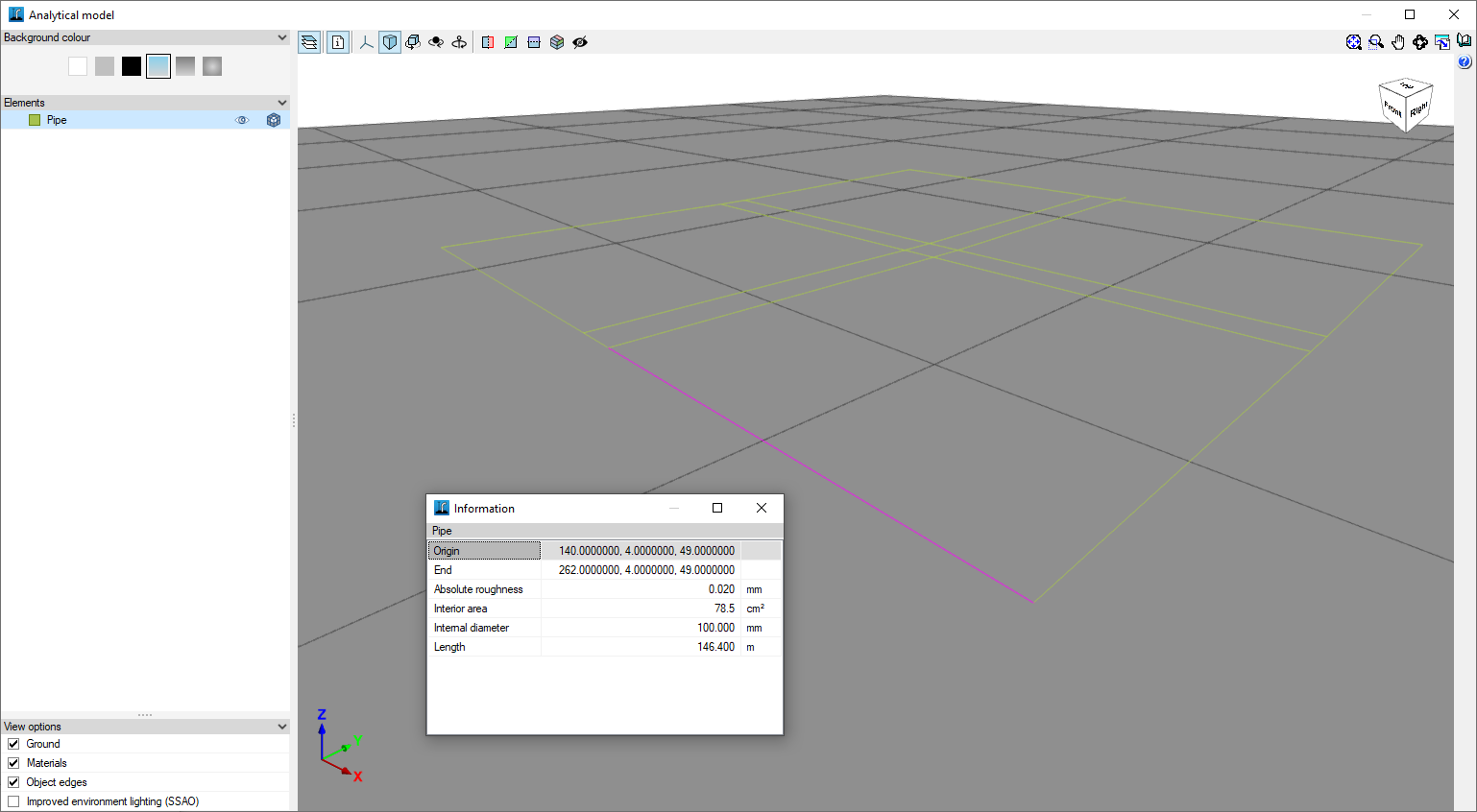
Once the job has been analysed, this option opens a window with a 3D representation of the system. In addition, it is possible to check the geometric characteristics of each section by using the "Information" option and clicking on the section.
Show/hide topographic profile lines
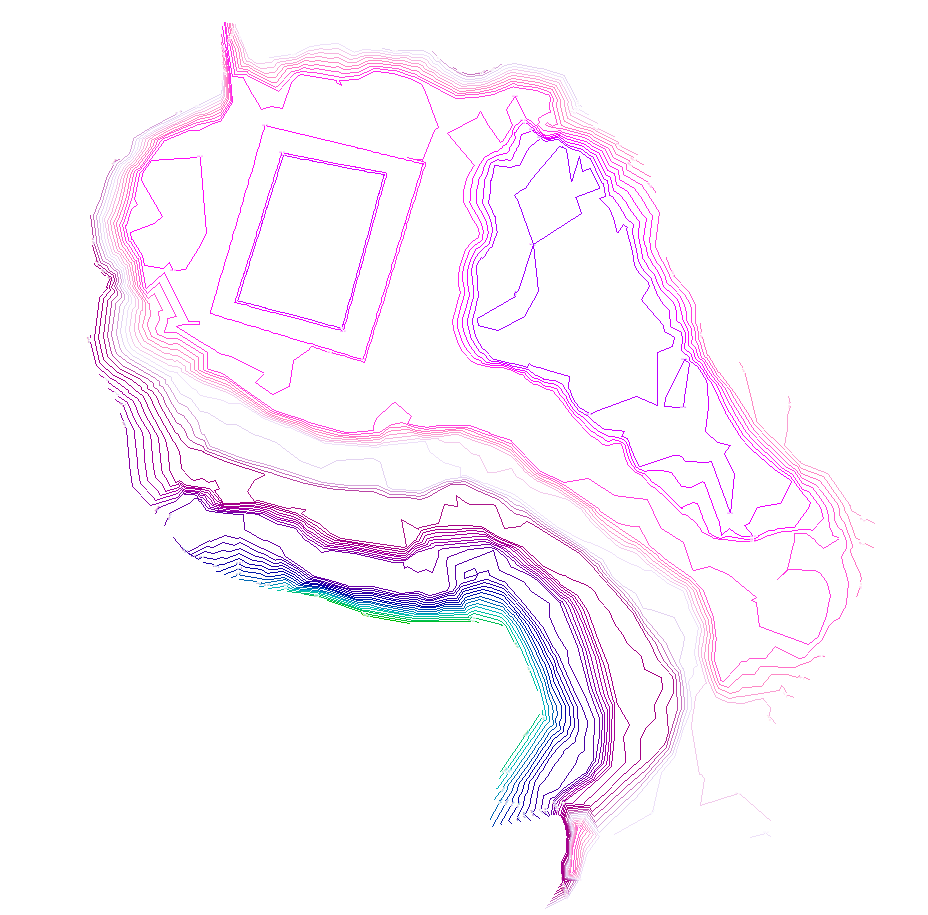
Shows or hides on screen the contour lines generated in the case of having imported an IFC file with the terrain model in the process of creating the job.
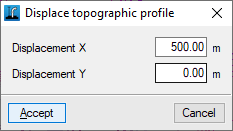
Displacement of the topographic profile
Moves the topographic profile generated in the case of having imported an IFC file with the terrain model in the process of creating the job.
Results output
Viewing results on screen
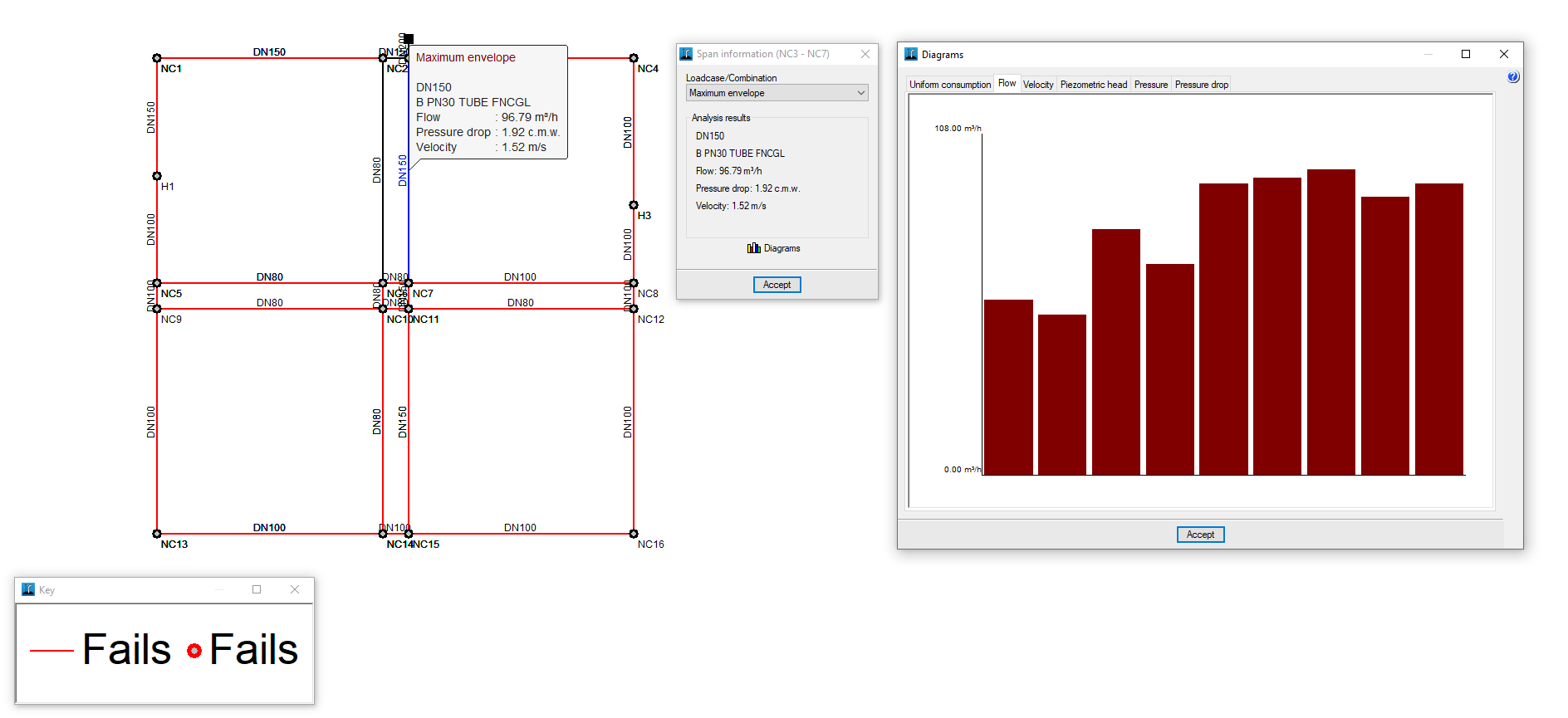
After the analysis, the program displays the results on the screen when selecting an element in the system by clicking on "Nodes" and "Information" or on "Sections" and "Information".
This includes the analysis data of the nodes and the analysis data of the spans, with results by loadcase, combinations or envelopes.
Reports
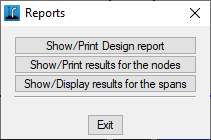
The program can print the reports directly or generate .html, .pdf, .txt, .rtf or .docx files.
The reports are obtained via the "Reports" option in the "File" menu or from the right-hand side of the top toolbar.
The following reports are available:
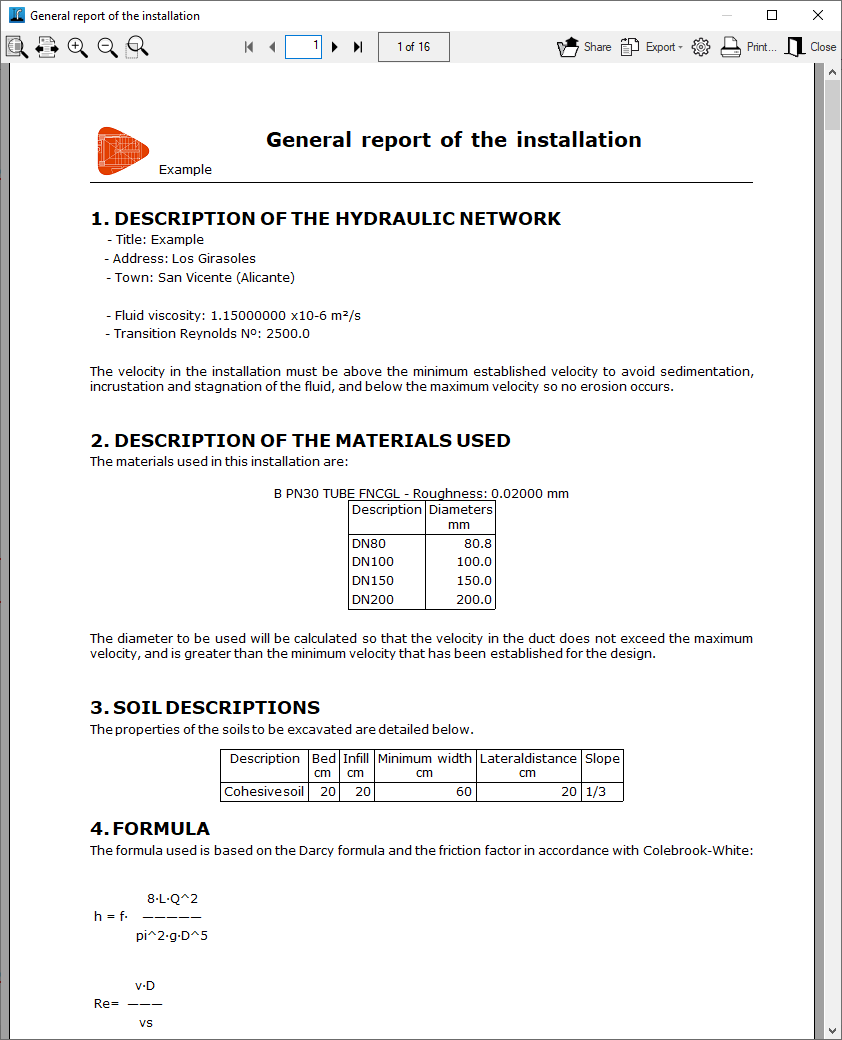
- Calculations
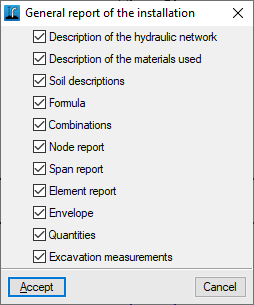
Prints the general report of the system. It includes the following sections, which can be activated or deactivated:- Description of the hydraulic network (optional)
- Description of the materials used (optional)
- Soil descriptions (optional)
- Formula (optional)
- Combinations (optional)
- Node report (optional)
- Span report (optional)
- Element report (optional)
- Envelope (optional)
- Quantities (optional)
- Excavation measurements (optional)
- Node report
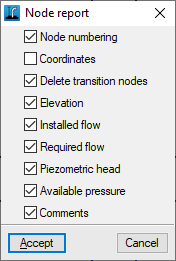
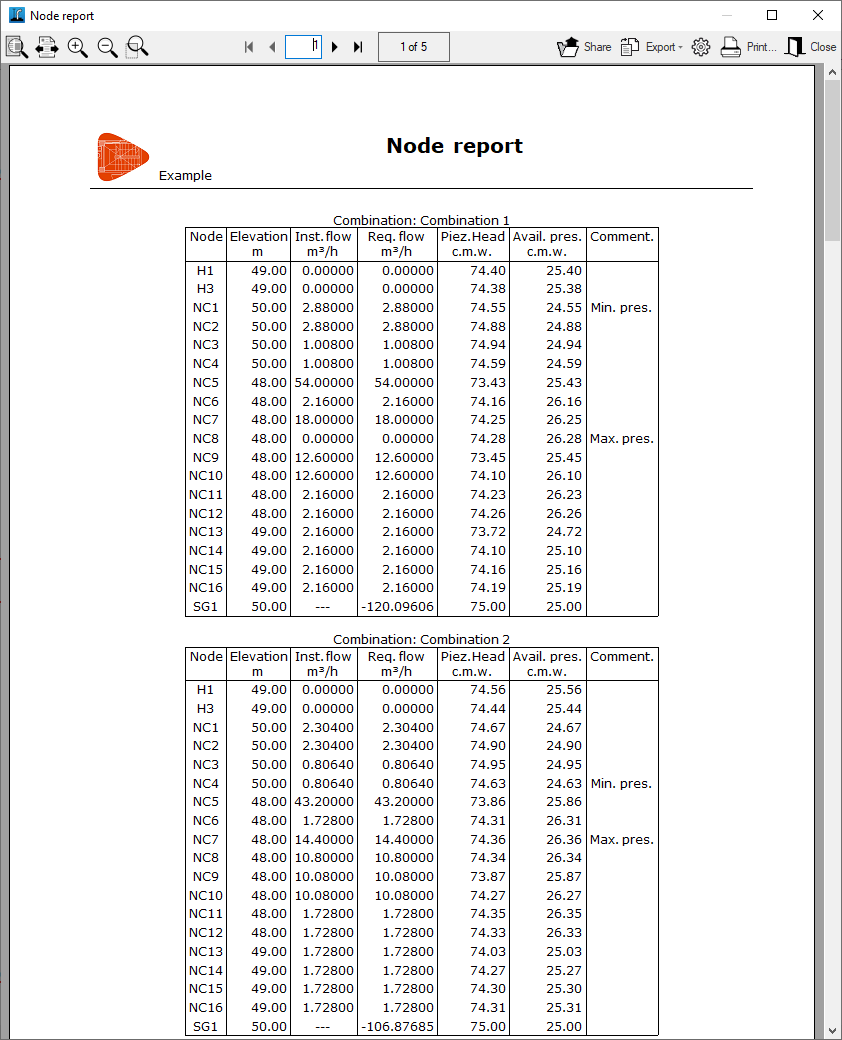
Prints the report of the results for the nodes. It includes the following information, which can be activated or deactivated:- Node numbering (optional)
- Coordinates (optional)
- Delete transition nodes (optional)
- Elevation (optional)
- Installed flow (optional)
- Required flow (optional)
- Piezometric head (optional)
- Available pressure (optional)
- Comments (optional)
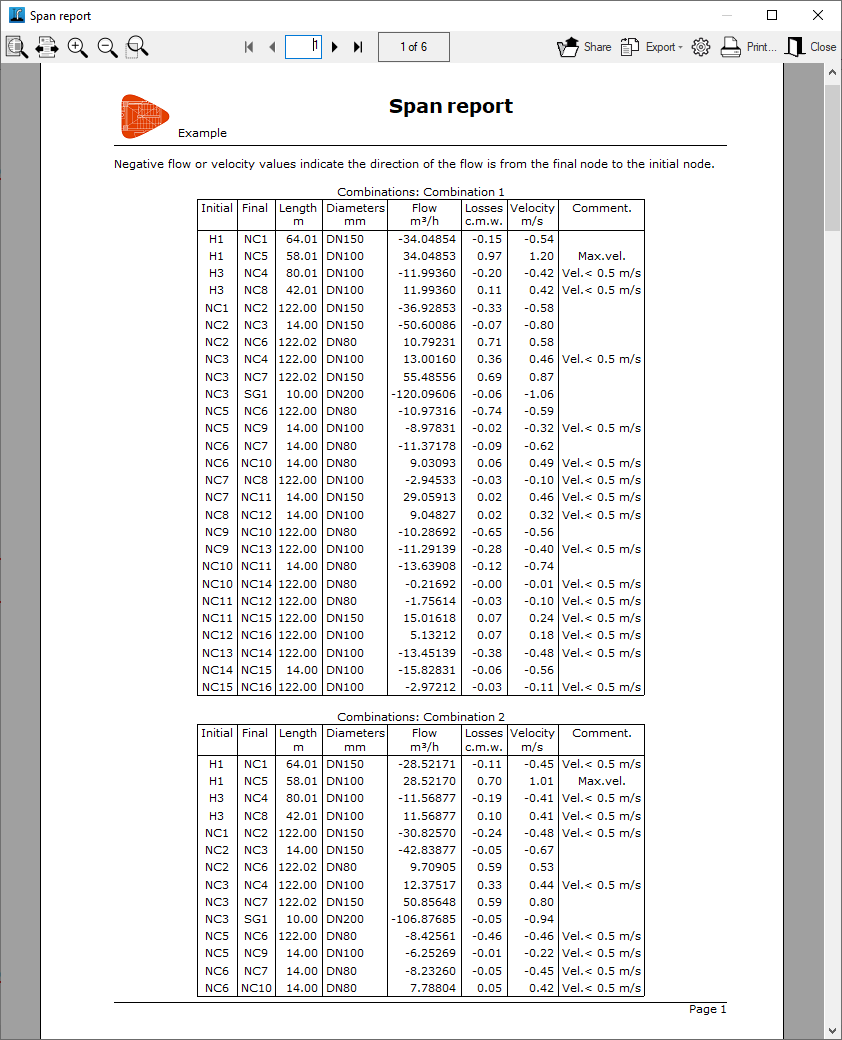
- Span report
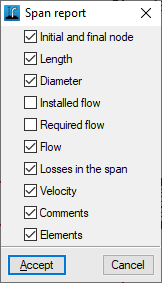
Prints the report of the results for the nodes. It includes the following information, which can be activated or deactivated:- Initial and final node (optional)
- Length (optional)
- Diameter (optional)
- Installed flow (optional)
- Required flow (optional)
- Flow (optional)
- Losses in the span (optional)
- Speed (optional)
- Comments (optional)
- Elements (optional)
Drawings
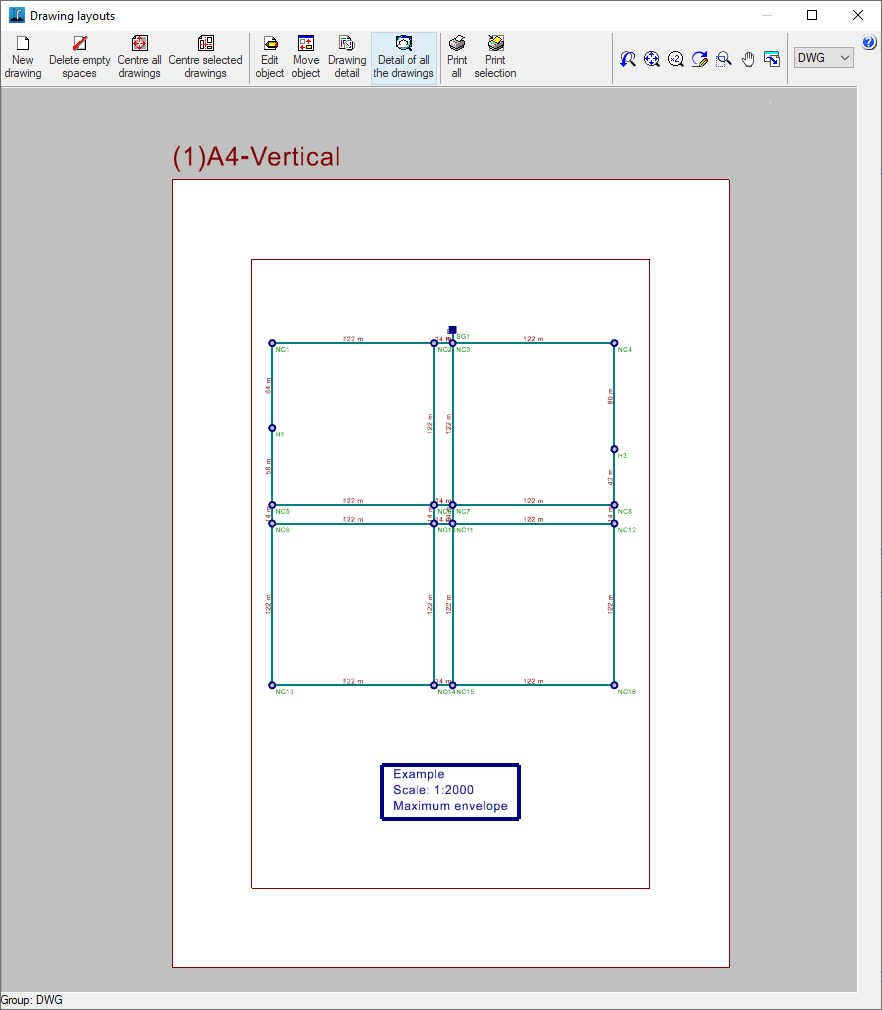
The program can print the drawings of the job on any graphic peripheral configured on the computer, or create .dwg, .dxf or .pdf files.
The drawings are obtained from the "Drawings" option in the "File" menu or from the right-hand side of the top toolbar.
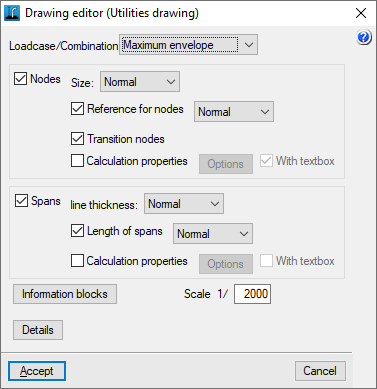
The editing of the drawing offers the following options:
- Loadcase/Combination
Selects the loadcase, combination, envelope or oscillation for which data is to be displayed in the drawing. - Nodes (optional)
Displays the input information and analysis results of the nodes:- Size
- Node reference (optional)
- Transition nodes (optional)
- Calculation properties (optional)
- Options: Flow, Deposit elevation, Level, Ground level elevation, Soil elevation, Piezometric head, Available pressure
- Spans (optional)
Displays the input information and analysis results of the spans:- Line thickness
- Length of the spans (optional)
- Design properties (optional)
- Options: Dimension, Material, Flow, Pressure drop, Velocity
- Information blocks
- General information block (optional)
- Quantities information block (optional)
- Excavation information block (optional)
- Scale
- Details
GLTF file compatible with BIMserver.center
If the job has been linked to a BIMserver.center project, a 3D model is generated in GLTF format for the integration of the system model in the project when exporting to the platform, allowing it to be displayed:
- on the online platform;
- in the BIMserver.center app for iOS and Android;
- in virtual reality and augmented reality;
- in other CYPE programs.
Integration into the BIMserver.center platform
Many of CYPE's programs are connected to the BIMserver.center platform and allow collaborative work to be carried out via the exchange of files in formats based on open standards.
Please note that, to work on BIMserver.center, users can register on the platform free of charge and create a profile.
When accessing a program connected to the platform, the program connects to a project in BIMserver.center. This way, the files of the projects that have been developed collaboratively in BIMserver.center are kept up to date.

| More information: |
|---|
| For further details related to using CYPE software via the BIMserver.center platform, please click on this link. |