Update history​​

Arquimedes

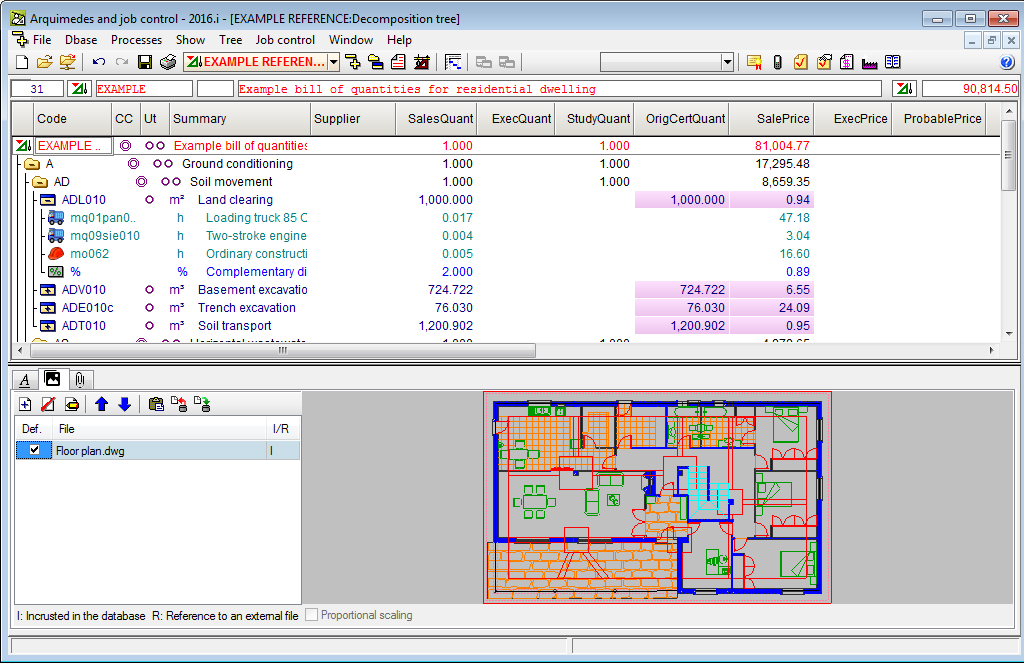
The 2016.i version of Arquimedes allows users to link a concept (chapter, job item, unit) of the database to one or more files of any type.

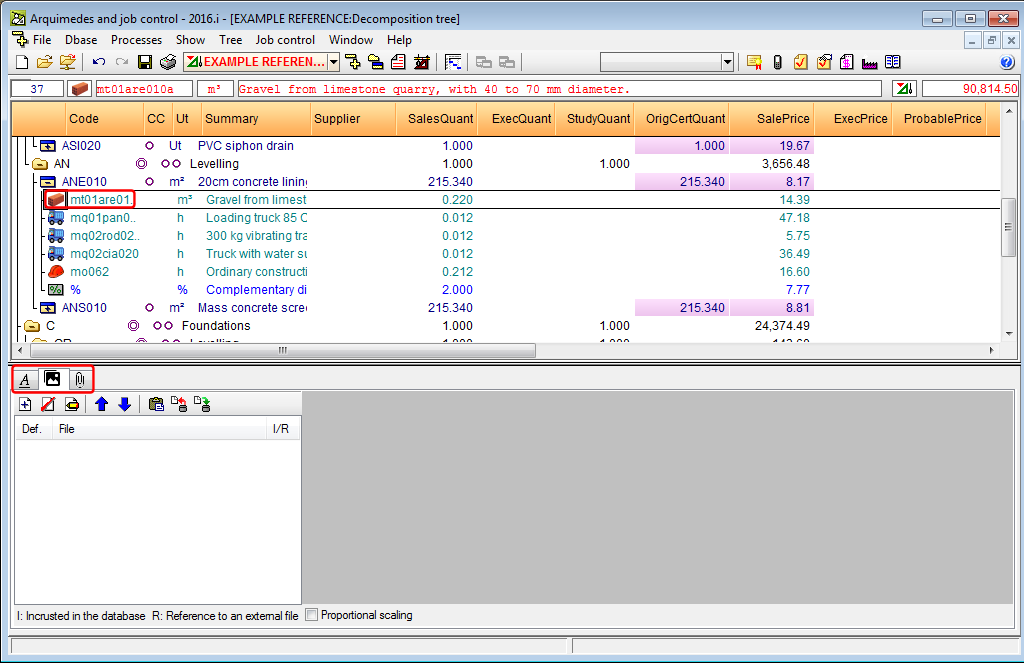
The attached documents are managed in the “Decomposition tree” window in the zone to which the graphical information is added. To do so, click on the field containing the code of the concept to which the documents are to be attached. Alternatively, click on the concept icon or on the field in which the measurement units are displayed (Ut). Once one of these fields has been selected, a new view containing three tabs in the bottom half of the window will appear:

  • “Attached documents of the concept” tab 
    Allows users to manage attached documents using a series of buttons that appear in the tab. Using the Add new element to the list button, the element to be attached to the concept can be found.

    When a file is attached, the program prompts the user if s/he wishes to copy the selected document to the documents folder of the job. If the user answers “Yes”, a new folder, named after the database which is currently in use, with “doc” extension is created. The attached file is copied to this folder and in such a way that it remains linked to the concept. If the user answers “No”, the file is linked from its original location.

    When a BC3 file, containing attached files or documents, is read, these will be incorporated into the database by linking them to a specific folder, which is created for that purpose.

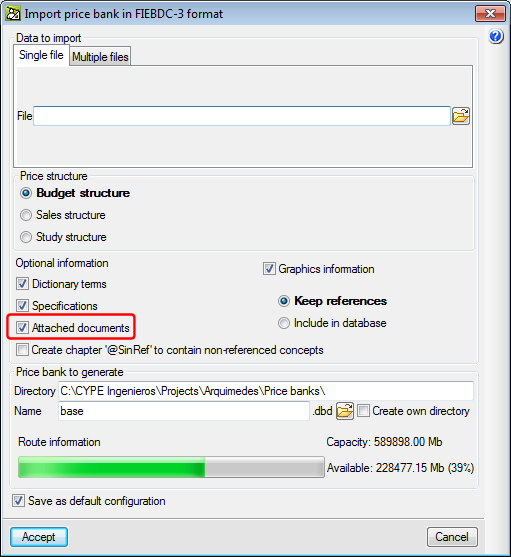
    To import a BC3 file containing attached documents (File > Import > Import new price bank from FIEBDC-3), users must ensure the “Attached documents” option is activated and that the attached document files are with the BC3 file.

    When a database (Price bank or bill of quantities) concept is first copied to another price database, if the Attached documents option has been activated, the attached documents will be copied as well as the concept.

    All concepts containing attached documents can be found in the option “List > Other concepts > Concepts with attached documents”.


  • “Texts of the concepts” tab 
    Contains information of the “Description” field, which can be edited by users.


  • “Graphical information of the concept” tab 
    Allows users to manage the graphical information as was done in previous versions.

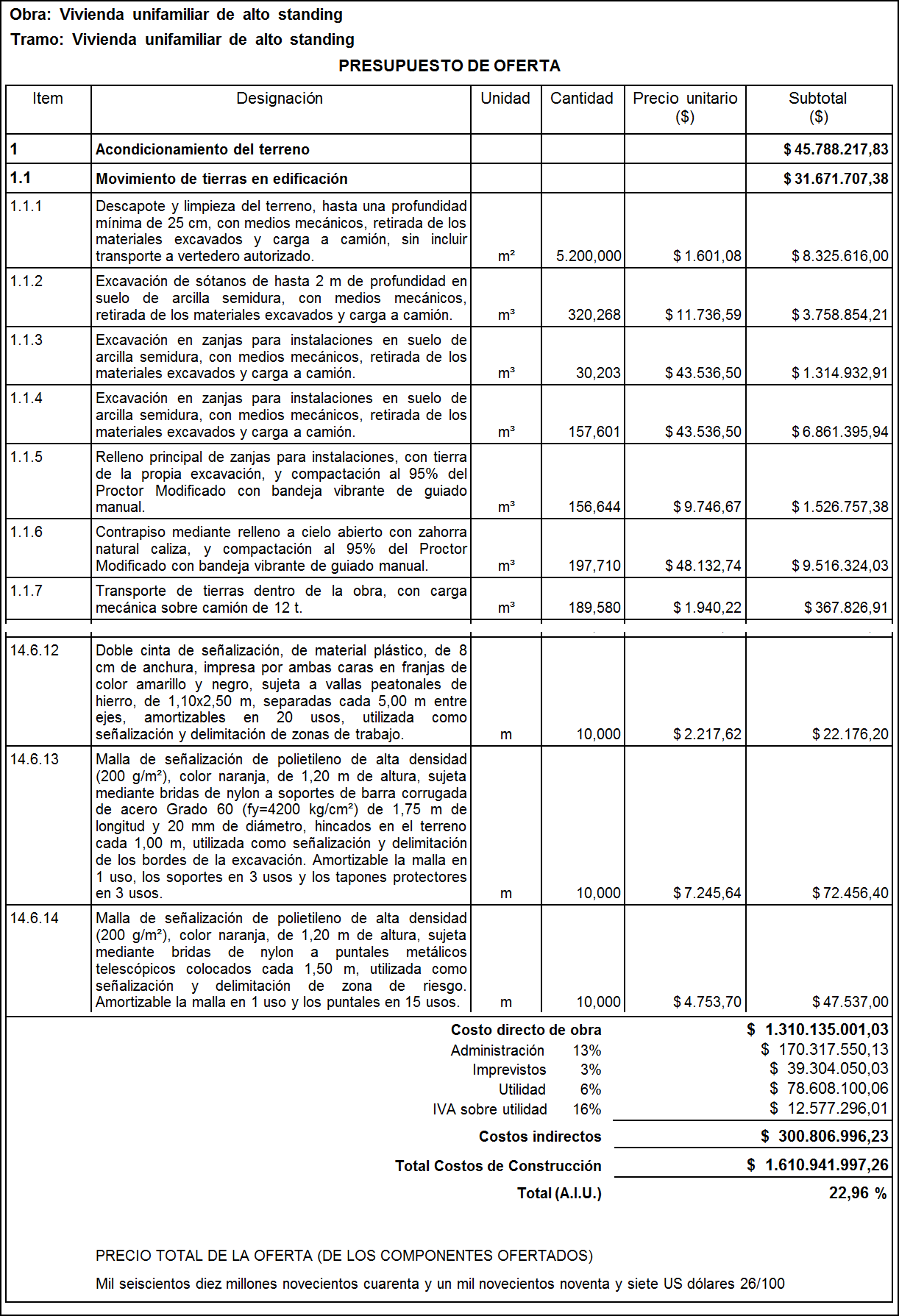
This new report template displays the offer proposal and can be found in the “ZG Colombia” template types (File > Print > Print report)

A new option: Edit link between the job unit and Revit, has been implemented in a contextual menu which appears when the right mouse button is clicked on a quantities line in the Decomposition tree window. This option displays the element that corresponds to the selected quantity line in REVIT, helping users to locate it more easily.

A new option: Show properties, has been implemented which displays all the information of an element in a specific window to find information more easily.

The Show properties option appears in a contextual menu when the right mouse button is pressed over an Element or a Type from the Job item assignment and quantity extraction window.

If a Type exists in the Revit model which contains more than one code in its Keynote, Arquimedes reads each job item code and assigns it to the “Cype_CodMed” field, as long as the job item code in the bill of quantities of Arquimedes is linked to the Revit model.

The job item codes in the Revit keynote must be separated by one of the symbols shown in the table below:

Comma,
Colon:
Semi-colon;
Forward slash/
Back slash\
Vertical bar|

It is possible to identify, depending on the “Room”, elements of the BIM model containing information of the “Room” in which they are included.

Not all the Revit elements contain “Room” information. This information usually corresponds to elements which are specific to the room containing them, such as doors, windows, furniture, bathroom fittings, etc. For example, when measuring doors or windows, users can indicate in the comments section of the quantities which room each measurement corresponds to using the “Comments” or “Comments 2” field. Doors and windows between rooms are not considered as being in one room but in two, and Revit provides the name of both rooms.

The Revit model which is read by Arquimedes contains all the information on Groups. This way all the information of the groups that have been created in Revit and their data can be viewed from Arquimedes. It is also possible to measure the groups.

As well as the new features and improvements that are indicated explicitly in each CYPE software version update, these updates also include process optimisations which imply internal improvements of our programs. Systematic checks are carried out on all the programs in each revision, as well as changes which improve their operation. Therefore, we recommend all our users (in this case of the 2016 version) to always update their program version to the latest available version, regardless of the country CYPE software is being used for or the language in which the program is installed.

  • button
    To help to alternate between the “Job item assignment and quantity extraction” and “Linked job data” dialogue boxes, the  button has been added to both dialogue boxes. The F7 key also carries out the same alternating function between the dialogue boxes.
  • button
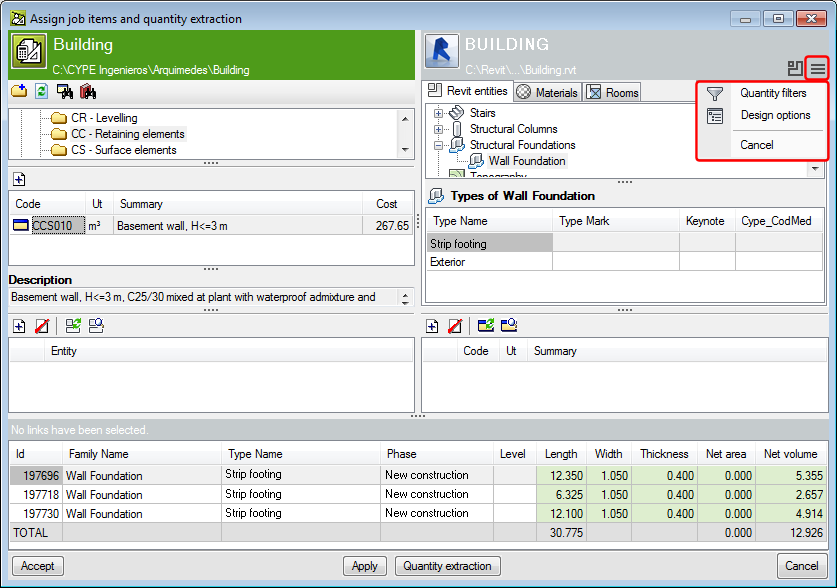
    The  button has been added to the “Job item assignment and quantity extraction” and “Linked job data” dialogue boxes. This button is the access point to the different options in each of these dialogue boxes:
    • In the “Job assignment and quantity extraction” dialogue box, the   button allows users to access the Global quantity filters and the Design options.
    • In the “Linked job data” dialogue box, the  button allows users to access the “Find element by ID” option.

The Design options consist of design alternatives which, by always working on a single model, allow users to save a substantial amount of work.

For example, two or more proposals can be carried out simultaneously to show clients various alternatives. Therefore, Arquimedes’ new “Design options” tool allows users to only measure Revit entities which belong to the design options selected in the Revit model. This tool permits users to extract different quantities depending on the quantity options that have been created in the Revit model, to obtain different quantity values.

The  button, in the “Job assignment and quantity extraction” dialogue box, allows users to access the “Design options” (if design options have been created in the Revit model) and select the group of design options to apply when extracting quantities to create the bill of quantities.

Quantity filters allow users to obtain the quantities of job items that are only assigned to phases, categories, levels or assignments (entity–job item) of Revit and are to be measured. Two types of filters can be established:

  • Global filters (categories, phases and levels)
    Global filters are created using the Quantity filters option in the drop-down menu that appears when the  button of the “Job item assignment and quantity extraction” dialogue box is pressed.


  • Filters by assignment (entity – job item)
    Filters by assignment allow users to obtain quantities only from elements that meet specific requirements. Filters created by assigning job items to entities are saved by categories. Filters of this type are created based on the element parameters.

    Once a job item has been assigned to a Revit entity or vice-versa, filters can be carried out by assignments. If, for example, users wish to filter elements whose length is less than 12 m, they must first press the  button and, in the “Select a filter to limit the elements to be measured” dialogue box, add the filter.
As well as the new features and improvements that are indicated explicitly in each CYPE software version update, these updates also include process optimisations which imply internal improvements of our programs. Systematic checks are carried out on all the programs in each revision, as well as changes which improve their operation. Therefore, we recommend all our users (in this case of the 2016 version) to always update their program version to the latest available version, regardless of the country CYPE software is being used for or the language in which the program is installed.