
Update history​​

CYPE 3D

NCh430.Of2008 (Chile)
Hormigón armado - Requisitos de diseño y cálculo

Implemented in CYPECAD and Metal 3D.
CBH 87 (Bolivia)
ICS 91.080.40 Estructuras de hormigón. Año 1987

Implemented in CYPECAD and Metal 3D.

ABNT NBR 6118:2007 (Brazil)
Projeto de estruturas de concreto – Procedimento

Implemented in CYPECAD and Metal 3D.

The design process of special aluminium sections has been optimised by now obtaining the shear plastic areas, as well as the reductions which, because of the tangential stresses due to the torsional moment and shear forces, arise when subject to normal forces: axial force and bending moments. This way, in checks where in previous versions, an elastic analysis was used (in accordance with the plastification criteria exposed in EC9), now a plastic analysis is carried out and, therefore, improved usage factors are obtained.

In this new version, aluminium sections requiring longitudinal welds can now be introduced in the Special aluminium sections editor. The program checks these sections taking into account the reduction of the resistance properties which arise in areas close to these welds: where the elastic limit of the material is affected significantly. The softened zone is referred to as the HAZ (heat affected zone), its extent and severity are calculated by the program.
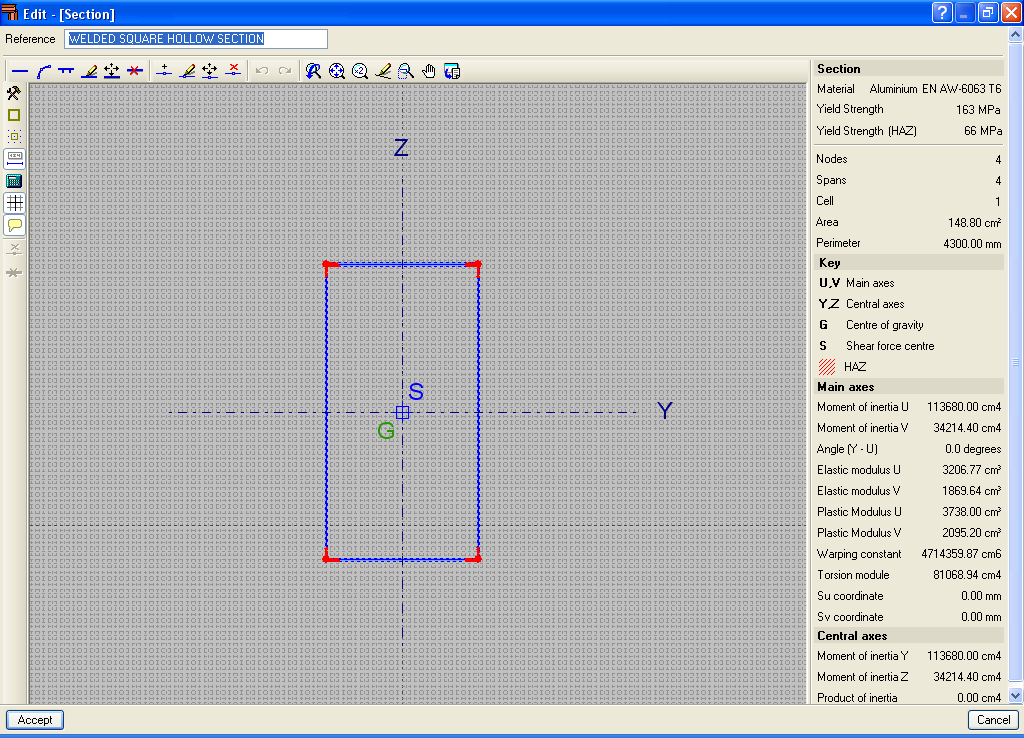
In previous versions of the program, the automatic calculation of the susceptibility to local buckling due to compression was already included assuming that each of the flat elements making up the section buckled in an isolated manner (independent from the rest), and the possibility was included, for any other type of buckling other than the individual type to be considered, to modify the local buckling coefficient which affects the slenderness parameter associated to each element. In this new version, the automatic calculation of the susceptibility to local buckling due to compression considering the possibility that several elements can buckle together as if they were a single element, is also included, hence combined buckling modes are obtained. The program is able to detect and analyse the buckling in a group of elements in the following cases:

  • Element sequence with all their ends aligned along a straight line
  • Element sequence with all their ends arranged along a circumference arc with small curvature
  • Element sequence making up a cell

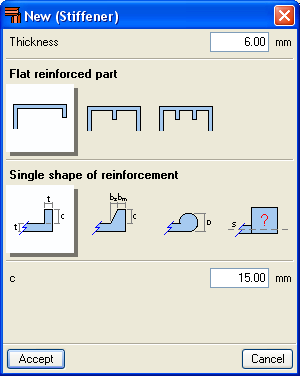
The combined buckling is also studied if the elements making up the section have been stiffened, which is commonly referred to as buckling due to distortion. Regarding the stiffened elements, a new assistant has been implemented for the design with standard reinforcement in accordance with that exposed in EC9.

The following rolled steel codes have been implemented for the five joints modules (Joints I, Joints II, Joints III, Joints IV and Joints V):

  • ANSI/AISC 360-05 (LRFD) (USA – International )
  • IS 800: 2007 (India)

NCh433.Of1996 Modified in 2009 (Chile). Official Chilean Code. Seismic Design of Buildings.

Implemented in CYPECAD and Metal 3D. Includes the emergency modifications presented in the Decree Nº117 (V. and U.) of the Diario Official de Chile of the 14th February 2011.

NSR-10 (Colombia): Reglamento Colombiano de Construcción Sismo Resistente
Code implemented in CYPECAD and Metal 3D.
The NSR-10 code substitute the outdated NSR-98 code. Nonetheless, any of the two codes can be used in CYPECAD and Metal 3D.

  • IS 456: 2000 (ACI318M-08) (India): Plain and Reinforced Concrete – Code of Practice.
    Implemented in CYPECAD and Metal 3D.
    Includes materials, steel bar diameters and load combinations of the code with the design criteria of the ACI 318M-08 (USA) code. The design criteria of the IS 456: 2000 code will be included in upcoming updates of the 2011 version.

CFE 2008 (Mexico): Manual de diseño de Obras Civiles. Diseño por sismo. Comisión Federal de Electricidad. México 2008.
Code implemented in CYPECAD and Metal 3D.

DIN 18800:2008-11 (Alemania): Deutsches Institut für Normung. Stahlbauten.
Code implemented in CYPECAD and Metal 3D for the following sections:

Rolled and welded steel

  • I
  • C
  • L
  • Rectangular hollow section
  • Circular hollow section

Cold-formed steel

  • C and stiffened C
  • L and stiffened L
  • Rectangular hollow section
  • Circular hollow section
CYPE Mentor