Update history​​

CYPECAD

Norma Brasileira ABNT NBR 6118 (2014). Projeto de estruturas de concreto – Procedimento.

Implemented in CYPECADCYPE 3D (Metal 3D), Punching shear verification, Stairs, Flat slabs, Corbels, Great depth beams, Foundation elements and Continuous beams.

Eurocode 2: Design of concrete structures. SR EN 1992-1-1:2004/AC

This code was already implemented in CYPE programs as of previous versions.

Now, with the 2014.m version, when Eurocode 2 (Romania) is selected in CYPECAD, columns and beams are edited using their corresponding advanced editors.

More information on CYPECAD’s advanced column editor. 

More information on CYPECAD’s advanced beam editor. 

If a seismic analysis is carried out, Eurocode 2 (Rumania) is compatible with a group of seismic codes which allow for the advanced beam and column editors to continue to be used, and take into account the capacity design criteria for concrete columns and beams:

  • Eurocode 8 (EU)
    EN 1998-1. Eurocode 8: Design of structures for earthquake resistance – Part 1: General rules, seismic actions and rules for buildings
  • 1997 UBC (USA)
    Uniform Building Code
  • 2009 IBC (USA)
    International Building Code

The following codes, used in the “Floor slab sheet editor for precast, reinforced and prestressed joists” for Mexico have been implemented in the 2014.l version:

  • NTCRC: 2004 (Mexico)
    Normas técnicas complementarias para diseño y construcción de estructuras de concreto.
    Used in Mexico City.
  • ACI 318M-08 (USA)
    Building Code Requirements for Structural Concrete (ACI 318M-08).
    Used in the rest of Mexico.

CYPE’s “Floor slab sheet editor” is a free software program. The program is included in the CYPE program installation DVD. It is available in Spanish for Mexico and Spain, in Catalan and in Portuguese for Brazil and Portugal. The file which installs the program is located in the “Install individual programs” directory of the installation folder of any of the indicated languages. Please recall, that when the complete CYPE program version is downloaded from the download area of our website, it consists of a compressed file containing the CYPE software installation DVD. 

CYPE’s “Floor slab sheet editor” is used to introduce data sheets for precast, reinforced and prestressed joist floor slabs that are not included in CYPECAD. The “Floor slab sheet editor” generates an FVA format file which CYPECAD can import and then use the floor slab data sheets that have been introduced in the editor. This is a very useful tool for users wishing to analyse and design projects containing precast, reinforced or prestressed joist floor slabs not included in the program (if they have been provided with data sheets from the manufacturers), and for manufacturers wishing to provide CYPECAD users with the properties of the precast, reinforced or prestressed joist floor slabs so they may be used in their projects (if the manufacturers’ joist floor slabs are not included in CYPECAD).

More information can be found on the “Floor slab sheet editor for precast, reinforced and prestressed joists” on our Spanish webpage (Download, Installation, Data introduction...). 

 A link is also available on the same webpage to download a compressed file to install CYPE’s “Floor slab sheet editor for precast, reinforced and prestressed joists” individually for the indicated languages.

SR EN 1991-1-4/NB (2007) Eurocode 1: Actions on structures. Part 1-4: General actions – Wind actions. National annex (SR EN 1991-1-4/NB).

Implemented in CYPECAD.

The 2014.j version includes two options to define the end of each column span in a different manner when exporting the CYPECAD job to IFC (Industry Foundation Classes) format:

  • The end of the column is situated at the bottom surface of the floor slab or beam of the floor above.
  • The end of the column is situated at the top surface of the floor slab or beam of the floor above.

Norma Técnica para Diseño por Viento (El Salvador, 1997).

Implemented in CYPECAD.

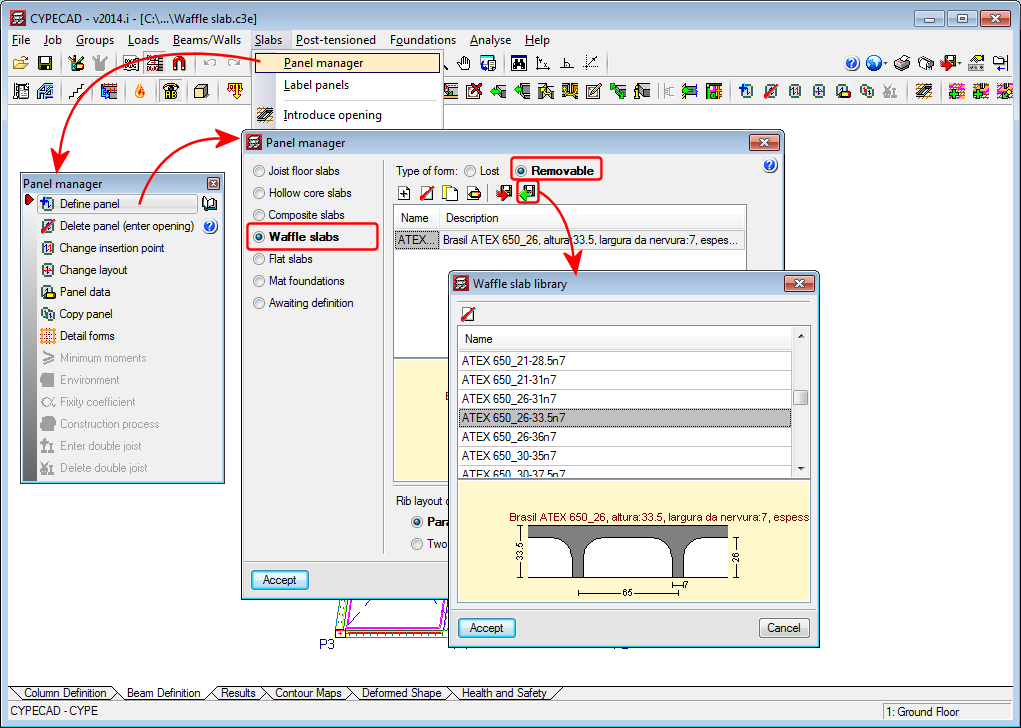
New types of waffle slabs with removable forms, belonging to the Brazilian manufacturer ATEX, have been implemented. All floor slabs belonging to that manufacturer have also been updated. The 2014.i version has a total of 110 ATEX floor slabs available.

The previously mentioned implementation and update is available when one of the following Brazilian design codes has been selected:

  • ABNT NBR 6118 Projeto Junho 2013
  • ABNT NBR 6118:2007
  • ABNT NBR 6118:2003

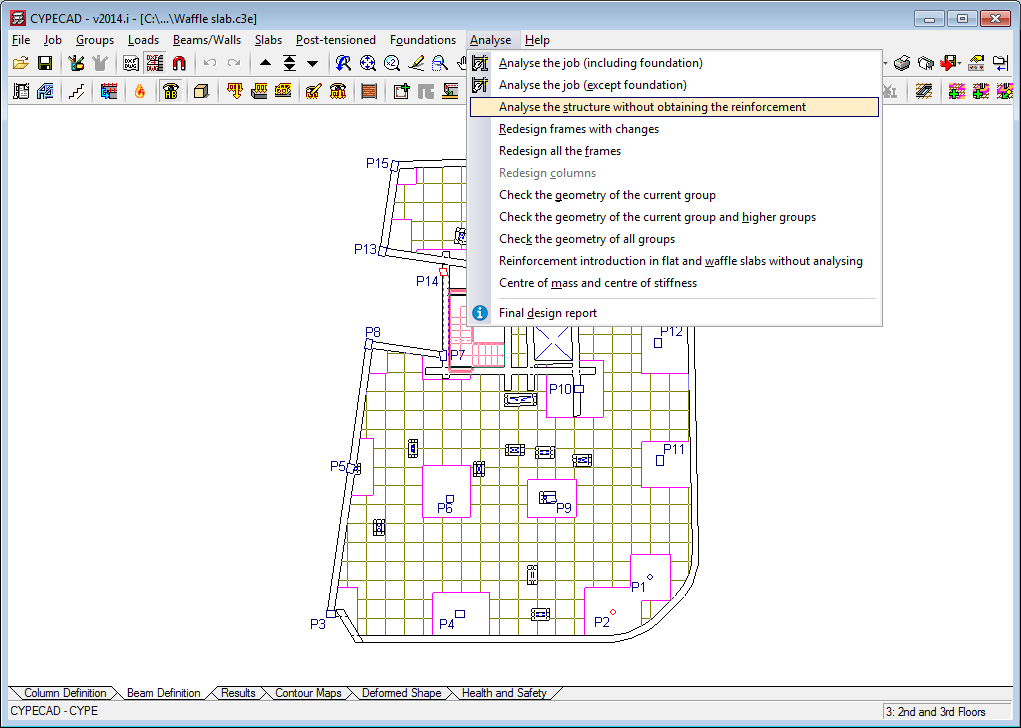
The 2014.i version includes a new analysis option: Analyse the structure without obtaining the reinforcement (Beam Definition tab > Analyse).

Using this option, users can obtain the forces and displacements of the structure without the need to design its elements. By not designing the elements, the time required to analyse the structure is reduced.

This can save users a substantial amount of time when structures requiring a long analysis period are being designed, since usually, the first analyses are used to check that the dimensions of the structural elements that have been introduced are adequate, so to avoid excessive displacements.

Norma Técnica para Diseño por Sísmico (El Salvador)

Implemented in CYPECAD and Metal 3D.

The 2014.i version includes in CYPECAD:

  • static analysis method (equivalent lateral force)
    The analysis method selection (dynamic or static) is carried out using the Analysis method option within the dialogue box where the seismic load is defined.
  • Correction due to base shear
    This correction is applied to the seismic analysis using the dynamic analysis (spectral modal) method. To calculate the base shear with the ABNT NBR 15421:2006 code, CYPECAD offers two options for users to indicate the Fundamental period of the structure in two ways:
  • Based on the code
  • Specified by the user

More information on the correction due to base shear carried out by CYPECAD .
More information on how the fundamental period of the structure is determined .

  • AISI/NASPEC-2007 (LRFD) (USA)
    North American Specification for the Design of Cold-Formed Steel Structural Members.
  • AISI/NASPEC-2007 (LRFD) (México)
    North American Specification for the Design of Cold-Formed Steel Structural Members. S136-07 Endorsed in Mexico by CANACERO.
  • CAN/CSA S136-07 (Canadá)
    North American Specification for the Design of Cold-Formed Steel Structural Members. Approved in Canada by the Canadian Standards Association CSA.

These design standards were already implemented in CYPECAD and Metal 3D. As of the 2014.i version, the program implements the design of L and Z-shaped cold-formed sections.

Projeto de estruturas resistentes a sismos - Procedimento.

This code was already implemented as of previous versions for CYPECAD and Metal 3D for the dynamic analysis method (modal spectral).
The 2014.h version includes in CYPECAD:

  • static analysis method (equivalent lateral force)
    The analysis method selection (dynamic or static) is carried out using the Analysis method option within the dialogue box where the seismic load is defined.
  • Correction due to base shear
    This correction is applied to the seismic analysis using the dynamic analysis (spectral modal) method. To calculate the base shear with the ABNT NBR 15421:2006 code, CYPECAD offers two options for users to indicate the Fundamental period of the structure in two ways:
    • Based on the code
    • Specified by the user

More information on the correction due to base shear carried out by CYPECAD.

More information on how the fundamental period of the structure is determined.

When CYPECAD carries out a dynamic analysis (modal spectral) to calculate the seismic action, users have the option to not consider any floors below ground level in the dynamic model. To do so, the option “Consider the floors below ground level in the dynamic model” has to be deactivated.

On the other hand, when designing in accordance to some seismic standards, the minimum base shear condition must be met when a dynamic analysis (modal spectral) is applied. This minimum value is equal to a percentage of the shear at the base of the structure (base shear), which is calculated using a static method. 

As of the 2014.g version, the calculation of the base shear takes into account the deactivating of the “Consider the floors below ground level in the dynamic model” option. In other words, if users deactivate this option, the program only takes into account the floors above ground level when calculating the base shear using the static method.

CYPE Mentor