Update history​​

CYPECAD

Construction in seismic regions.

This code was already implemented in CYPECAD and Metal 3D in the 2014.b version. Now, with the 2014.f version, the ductility reinforcement criteria and capacity design criteria for bending are taken into account when this code is used together with the Russian concrete code SP 63.13330.2012 (implemented in this version).

Normas Técnicas Complementarias para diseño por sismo.

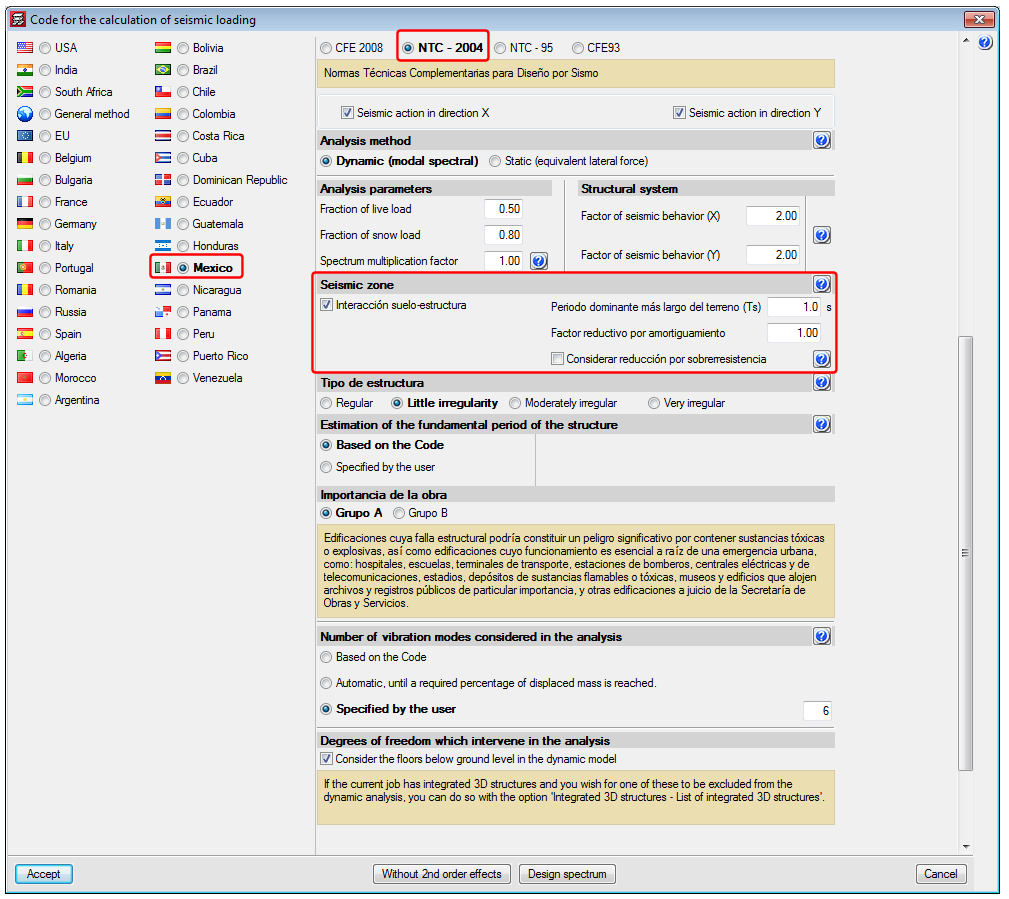
This code was already implemented in CYPECAD and Metal 3D as of previous versions. Now, with the 2014.f version the option offered by appendix A of the code has been implemented, whereby for the seismic design of structures located in zones II and III, the effects of the site and ground-structure interaction can be taken into account explicitly.

To apply this possibility, an option “Interacción suelo-estructura” has been implemented in the “Seismic zone” section of the "Code for the calculation of seismic loading” dialogue box (Job > General data > Select “With seismic loading” in the Loads section > Select Mexico and the NTC 2004). This option allows users to define the values of the “Periodo dominante más largo del terreno (Ts)” and the “Factor reductivo por amortiguamiento”, and consider an overresistance factor, if necessary.


New Zealand Standard™ Cold-formed steel structures.

Implemented in CYPECAD and Metal 3D.

Australian StandardTM Cold-formed steel structures.

Implemented in CYPECAD and Metal 3D.

Concrete and reinforced concrete. Construction. Updated edition SNIP 52-01-2003. Moscow 2012.

Implemented in CYPECADMetal 3D and Continuous beams.

For this code, CYPECAD, Metal 3D and Continuous beams allow for:

  • Additional loadcases to be added for special frost loads.
  • A percentage of the load to be defined as long-term loading, for live load and snow loadcases.
  • The advanced beam editor (CYPECAD) to be used 
  • The advanced column editor (CYPECAD) to be used 

If the Russian concrete code is used together with its corresponding seismic code (СНиП II-7-81 – implemented in the 2014.b version), the ductility reinforcement criteria and capacity design criteria for bending of concrete columns are taken into account.

A new library of cold-formed sections, Profil du Futur of ARVAL (ArcelorMittal), has been included in CYPECAD and Metal 3D.

This library includes the following cold-formed section series:

  • Profilé U (simple cold-formed U)
  • Profilé CE (stiffened cold-formed U)
  • Cornière L (symmetrical cold-formed angle)
  • Oméga (Omega inclined along external edge)
  • SIGMA (Channel with stiffened web)

The generation process of the “Detailing of columns” plan has been optimised internally, substantially reducing the time required to create it.

The tool, Strut3D, was implemented in the 2013.e version, which allows users to check (in CYPECAD and Metal 3D – for the pile caps module -, and in Foundation elements) pile caps using a general analysis method that analyses the D regions of reinforced concrete using a strut and tie method This tool was only available for use with the EHE 08 concrete code (Spain). In the 2014.b version, the ACI 318M-08 (USA), Nch430.Of2008 (Chile), NTE E.060: 2009 (Peru) and NSR-10 (Columbia) concrete codes were implemented in Strut3D. In the 2014.d version the ABNT NBR 6118 2007 (Brazil), ABNT NBR 6118 Projeto Junho 2013 (Brazil) and Eurocode 2 (EU, France and Portugal) were added.

Now, with the 2014.e version, the following concrete codes have been implemented in Strut3D:

  • CIRSOC 201-2005 (Argentina)
    Reglamento Argentino de Estructuras de Hormigón CIRSOC 201 (Julio 2005).
  • IS 456: 2000 (India)
    Indian Standard. Plain and reinforced concrete code of practice (Fourth Revision).
  • NTC: 14-01-2008 (Italy)
    Norme tecniche per le construzioni.

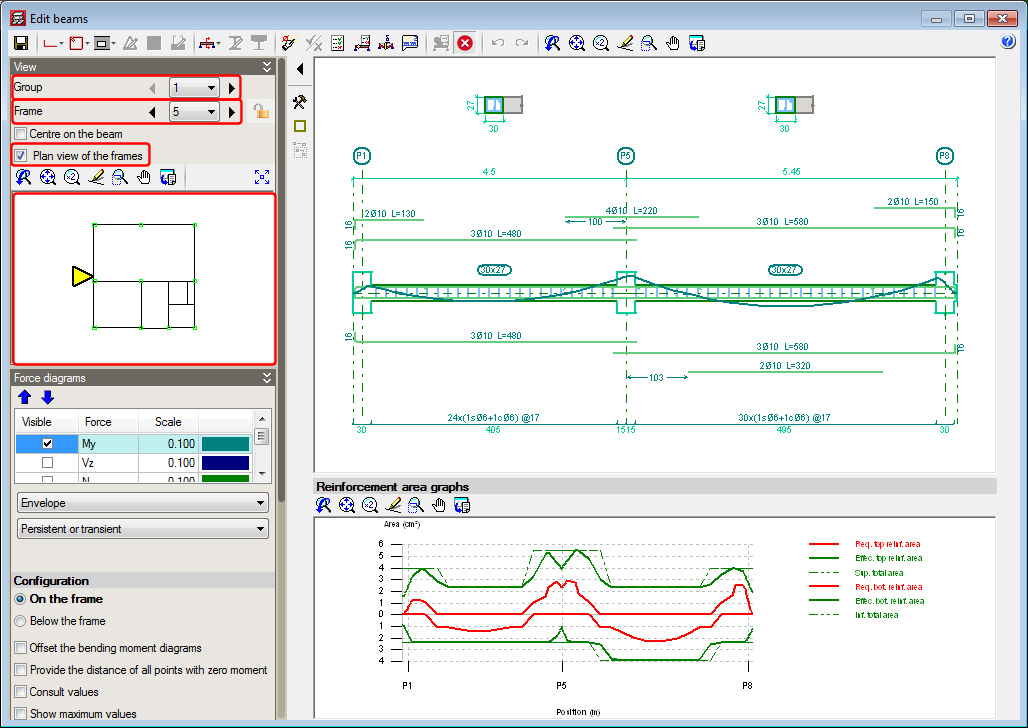
A plan view of the current floor is displayed in the “View” section on the left side menu of the advanced beam editor. Users can use the view to select a different frame to edit by clicking on the frame with the left mouse button.

Please recall it has been possible, since previous versions, to change groups and frames by selecting them in the drop-down menus next to the “Group” and “Frame” texts that appear in the same “View” section.

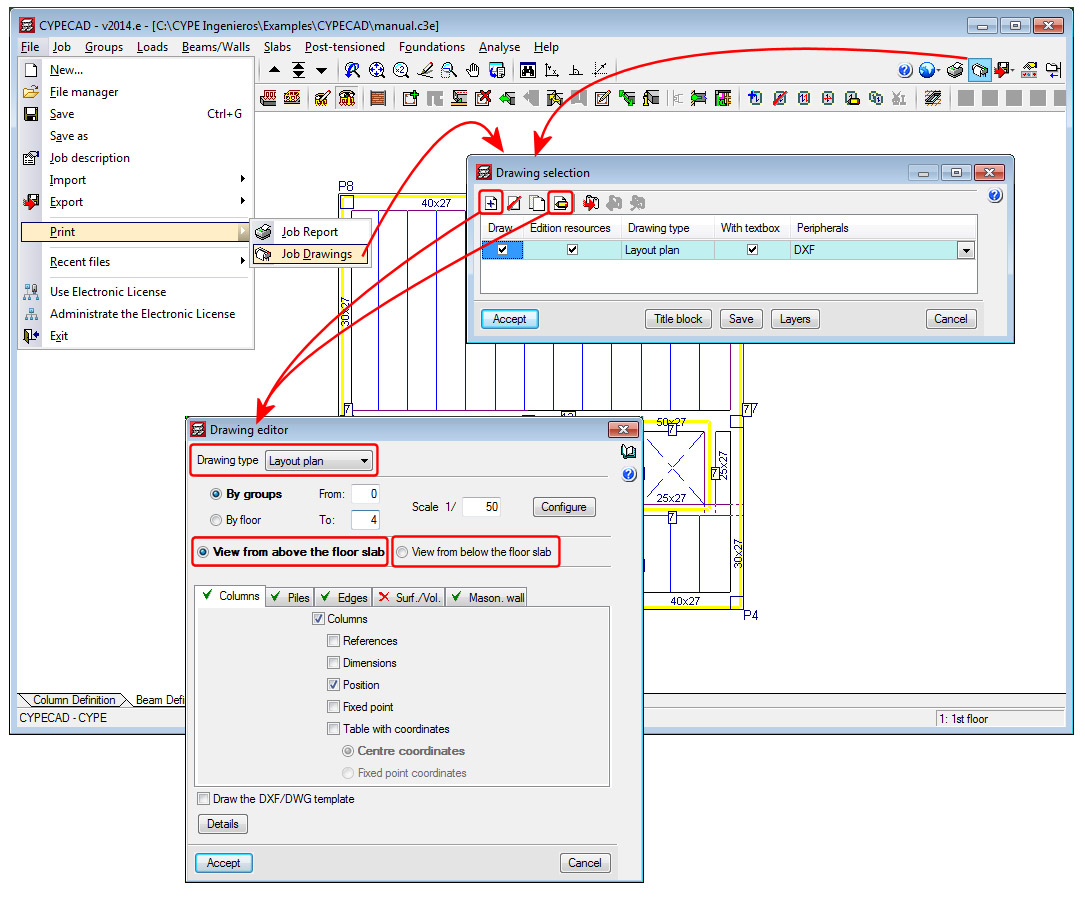
Two new options have been included to represent the layout plan seen from above or below the floor slab.

CYPECAD reduces the inertia of the concrete elements in seismic analyses and only for seismic loadcases, when the codes indicated below are applied. The codes that are implemented in the program which include seismic analyses using cracked inertias are:

  • CIRSOC 103-2005 (Argentina)
    Normas Argentinas para Construcción Sismorresistente. Parte II: Construcciones de Hormigón Armado.
  • CSCR 2010 (Costa Rica)
    Código Sismo de Costa Rica 2010.
  • NEC-11 (Ecuador)
    Norma ecuatoriana de la construcción. Capítulo 2.- Peligro sísmico y requisitos de diseño.
  • R-001 2011 (Dominican Republic)
    Reglamento para el Análisis y Diseño Sísmico de Estructuras

Norma Chilena Oficial. Diseño Sísmico de Edificios.

This code was already implemented as of previous versions in CYPECAD and Metal 3D for the dynamic analysis method (modal spectral) – including the modifications of Decree nº61 (V. and U.) of 2011.

The 2014.e version of CYPECAD also includes a static analysis method (equivalent lateral force) for this code. Users can select the analysis method (dynamic or static) using the Analysis method option within the dialogue box in which seismic action is defined.

CYPECAD has carried out the correction due to base shear using the dynamic analysis method (spectral modal) since the 2013.a version.