

Update history​​

CYPECAD

CYPECAD, as of previous versions, takes into account the capacity design criteria of concrete beams and columns, for specific codes when undertaking the seismic analysis of the structure .

The geometric and mechanical properties of the columns and beams are automatically contemplated with the capacity checks (as of previous versions) as are, optionally, the properties of the floor slabs bearing on beams reaching a column (as of the 2014.d version).

To define the geometric and mechanical properties of the floor slabs, with regards to the capacity checks for concrete beams and columns, a new option has been implemented in the program: Assign data for the capacity check (Beam Definition tab > Beams/Walls).

The aforementioned option will only be visible if a seismic analysis is carried out with a design code which has the capacity check implemented for CYPECAD .

When this option is activated, a dialogue box appears where users can define the following data:

  • Effective width (1)
  • Effective width (2)
  • Effective depth (3)
  • Mechanical steel area of the top reinforcement
  • Mechanical steel area of the bottom reinforcement

Users can assign them freely to any side or end of beams reaching columns. This way, slabs which have different geometric or mechanical properties at either side of the beam, or beams which only have the floor slab on one side can be contemplated.

To identify each of the sides and ends of the beam to which the data has been assigned for the capacity checks, the program displays small magenta triangles at these zones, which are displayed when the option Assign data for capacity check is selected. The triangles will be displayed in green at zones where the properties of the slab have not been assigned, in which case, the dimensions and steel areas of the slab will not intervene in the capacity checks for the concrete beams and columns.

When either of these codes is used in CYPECAD (NSR-10 (Columbia) and NC 46:1999 (Cuba)), there are two options to indicate the value of the Fundamental period of the structure (used to calculate the base shear):

  • Based on the code (only possibility in previous versions)
  • Specified by the user (implemented in the 2014.d version)

Both options can be selected in the Estimation of the fundamental period of the structure section in the Code for the calculation of seismic loading dialogue box (Job ˃ General data ˃ select “With seismic loading” in the “Loads” section ˃ select Columbia or Cuba as the country and the NSR-10 or NC 46:1999 codes respectively).

The value of the fundamental period of a building must be obtained based on the properties of its seismic resistant system, in the direction under consideration, in accordance with structural dynamics principles. Alternatively, most seismic codes have other procedures to estimate the fundamental period:

  • In accordance with empirical formulas provided in their articles
  • In accordance with other methods, as long as they are adequately sustained analytically or experimentally

The estimated fundamental period is applied in the static shear analysis at the base of the structure (base shear) to adjust the dynamic results to the minimum values prescribed in the codes, when the dynamic method is applied, and to generate the equivalent static lateral forces when the static method is applied.

The values indicated by the codes are limits that can be applied in the absence of more precise data. If users have fundamental period values, which are more adjusted to their structure (calculated using other methods or with software tools such as CYPECAD, which calculate the fundamental period of the structure in both directions – the values can be consulted after the analysis in the “Justification of seismic action” report: File ˃ Print > Job report) they can specify them using the option Specified by the user located in the Code for the calculation of seismic loading dialogue box.

The 2014.d version of CYPECAD includes the reinforcement ductility criteria and the capacity design criteria when they are combined in the same analysis with the Eurocode 2 concrete codes: Eurocode 2 (EU), Eurocode 2 (France), Eurocode 2 (Portugal) with their corresponding seismic codes.

More information on the combined use of these concrete and seismic design codes can be found in the Eurocode 2 (EU, France and Portugal) section on this webpage.

The 2014.d version of CYPECAD allows users to use the advanced beam editor with the Eurocode 2 concrete codes (Eurocode 2 (EU), Eurocode 2 (France – which includes the National Application Document for France), Eurocode 2 (Portugal – which includes the National Application Document for Portugal)) combined with their corresponding seismic codes.

The ductility reinforcement criteria and capacity design criteria are also included and are indicated in the seismic codes that are compatible with Eurocode 2 (EU), Eurocode 2 (France) and Eurocode 2 (Portugal) as is indicated in section: “Eurocode 2 (EU, France and Portugal)” on this webpage, where more information can be found on the combined used of these concrete and seismic codes.

Reglamento Colombiano de Construcción Sismo Resistente (2010).

This code was already implemented in CYPECAD and Metal 3D as of previous versions. Now, for the 2014.d version, CYPECAD has two options to indicate the value of the Fundamental period of the structure (used to calculate the base shear):

  • Based on the code (only possibility in previous versions)
  • Specified by the user (implemented in the 2014.d version)

More information on how to establish the Fundamental period of the structure.

Minimum Design Loads for Buildings and Other Structures.

Implemented in CYPECAD and Metal 3D.

Users can choose to CYPECAD carry out the dynamic analysis (modal spectral) or static analysis (equivalent lateral force) proposed by the ASCE 7-10 design code. The analysis method (dynamic or static) is selected using the Analysis method option within the dialogue box where seismic action is defined.

When the dynamic analysis (modal spectral) method is used, CYPECAD takes into account the correction due to base shear.

Construcciones sismo resistentes. Requisitos básicos para el diseño y construcción.

This code was already implemented in CYPECAD and Metal 3D as of previous versions using the dynamic analysis (modal spectral) method.

For this design code, the 2014.d version of CYPECAD includes:

  • A static analysis method (equivalent lateral force)
    The analysis method (dynamic or static) is selected using the Analysis method option within the dialogue box where seismic action is defined.
  • The correction due to base shear
    This correction is applied to the seismic analysis using the dynamic analysis (modal spectral) method. To calculate the base shear using the NC 46:1999 code, CYPECAD has two options to indicate the value of the Fundamental period of the structure:
  • In accordance with the code
  • Specified by the user

More information on the correction due to base shear carried out by CYPECAD.

More information on how to establish the Fundamental period of the structure.

When an analysis is carried out in CYPECAD using any of the indicated seismic design codes, combined with Eurocode 2 (EU), Eurocode 2 (France) and Eurocode 2 (Portugal), the program takes into account the reinforcement ductility criteria and the capacity design criteria for seismic design of the selected seismic code. These criteria are justified in the Ultimate Limit State reports generated by the advanced column and beam editors of CYPECAD.

More information on the combined use of these concrete and seismic codes can be found in the “Eurocode 2 (EU, France and Portugal)” section on this webpage.

  • Eurocode 2 (EU)
    Design of concrete structures. EN 1992-1-1:2004/AC 2008
  • Eurocode 2 (France)
    Calcul des structures en béton. NF EN 1992-1-1:2005/NA: Mars 2007
  • Eurocode 2 (Portugal)
    Projecto de estruturasdebetão. NP EN 1992-1-1:2010/NA

These codes were already implemented as of previous versions. They were also included, in previous versions, in the group of codes which use CYPECAD’s advanced beam editor (which implies that as well as the advantages obtained from using this editor, detailed Ultimate Limit State reports and reinforcement tables can be automatically generated).

Now, as of the 2014.d version, when the selected concrete code is Eurocode 2 (EU), Eurocode 2 (France) or Eurocode 2 (Portugal), beams are edited using CYPECAD’s advanced beam editor. This implies important improvements in the application of these codes:

  • Detailed U.L.S. and S.L.S. check reports for concrete beams (including check for failure due to torsion)
  • U.L.S. and S.L.S. reports for steel beams
  • Graphs and numerical values of the required and effective reinforcement areas
  • Bar bending diagrams and reinforcement detailing configurations for frame drawings
  • Design of dropped beams with a variable section
  • And generally provides a graphical interface to edit the resistance elements of the frame (reinforcement, steel sections, lattices etc.) that is quick and easy to use.

More information can be found in the “Advanced beam editor” section on the webpage dedicated to concrete beams in CYPECAD .

If an analysis with seismic loads is carried out, each one of the Eurocodes; Eurocode 2 (EU), Eurocode 2 (France) and Eurocode 2 (Portugal), has a corresponding set of seismic codes with which it is compatible, and allow for CYPECAD’s advanced column and beam editors to be used, taking into account their capacity design criteria to design concrete beams and columns:

  • Eurocode 2 (EU)
    • Eurocode 8 (EU)
      EN 1998-1. Eurocode 8: Design of structures for earthquake resistance. Part 1: General rules, seismic actions and rules for buildings.
    • Eurocode 8 (France)
      NF EN 1998-1/NA (2007) Eurocode 8: Calcul des structures pour leur résistance aux séismes.Partie 1 : Règles générales, actions sismiques et règles pour les bâtiments Annexe nationale à la NF EN 1998-1:2005.1
    • Eurocode 8 (Portugal)
      NP EN 1998-1 (2010). Eurocódigo 8 - Projecto de estruturas para resistência aos sismos. Parte 1: Regras gerais, acções sísmicas e regras para edifícios.
    • Eurocode 8 (Belgium)
      NBN-ENV 1998-1-1: 2002 NAD-E/N/F Eurocode 8: Conception et dimensionnement des structures pour la résistance au séisme. Partie 1-1: Règles générales. Actions sismiques et exigencies générales pour les structures
    • PS 92 (France)
      Règles de Construction Parasismique - Règles PS applicables aux bâtiments – PS 92.
    • PS 92 (version révisée 2010) (France)
      Règles de Construction Parasismique - Règles PS applicables aux bâtiments – PS 92 (version révisée 2010).
    • RPA 99/v 2003 (Algeria)
      Règles Parasismiques Algériennes RPA 99 / VERSION 2003.
    • RPS 2000 (Morocco)
      Règlement de Construction Parasismique.
    • RPS 2011 (Morocco)
      Règlement de Construction Parasismique (version révisée 2011).
    • 1997 UBC (USA)
      Uniform Building Code.
    • 2009 IBC (USA)
      International Building Code.
  • Eurocode 2 (France)
    • Eurocódigo 8 (Francia)
      NF EN 1998-1/NA (2007) Eurocode 8 : Calcul des structures pour leur résistance aux séismes. Partie 1 : Règles générales, actions sismiques et règles pour les bâtiments Annexe nationale à la NF EN 1998-1:2005.1
    • PS 92 (France)
      Règles de Construction Parasismique - Règles PS applicables aux bâtiments – PS 92.
    • PS 92 (version révisée 2010) (France)
      Règles de Construction Parasismique - Règles PS applicables aux bâtiments – PS 92 (version révisée 2010).
    • RPA 99/v 2003 (Algeria)
      Règles Parasismiques Algériennes RPA 99 / VERSION 2003.
    • RPS 2000 (Morocco)
      Règlement de Construction Parasismique.
    • RPS 2011 (Morocco)
      Règlement de Construction Parasismique (version révisée 2011).
    • 1997 UBC (USA)
      Uniform Building Code.
    • 2009 IBC (USA)
      International Building Code.
  • Eurocódigo 2 (Portugal) 
    • Eurocode 8 (Portugal)
      NP EN 1998-1 (2010). Eurocode 8 - Projecto de estruturas para resistência aos sismos
      Parte 1: Regras gerais, acções sísmicas e regras para edifícios.
    • 1997 UBC (USA)
      Uniform Building Code.
    • 2009 IBC (USA)
      International Building Code.

The concrete and seismic codes that are available for the capacity design criteria for concrete columns and beams can be found in the “Capacity design criteria for seismic design of concrete columns and beams” section on the CYPECAD webpage.

More information can also be found in the “Design codes available for use with the Advanced beam editor” section on the Concrete beams webpage.

Projeto de estruturas de concreto - Procedimento.

This document is a project revision of the ABNT NBR 6118 2007 code, which is currently not in force, however it is foreseen that it will substitute the current standard.

It has been implemented in CYPECAD (including Strut3D) and Metal 3D.

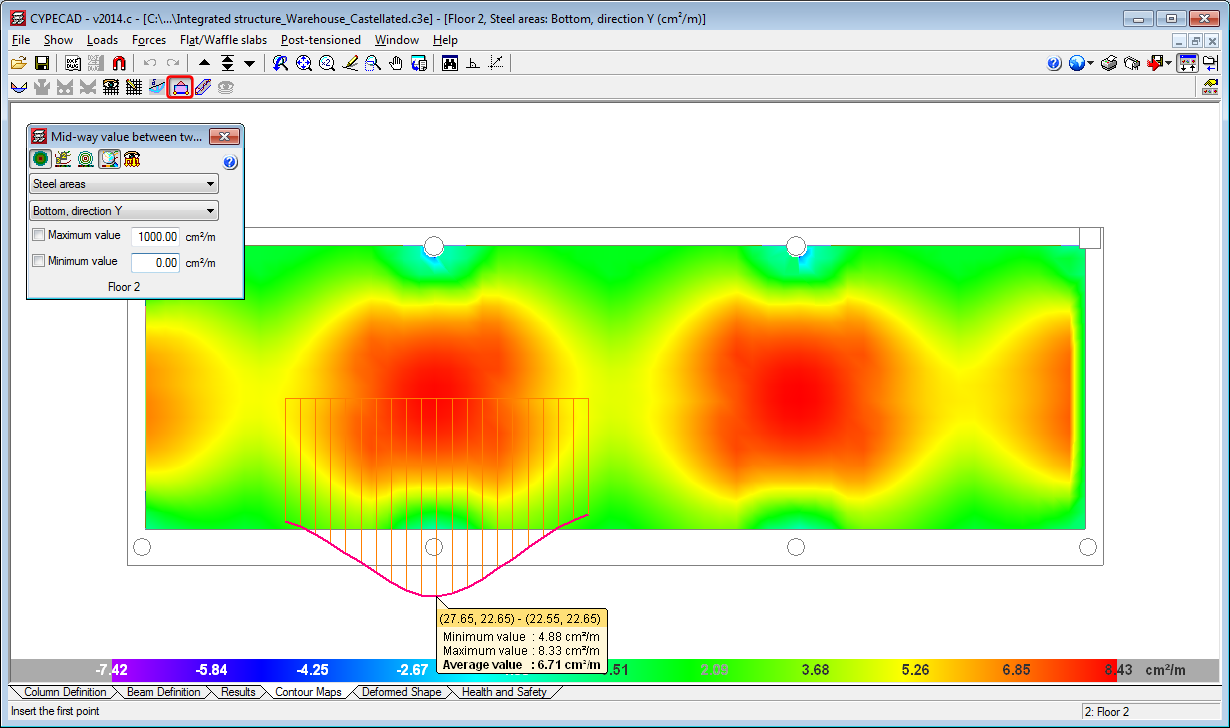
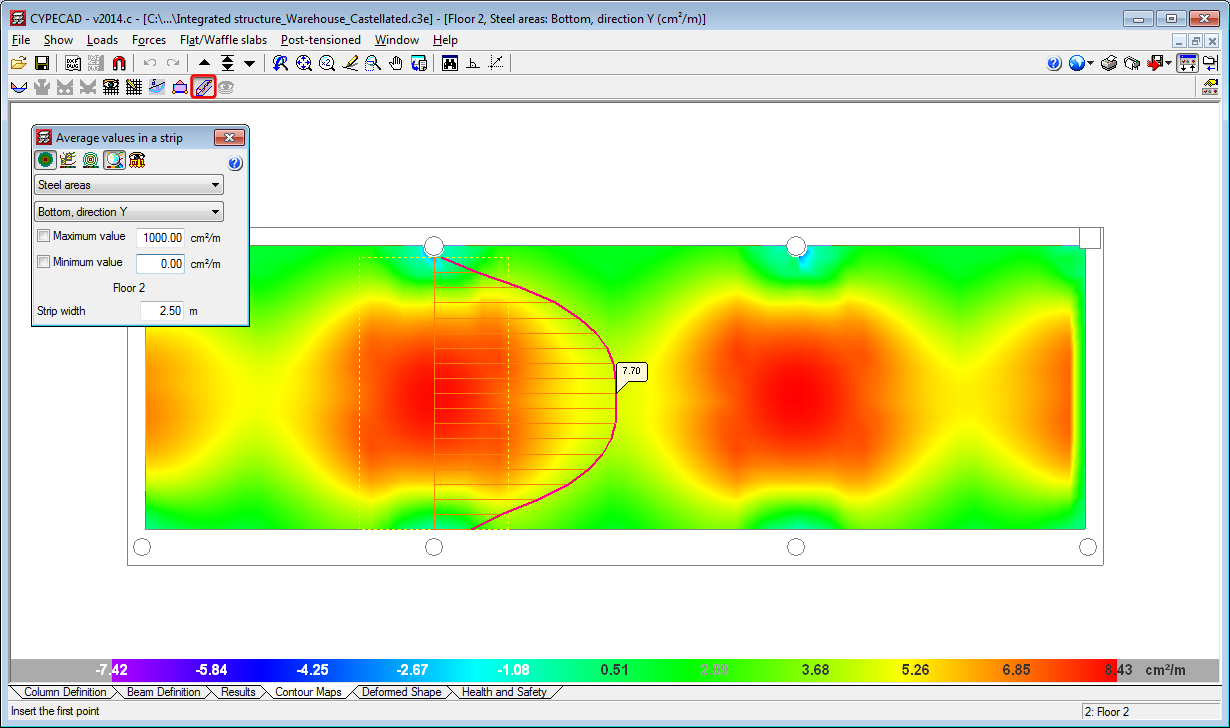
Two new options have been implemented in the Contour Maps tab so the average values of the forces, design forces or steel areas of flat slabs and waffle slabs can be consulted. The mid-way value between two points or average values of a strip can be viewed in either reinforcement direction of the slab.

The edition of beam assembly reinforcement tables has been improved (Job ˃ General data ˃ By position button ˃ Beam options ˃ Beam reinforcement tables ˃ select any of the three assembly reinforcement tables). Now, the creation of new table entries, the creation of new stirrup arrangements, the visualisation and modification of the width and depth intervals for which each reinforcement arrangement is available in the table, are carried out in the same dialogue box without successive windows appearing.

Please recall that the edition of the reinforcement tables that has been indicated is only available for codes which can use the Advanced beam editor.