Update history​​

CYPECAD

The design of the anchorage of longitudinal reinforcement has been improved for jobs that can use CYPECAD’s new beam editor (depends on the selected design code).

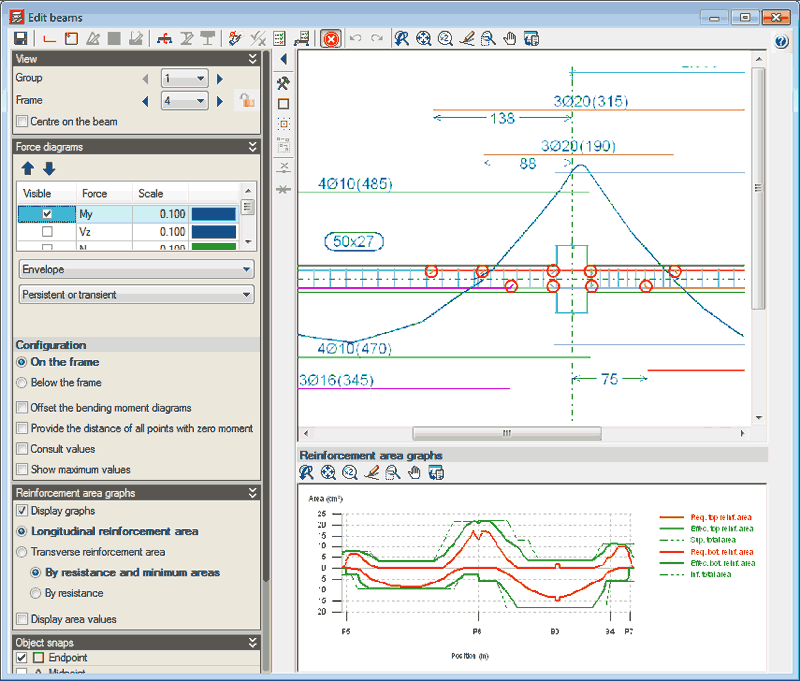
A new button, Edit the frame’s reinforcement, has been added in the Beam errors dialogue box (Results tab > Beams/Walls > Select beam), for jobs that can use CYPECAD’s new beam editor, which allows users to access the beam editor directly and view the frame, displayed centred on the span selected previously by the user (in the Beam errors dialogue box).

This way, users can quickly view the information offered by the beam editor without having to select the span displaying error warnings, using another option of the program.
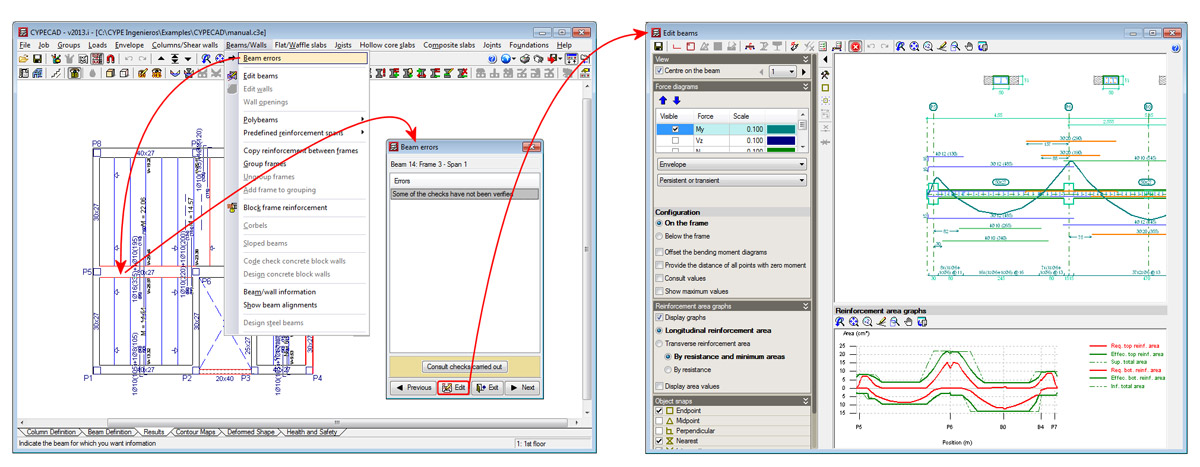
CYPECAD designs the longitudinal reinforcement of beams without limiting the number of reinforcement layers contained in the various horizontal planes, for the jobs that can use CYPECAD’s new beam editor (depends on the selected design code).

CYPECAD’s new beam editor (Results tab > Beams/Walls > Edit beams) was implemented in the 2013.e version, and since then more concrete design codes have been added to those available. Now, for the 2013.i version update patch, the ACI 318M-08 (USA) code has been implemented.

The concrete codes available for CYPECAD’s beam editor are:

  • ABNT NBR 6118:2007 (Brasil)
  • EHE-08 (España)
  • IS 456: 2000 (India)
  • ACI 318M-08 (USA)

More concrete codes will implemented in upcoming update patches of the 2013 version.

The 2013.e, 2013.g and 2013.h versions of CYPECAD implemented the capacity design criteria for bending and shear for the seismic design of concrete supports, and capacity design criteria for shear for the seismic design of concrete beams in accordance with the following codes: EHE-08 (Spain), NCSE-02 (Spain) and IS 13920:1993 (India).

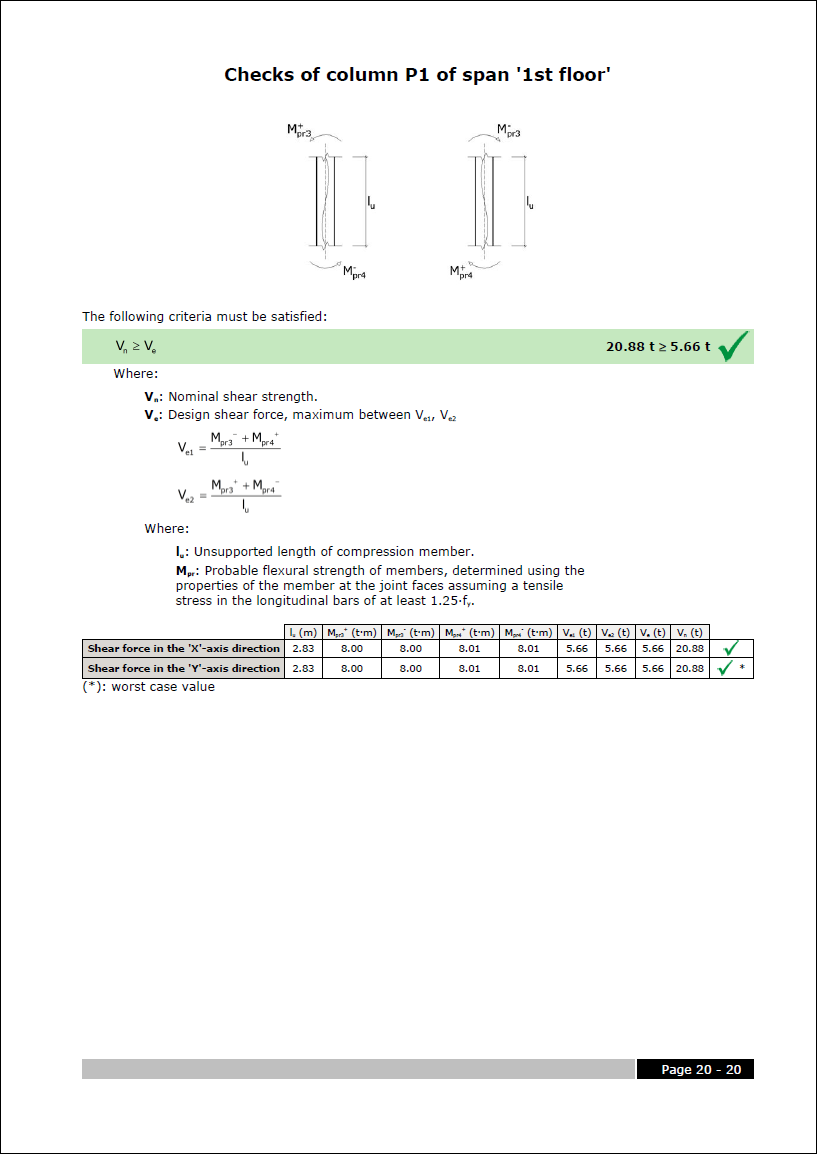
Now, implemented for the 2013.i version, is the capacity design criteria for bending and shear for the seismic design of concrete supports, and capacity design criteria for shear for the seismic design of concrete beams in accordance with the ACI 318M-08 code.

The capacity design criteria which are currently implemented are:

  • For concrete supports:
  • Capacity design criteria for bending and shear in accordance with Annex 10 of the EHE-08 code (Spain).
  • Capacity design criteria for bending in accordance with NCSE-02 code (Spain)
  • Capacity design criteria for shear in accordance with IS 13920: 1993 (India)
  • Capacity design criteria for bending and shear in accordance with ACI 318M-08 (USA)
  • For concrete beams:
  • Capacity design criteria for shear in accordance with Annex 10 of the EHE-08 code (Spain).
  • Capacity design criteria for shear in accordance with NCSE-02 (Spain).
  • Capacity design criteria for shear in accordance with IS 13920: 1993 (India).
  • Capacity design criteria for shear in accordance with ACI 318M-08 (USA).

These design criteria are applied in CYPECAD and are specified in the Detailed Ultimate Limit State check reports if the selected codes are those which have been indicated.

Improvements have been implemented in the following seismic codes:

  • ASCE 7-05 (USA)
    Minimum Design Loads for Buildings and Other Structures.
  • 2009 IBC (USA)
    International Building Code.
  • CFE93 (México)
    Manual de Diseño de Obras Civiles. Diseño por Sismo.
  • CFE 2008 (México)
    Manual de Diseño de Obras Civiles. Diseño por Sismo. Comisión Federal de Electricidad. México 2008.
  • CPE INEN 5:2001 (Ecuador)
    Código Ecuatoriano de la Construcción. Requisitos Generales de Diseño: Peligro Sísmico, Espectros de Diseño y Requisitos Mínimos de Cálculos para Diseño Sismo-Resistente.
  • NSE-10 (Guatemala)
    Normas de Seguridad Estructural de Edificaciones y Obras de Infraestructura para la República de Guatemala, edición 2010.
  • CHOC-04 (Honduras)
    Código Hondureño de la Construcción. Normas Técnicas Complementarias. XII. Cargas y Fuerzas Estructurales. Diseño por Sismo.
  • REP-04 (Panamá)
    Reglamento para el Diseño Estructural en la República de Panamá 2004 (REP-04).
  • R-001 2011 (República Dominicana)
    Reglamento para el Análisis y Diseño Sísmico de Estructuras.
  • COVENIN 1756-1:2001 (Venezuela)
    Norma Venezolana COVENIN 1756-1:2001. Edificaciones sismorresistentes.

This code was already implemented in CYPECAD and Metal 3D as of previous versions. They are used in CYPECAD together with the ACI 318M-08 (USA - International) concrete code.

As of the 2013.i version, users can use CYPECAD's new beam editor when analysing with the ACI 318M-08 (USA - International) concrete code combined with the mentioned seismic codes. 

Furthermore, if the ACI 318M-08 code is combined with the REP-04 (Panama) seismic code, also mentioned in the previous list, users can use CYPECAD's advanced column editor, as was done for other seismic codes of the 2013.g version.

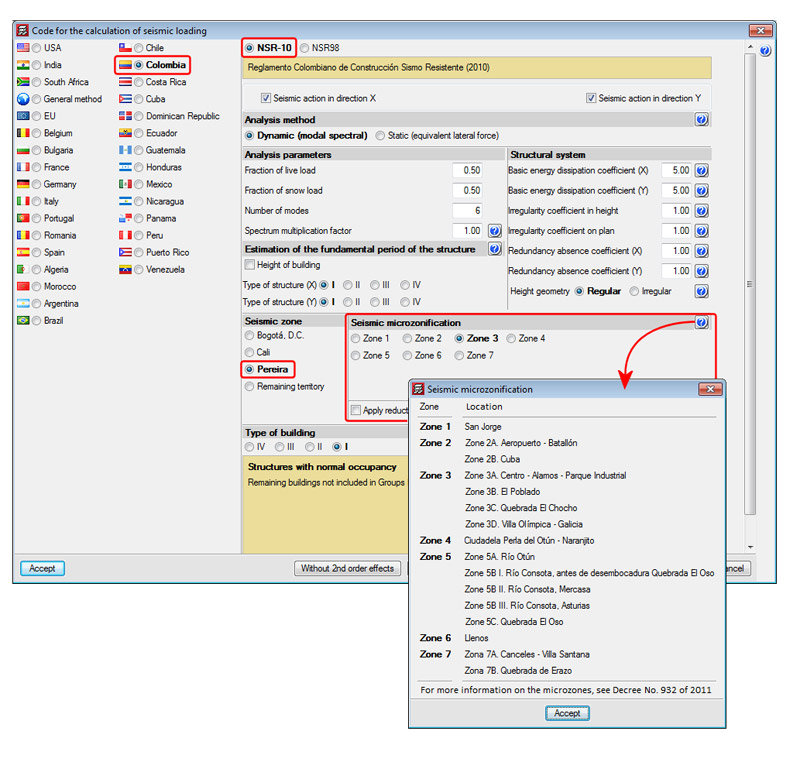
Reglamento Colombiano de Construcción Sismo Resistente (2010).

This code was implemented in the 2011.c version for CYPECAD and Metal 3D. The specific calculation for the Seismic Microzonification of Bogotá D.C. was implemented in the 2011.k version, followed by the implementation of the Seismic Microzonification of Cali in the 2012.k version. Now, for the 2013.i version, the specific calculation for the Microzonification of Pereira has been implemented.

In the Code for the calculation of seismic loading dialogue box corresponding to the NSR-10 (Job > General data > activate With seismic action > select Colombia and NSR-10), users can select the seismic zones of Bogotá D.C., Cali or Pereira, or Remaining territory. When any of the specific zones are selected (Bogotá D.C., Cali or Pereira), any of their microzonifications can be selected. Upon selecting them, their corresponding seismic design spectrum definition will be defined. 

CHOC-04 (Honduras): Código Hondureño de la Construcción. Normas Técnicas Complementarias. XII. Cargas y Fuerzas Estructurales. Diseño por Sismo.

This code was already implemented in CYPECAD and Metal 3D as of previous versions for use with the dynamic analysis method (spectral modal).

For this code, the 2013.i version includes in CYPECAD:

  • A static analysis method (equivalent lateral force)
    Users can select the analysis method (dynamic or static) using the Analysis method option within the dialogue box in which seismic action is defined.
  • The correction due to base shear
    This correction is applies when the seismic design is carried out using the dynamic analysis method (spectral modal).

More information on the implementation of capacity design criteria for the seismic design of concrete columns and beams can be found in the Capacity design criteria for seismic design of concrete columns and beams with the ACI 318M-08 (USA) code section of the new features of CYPECAD on this webpage.

Building Code Requirements for Structural Concrete.

Implemented in CYPECAD's new beam editor. This code was already implemented in Continuous beams (as of the 2013.a version) and in other CYPE programs as of earlier versions. More information on this implementation can be found in the section on the ACI 318M-08 (USA) in the new beam editor.

The following improvements have been implemented in the beam detailing representation:

  • Marks at bar ends
    The program marks (using inclined lines) bars which are anchored without any bends. These marks are visible within the on-screen display of the longitudinal section of the frame and on reinforcement details drawings. These marks are only provided if the ends of the bars are drawn overlapping other bars, due to them being in the same horizontal plane.

    This way, users can distinguish where the bar begins and ends within the longitudinal section of the frame, even if one end overlaps another bar placed in the same horizontal plane (within the longitudinal section).
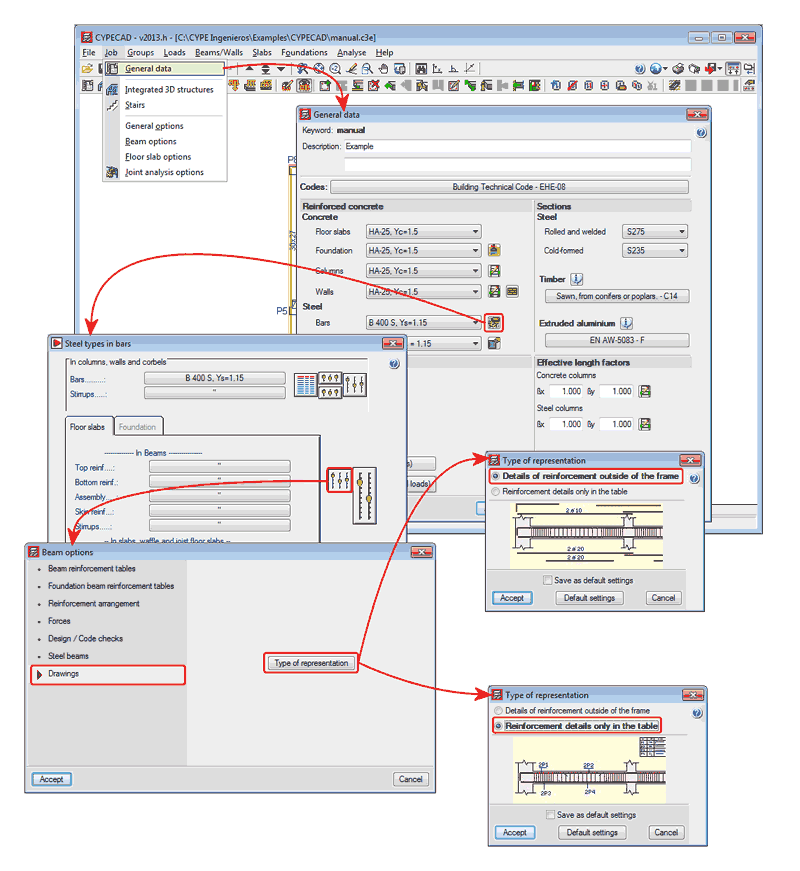
  • Representation of the reinforcement details in frame drawings
    Two options have been implemented, which are used to represent the reinforcement details in two ways within the frame drawings:
    • Details of reinforcement outside of the frame
      The reinforcement details are drawn outside the longitudinal section of each frame. This method has been used to represent the details as of previous versions.
    • Reinforcement details only in the table
      The reinforcement details are not drawn in the frame and are only defined in the Reinforcement details table.

The 2013.e and 2013.g versions of CYPECAD implemented the capacity design criteria for bending at the supports in accordance with Annex 10 of the EHE-08 code and in accordance with the NCSE-02 code, and the capacity design criteria for shear for the seismic design of beams in accordance with the same codes.

Now, for the 2013.h, the following codes have been implemented:

  • The capacity design criteria for shear at concrete supports in accordance with Annex 10 of the EHE-08 code (Spain).
  • The capacity design criteria for shear at concrete supports and beams in accordance with the IS 13920: 1993 (Indian).

The capacity design criteria which are currently implemented are:

  • For concrete supports:
  • Capacity design criteria for bending and shear in accordance with Annex 10 of the EHE-08 code (Spain).
  • Capacity design criteria for bending in accordance with NCSE-02 (Spain)
  • Capacity design criteria for shear in accordance with IS 13920: 1993 (India)
  • For concrete beams:
  • Capacity design criteria for shear in accordance with Annex 10 of the EHE-08 code (Spain).
  • Capacity design criteria for shear in accordance with NCSE-02 (Spain)
  • Capacity design criteria for shear in accordance with IS 13920: 1993 (India)

These design criteria are applied in CYPECAD and are specified in the Detailed Ultimate Limit State check reports if the selected codes are those which have been indicated.

CYPE Mentor