
Update history​​

CYPECAD

Eurocode 1 (National application document for Belgium) - prNBN EN 1991-1-4 ANB (2009).
Code implemented in CYPECAD.
Implemented in the Portal Frame Generator as of the 2010.a version.

DIN 18800:2008-11 (Alemania): Deutsches Institut für Normung. Stahlbauten.
Code implemented in CYPECAD and Metal 3D for the following sections:

Rolled and welded steel

  • I
  • C
  • L
  • Rectangular hollow section
  • Circular hollow section

Cold-formed steel

  • C and stiffened C
  • L and stiffened L
  • Rectangular hollow section
  • Circular hollow section

The following elements have been implemented when exporting to Tekla structures:

  • Concrete beams and columns of CYPECAD, and concrete bars of Metal 3D and integrated 3D structures of CYPECAD. The elements that are exported have rectangular, circular, T or L sections.
  • Special extruded aluminium sections
  • Trims at hollow section ends processed by the new Joints V module.
    These elements are exported as macros type “Tube-Saddle+Hole” for versions 15.0 SR1 and 16.0 of Tekla Structures.

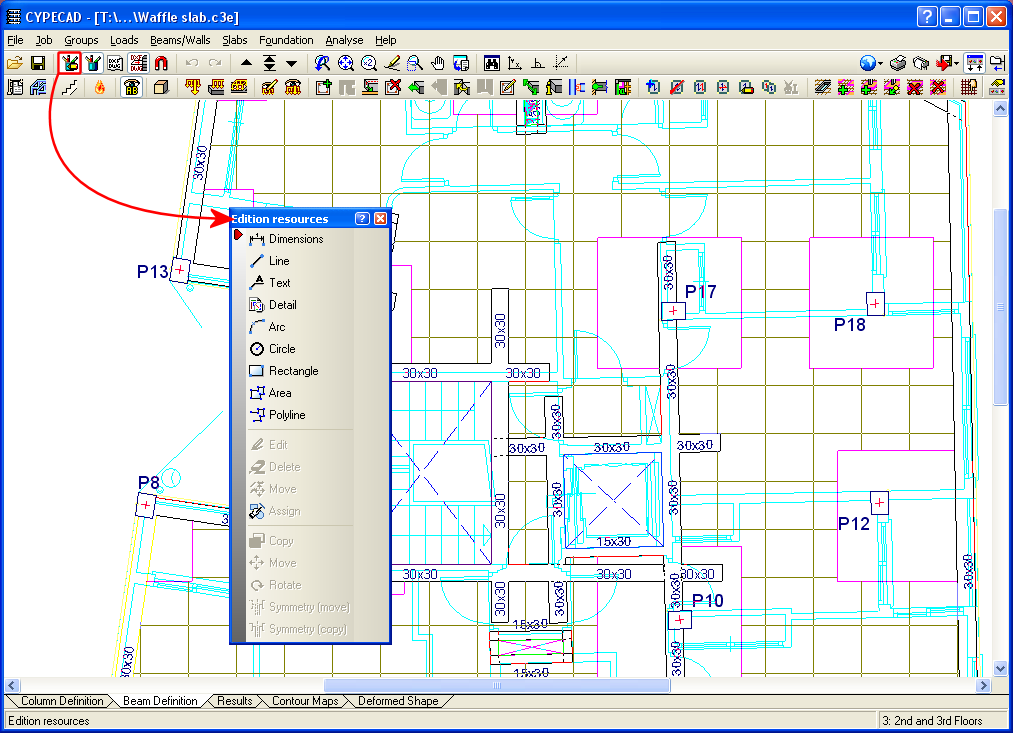
Two new options have been added to the Edition resources dialogue box:

  • Circle
    Draws a circle without dimensions by indicating the radius or diameter
  • Polyline
    Draws an open or closed polyline
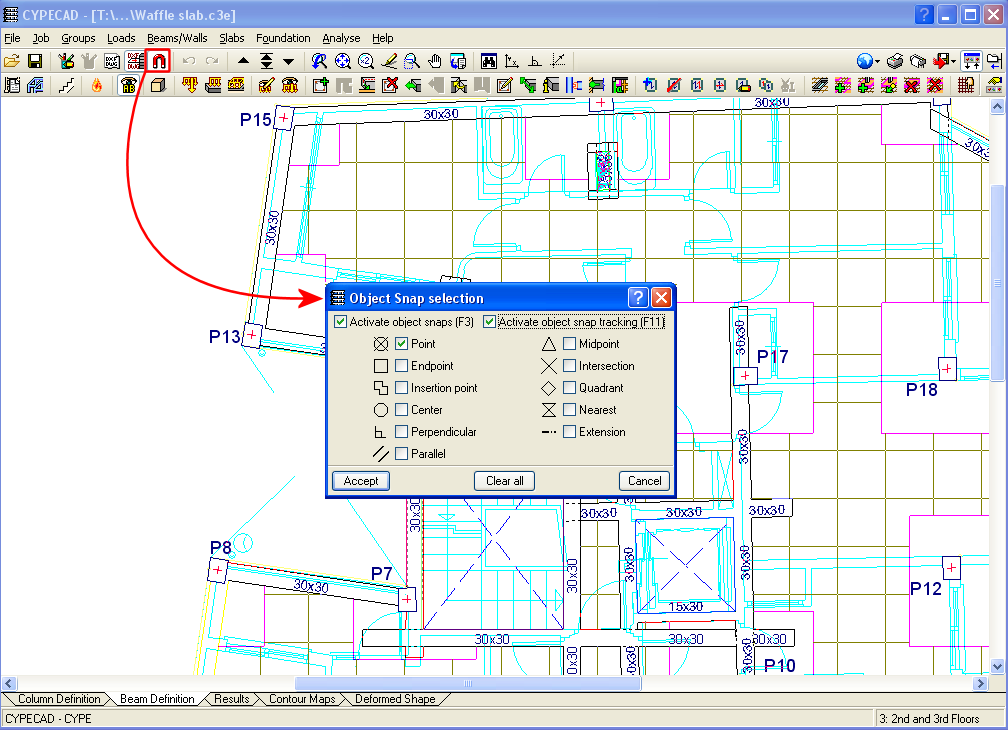
New object snap tracking options have been included in the Object snap selection box (perpendicularparallel and extension) to be used with DXF and DWG templates.
Horizontal or sloped planes defined in the Sloped floor slabs/El. Changes (Column Definition tab > Groups > Sloped floor slabs/ El. Changes) can now be assigned to the tops of walls. This way, the user can assign an elevation change or a slope to the top of a wall even if it does not support a floor slab.

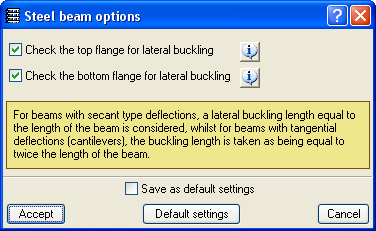
In previous versions, CYPECAD checked the bottom flange of steel beams not supporting floor slabs on that flange along their entire length, such as for example: beams below slabs, isolated beams, beams next to openings, or beams whose top flange projects above the floor slab.

Checking of both webs is activated in the Options for steel beams dialogue box which can be accessed from the Job menu in the Beam Definition tab > Beam options > Steel beam options.
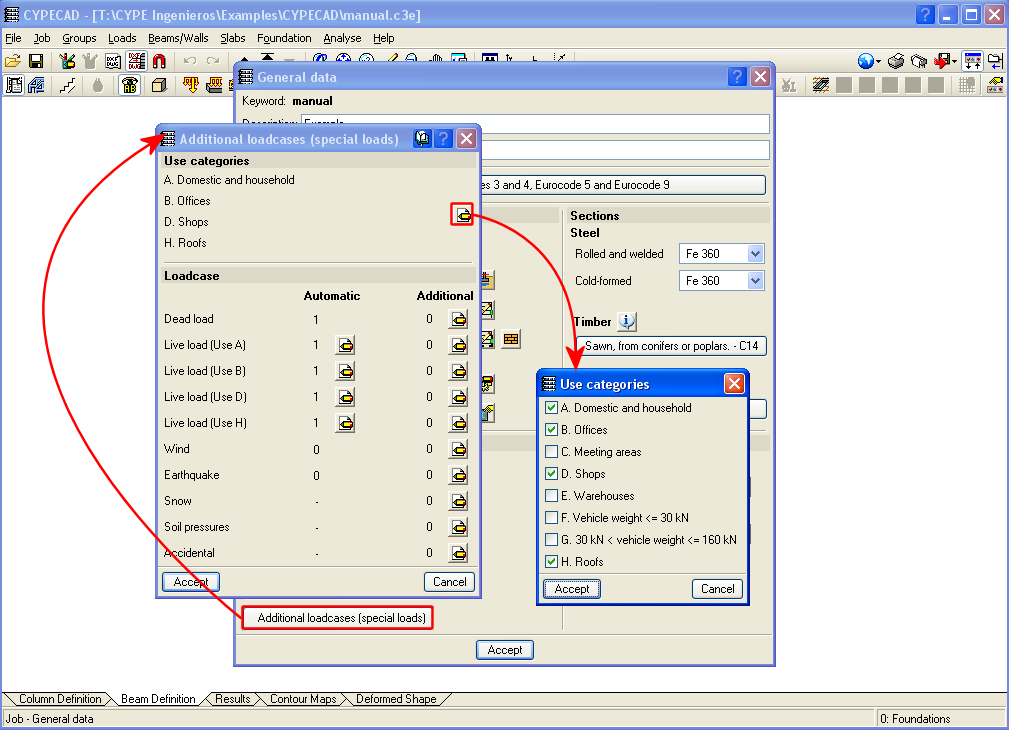
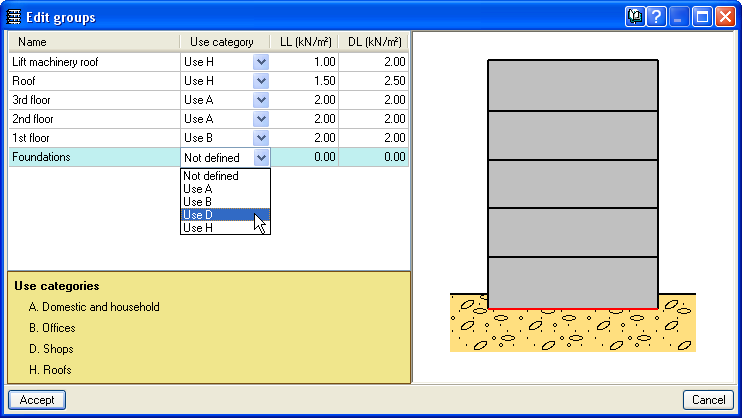
Now in CYPECAD, different use categories can be defined for each floor group of the structure. Examples of use categories include: dwellings, shops, warehouses, garages, etc. The number of use categories the program allows to choose amongst depends on the selected code. For example, the use categories for the Eurocode are:

  • A. Domestic and household
  • B. Offices
  • C. Meeting areas
  • D. Shops
  • E. Warehouses
  • F. Vehicle weight <= 30 kN
  • G. 30 kN < vehicle weight <= 160 kN
  • H. Roofs

For the program, a use category consists of a group of live loadcases, be they automatic or additional, which combine with the other loadcases that have been defined in the job with the same combination coefficients.

This way, the live load combinations for each use category can be analysed correctly amongst all the use categories and the remaining loadcases of the job for which different use categories exist per floor.

The use categories can be selected in the Additional loadcases (special loads) dialogue box within the General data window (Job > General data > Additional loadcases (special loads)). The categories that are selected in this dialogue box are assigned to each floor group in the Edit groups dialogue box which opens by selecting the Loads menu within the Beam Definition tab > Loads in groups or in the Column Definition tab > Floors/Groups > Edit groups.

Different use categories can also be defined for a floor group. To do so, simply do not introduce a live load for the group and once the geometry of the floor group has been defined, introduce the live loads at different positions on the group, assigned to the corresponding loadcase.

The user should bear in mind that the more use categories are defined for a job, the more loadcase combinations the program will create, and so, the time taken to analyse the job will be substantially longer.
Changes have been carried out in the calculation method used to obtain the forces of footings “with external fixity”, for footings, pile caps, strap and tie beams.

The current design can differ from previous versions. Now, once the reactions at the base of the supporting elements of the structure are obtained (columns, shear walls and walls), a model is created will all the foundation elements “with external fixity” and its beams, represented by its stiffness matrix. The stiffness matrix, together with the loadcases defined as loads acting on the foundation (reactions that have been obtained), is resolved using frontal methods to obtain the displacements and forces of all the elements. By doing this, the stiffness of all the elements intervene and interact with one another.

Composite sections made up of simple sections which are already implemented can be used with the following codes: AISI/NASPEC-2007 (LFRD) (USA), AISI/NASPEC-2007 (LFRD) (Mexico) and CAN/CSA S136-07 (Canada) (as of the 2011.a version). The simple sections and their corresponding composition to create composite sections are:

  • For simple cold-formed C and stiffened cold-formed C sections:
    • Double welded in a box
    • Double in a box with batten plates
    • Double in a box with generic joint
    • Double welded in I
    • Double in I with plates
    • Double in I with generic joint
  • For Rectangular cold-formed box and Square cold-formed box
    • Double with generic joint
    • Four with generic joint
  • Cold-formed angle and Symmetrical cold-formed angle
    • Double welded in a box
    • Double in a box with generic joint
    • Double welded in T
    • Double in T with generic joint
    • Double in U with generic joint
    • Double in cross with generic joint
  • Channel with stiffened web
    • Double welded in a box
    • Double in box with cover plates
    • Double in box with batten plates
    • Double in box with generic joint
    • Double welded in I
    • Double in I with plates
    • Double in I with generic joint
  • Eurocode 3
    The corrections undertaken by the CEN (European Committee for Standardization) have been implemented in the following documents (as of the 2011.a version)
    • EN 1993-1-1:2005/AC:2009
    • EN 1993-1-2:2005/AC:2009
    • EN 1993-1-3:2006/AC:2009
    • EN 1993-1-5:2006/AC:2009
    These implementations affect the use of Eurocode 3 for any of the countries that may be selected with this code (International, Bulgaria, France and Portugal).
    The following National documents of Eurocode 3 for France have been implemented:
    • NF EN 1993-1-2:2005/NA:2007
    • NF EN 1993-1-3:2007/NA:2007
    • NF EN 1993-1-5:2007/NA:2007

Eurocode 3
The corrections undertaken by the CEN (European Committee for Standardization) have been implemented in the following documents (as of the 2011.a version)

  • EN 1993-1-1:2005/AC:2009
  • EN 1993-1-2:2005/AC:2009
  • EN 1993-1-5:2006/AC:2009
  • EN 1993-1-8:2005/AC:2009

These implementations affect the use of Eurocode 3 for any of the countries that may be selected with this code (International, Bulgaria, France and Portugal).

The following National documents of Eurocode 3 for France have been implemented:

  • NF EN 1993-1-2:2005/NA:2007
  • NF EN 1993-1-5:2007/NA:2007