
Update history​​

StruBIM Steel

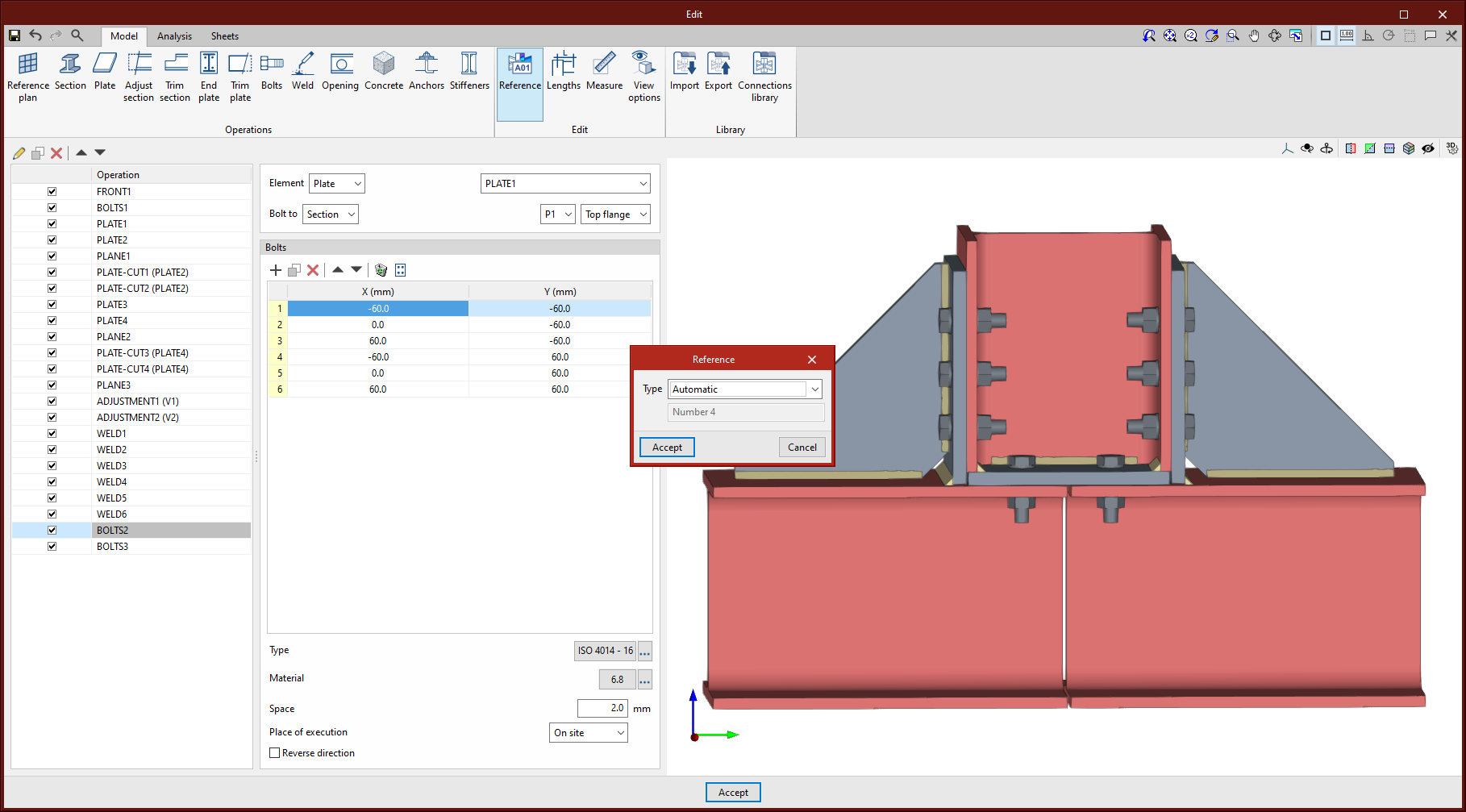
A connection reference editing feature has been added. This reference can be either automatic or user-defined. The automatic reference is composed of the prefix defined in the sheet generation options.
Options for managing groups of matching nodes have been added. Groups of nodes will be assigned the same connection.

The connection assigned to a group of nodes will read the bar forces from all the nodes in the group from the BIM project. The combination filtering carried out from "Generate from BIM model" is based on the sum of the combinations of all the nodes.


The options for managing these groups are:

  • Group
    Allows matching nodes to be grouped together. When a node is selected, all matching nodes will light up in yellow.
  • Ungroup
    Allows previously grouped nodes to be ungrouped.
  • Generate connections
    Generates nodes and groups them automatically if they match.

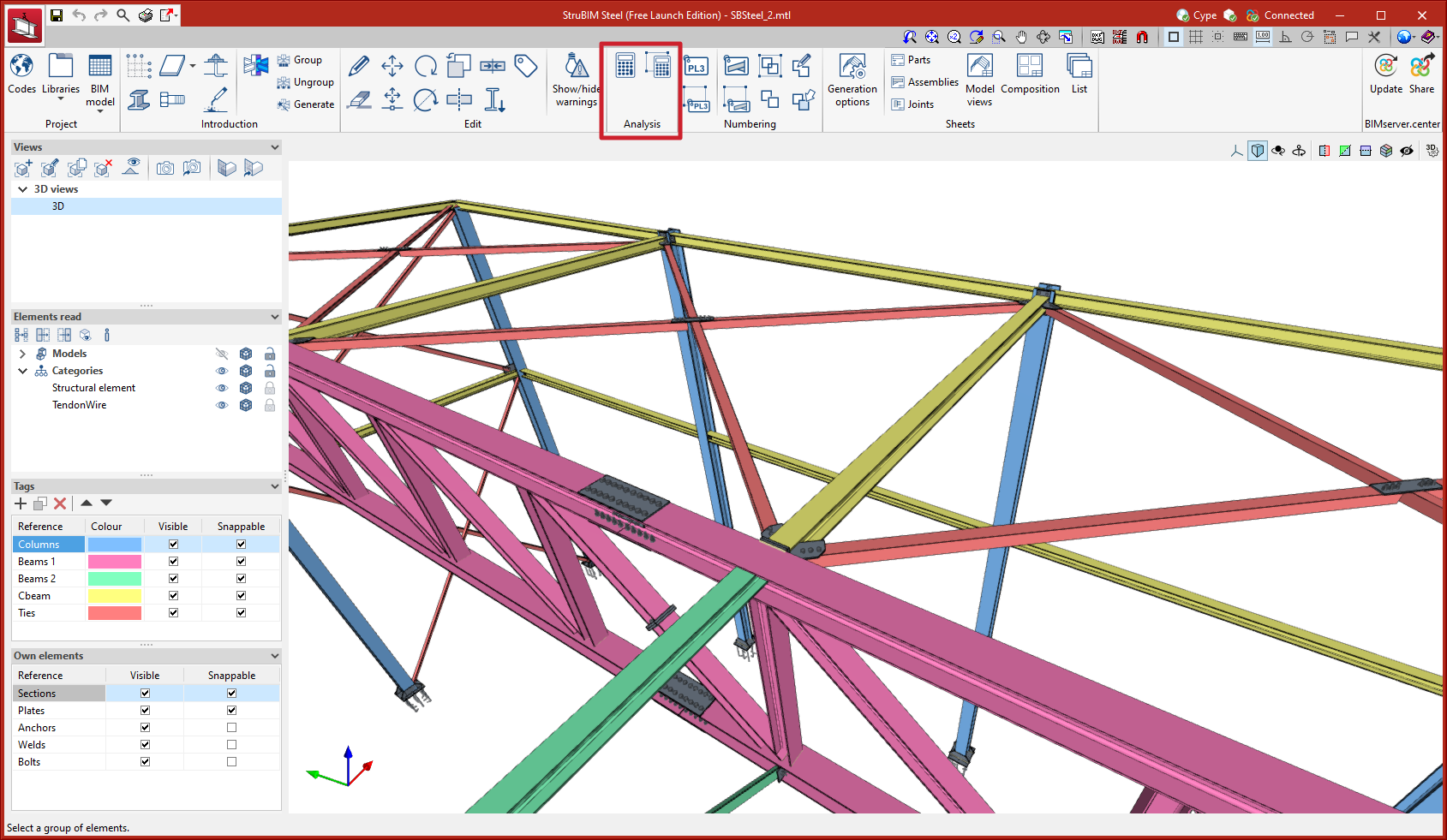
Two new options for analysing multiple connections have been added. These options, similar to those that were added in CYPE Connect version 2023.c, allow users to automatically analyse multiple connections without the need to access each connection to then click on the ''Stress/strain'' or ''Rotational stiffness'' analysis options:

  • Analyse all the connections
    Using this option, the program will analyse all the connections.
  • Analyse the selected connections
    This option allows users to select the connections to be analysed.
Up until version 2023.d, elements added from the connection editor were not grouped into assemblies. As of version 2023.d, elements that are connected by means of welds or bolts executed in the workshop will be grouped together to form workshop assemblies. When the construction site is defined as the place of execution, the elements will not be grouped together.

The tool for selecting the main part of an assembly has been added. These are the steps to follow:

  1. Select the assembly.
  2. Select the main part of the assembly.

The orientation of the assembly views in the sheets shall be that of the main part. In the sheets of the complete model, the assemblies may be tagged by adding the description of the main part.

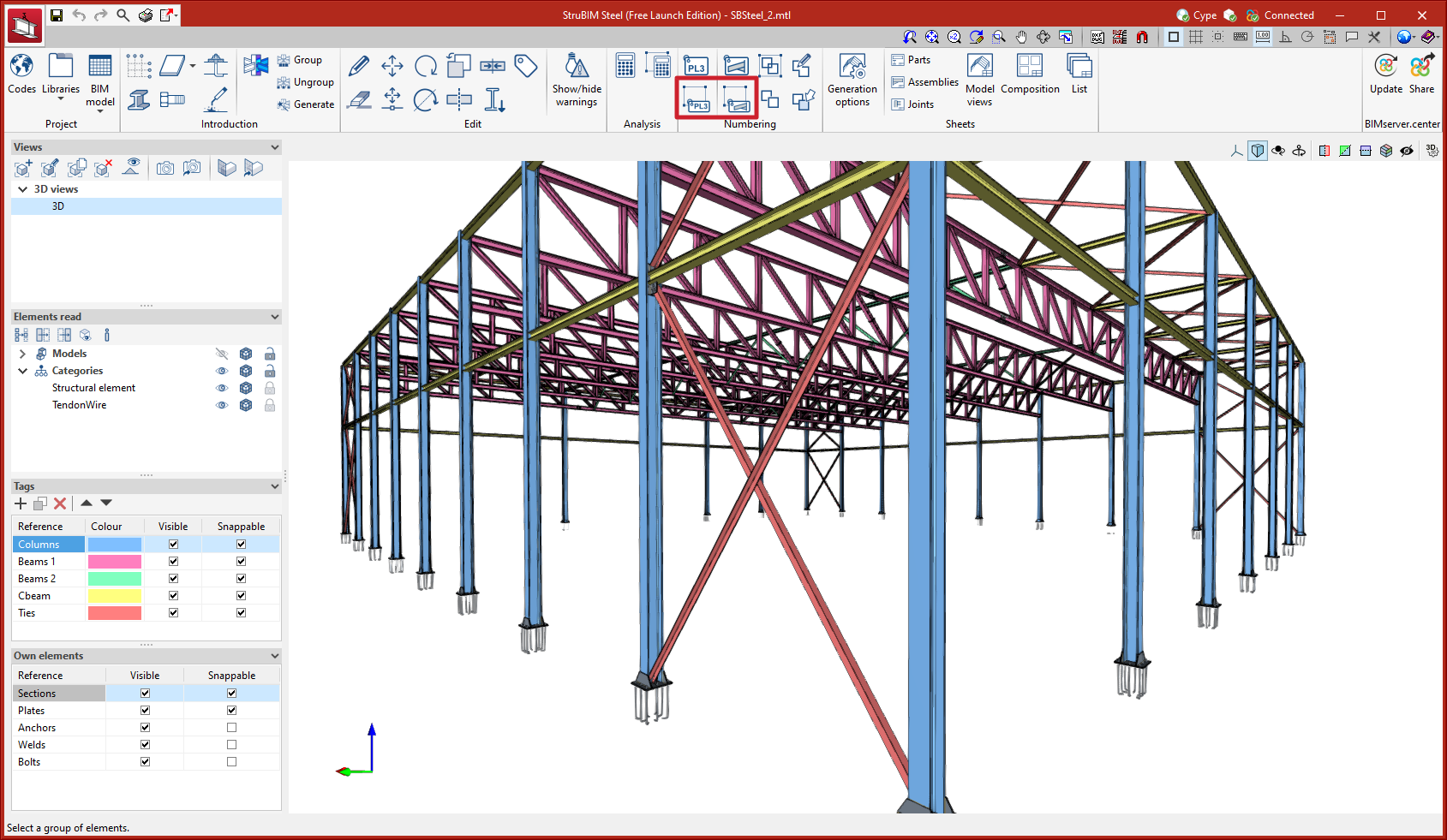
Two new tools have been added for numbering a selection of elements:

  • Numbering a part selection
  • Numbering an assembly selection

These tools only number selected elements, which allows users to number elements according to their own criteria, by floors, zones, phases, etc.
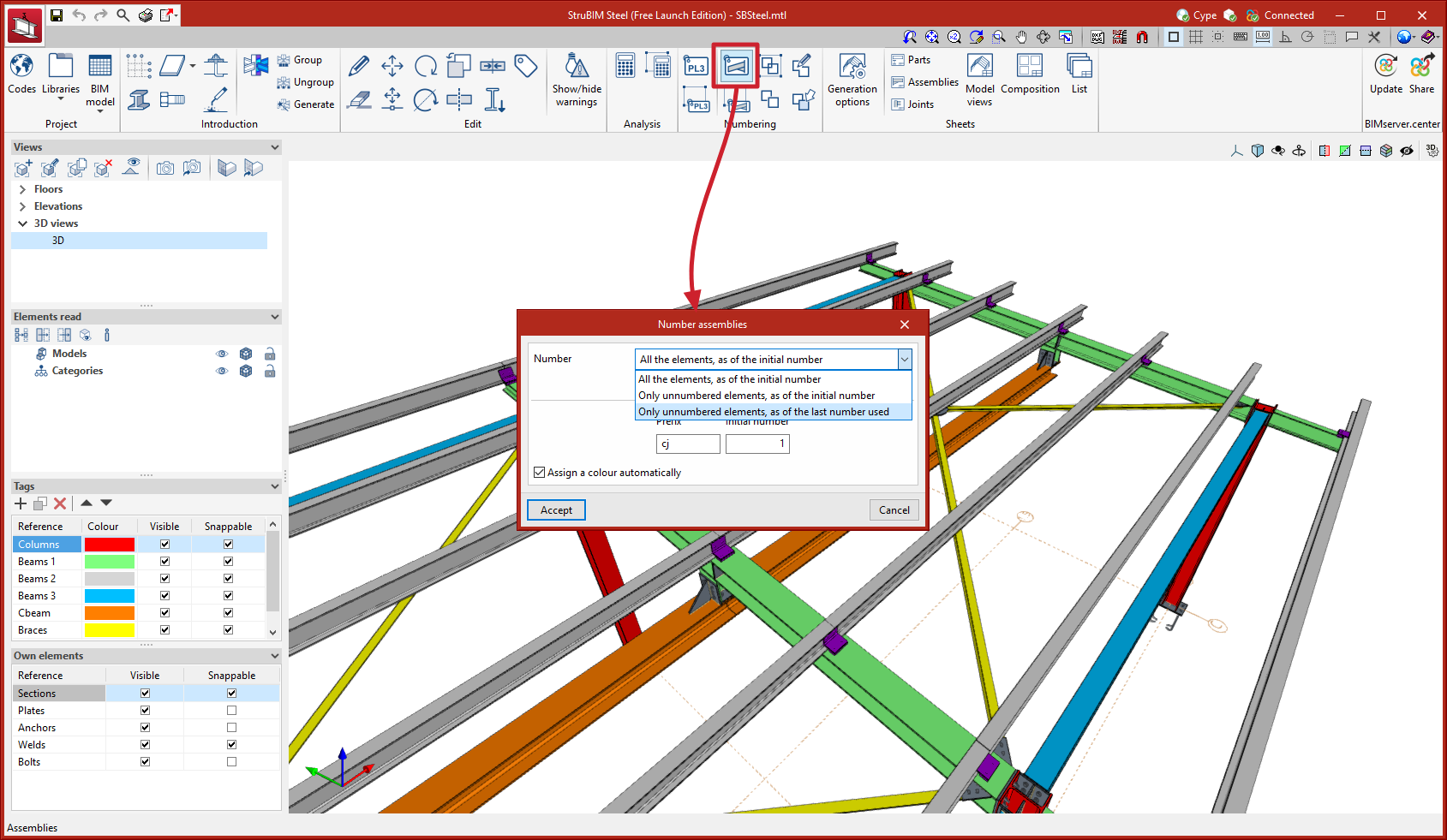
In version 2023.d the numbering tools for parts and assemblies have been improved. These tools search for matching elements and assign a number to them. With this new implementation, the grouping of equal elements is improved.

Three numbering options have also been added:

  • Number “All the elements, as of the initial number”.
  • Number “Only unnumbered elements, as of the initial number”.
  • Number “Only unnumbered elements, as of the last number used”.

The existing options together with the newly implemented tools are placed from left to right following the order in which they will commonly be used as the project develops.

Predefined connections, that existed until version 2023.c, will disappear in version 2023.d. From this version onwards, the connections between bars will be carried out using the “Connections” tool located in the "Introduction" menu.
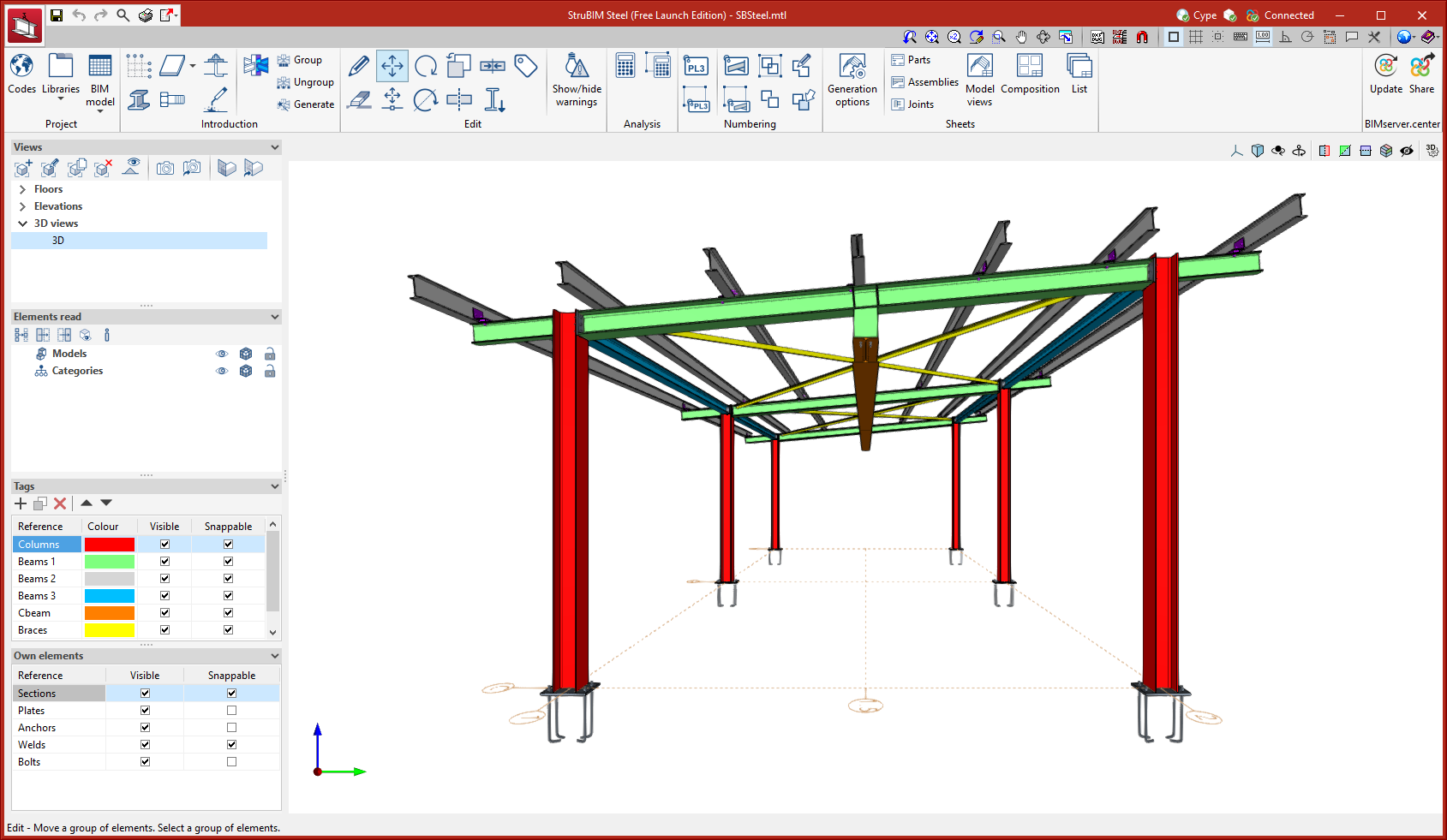
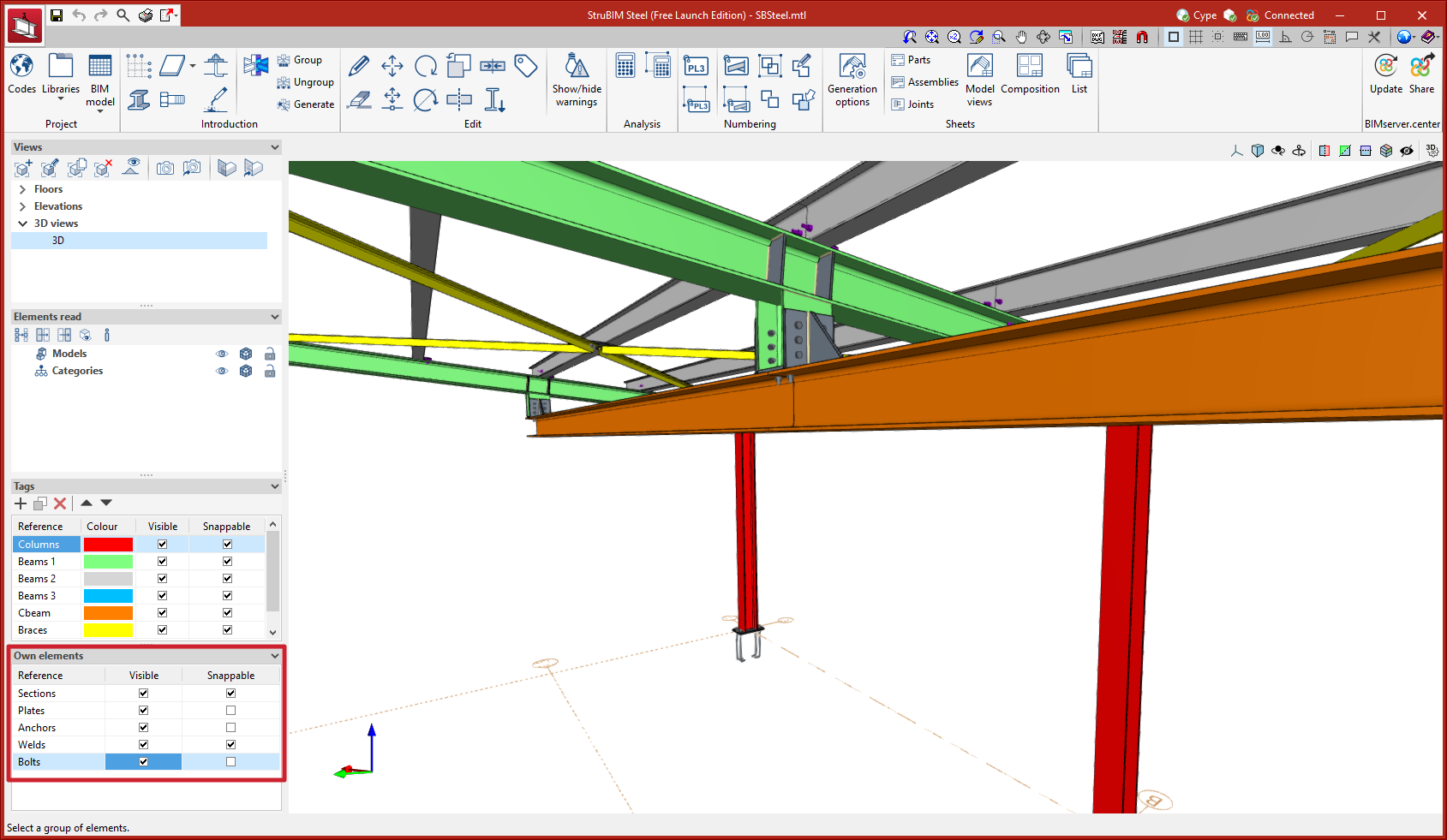
In previous versions, the management of visibility and snapping by elements was carried out by accessing a specific dialogue box from the options bar. As of version 2023.d, this management is located in the sidebar, allowing quick access to these commonly used tools.
In previous versions, tag management was carried out by accessing a specific dialogue box from the options bar. As of version 2023.d, tag management is now located in the sidebar. This improvement allows quick access to commonly used commands such as activating or deactivating the view, creating new tags or deleting them and activating or deactivating snaps.

As of version 2023.d, the "Copy" tool will also copy the connections applied to the bars that are being copied. In previous versions, single elements (bars, plates, etc.) could be copied but, when this was done, the applied connections were not copied.

In version 2023.d, the tools required for generating graphical documents of the structure have been added. Using these tools, users will be able to create sheets of the parts (sections and plates), assembly sheets, joint sheets and sheets with the general model views. The "Generation options", "Parts", "Assemblies", "Joints", "Model views", "Composition" and "List" tools can be accessed from the "Sheets" menu.

These tools are included in the new StruBIM Steel module "Structural steel detailing drawings" and require the user license to have the corresponding permission for this module.

Generation options

The generation options are arranged in a dialogue box with four tabs ("Parts", "Assemblies", "Joints" and "Model views"), which have both common and specific options.

  • Sheet format (included in the four tabs)
    Allows the format of the new sheets to be selected. In "Type", users can select "Empty" together with the sheet format or "Based on template" together with the selection of one of the user-created templates and the layer. The template has a sheet format associated with it.
  • Organisation (included in the four tabs)
    Allows the group of sheets to be selected in which the newly created sheets will be generated.
  • Tables (“Parts” and “Assemblies” tabs)
    Allows the formatted text of the predefined tables in the tabs to be selected.
  • Drawing options (included in the four tabs)
    In this section, the option for displaying the chord radius of the sections can be found. This option is deactivated by default.
  • Tags of the “Assemblies” and “Model views” tabs
    Allows the information that will appear on the automatic tags in the main part of the assembly to be selected.
  • Number (“Joints” tab)
    Allows a prefix to be defined for numbering the joints.
  • Tags in the “Joints” tab
    Allows the information that will appear on the automatic tags of sections and plates to be selected.

All generation option settings can be saved in the user library. User libraries can be managed via the options buttons on the right-hand side of the "Generation options" dialogue box.

Parts

This tool provides access to the drawing and editing panel of the sheets of the parts of the selected element. In the sheets of the parts, only one element (section or plate) is shown and its geometry is graphically documented. In these sheets, the predefined table of uses of the part in assemblies can be entered.

Assemblies

This tool provides access to the drawing and editing panel of the assembly sheets of the selected element. The assembly sheets show all the elements (sections, plates, welds, bolts or anchors) that are part of the assembly being assembled in the workshop. In these sheets, the predefined table of the parts of the assembly can be entered.

Joints

This tool provides access to the drawing and editing panel of the joint sheets of the selected element.

Model views

This tool provides access to the drawing and editing panel of the model sheets, where the different views of the structure will be drawn.

Composition

From the "Composition" level, sheets can be created from other sheets, i.e. sheets made up of a composition of drawings from different elements.

The "Link" tool allows a reference to the content of one sheet to be inserted into another, while the "Sheet composition" tool generates a mosaic with the selected sheets.

List

In the "List of sheets" dialogue box, a list of all the sheets in the structure is displayed. From the list, the content of each sheet can be accessed by clicking on "Edit". The list allows the content to be filtered by category, content type and completion status. The columns "Finished", "Comments 1", "Comments 2" and "Comments 3" allow users to add notes or comments to each sheet, as well as to mark them as finished when they consider it so.