
Databases in Arquimedes
Arquimedes works with databases, which may contain cost databases or bill of quantities (projects).
Cost databases contain the elements (simple and concepts with breakdown) that serve as the basis for calculating bills of quantities, whilst bills of quantities apply these items to specific projects, including quantities, certificates or technical documents.
Setting up a database involves identifying and recording all its elements through a process of breaking them down into simpler parts known as concepts. These are organised into a hierarchical tree-like structure known as a Work Breakdown Structure (WBS). Each concept is identified by a unique code and contains associated information known as fields. In turn, they can act as a parent concept (containing others) or as a child concept (forming part of another). Concepts that cannot be broken down further are called simple.
The concepts in Arquimedes can be:
- Root concept
This is the only concept that is not part of the breakdown of another concept. In a bill of quantities, it represents the project being costed; in a cost database, it represents the cost database itself. - Work sections
Work sections are used to organise concepts and identify certain added amounts. If a work section is dependent on another work section, it is referred to as a sub work section, and there may be several levels of sub work section. - Concepts with breakdown
In a cost database, we refer to an "Item", which is an element containing a price and other associated information. If it does not have a breakdown, we refer to it as "Unclassified". - Items
In a bill of quantities, if an "Item" includes quantities, it is referred to as an "Item". If it does not include a breakdown, it is called a "Lump-sum item" (which may be subject to project verification or paid in full). It is used when there is no detailed information, and it is part of the price justification. - Resources
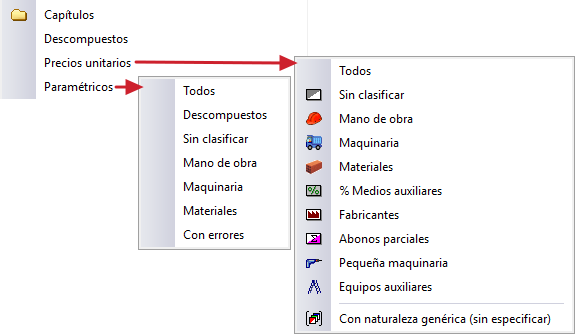
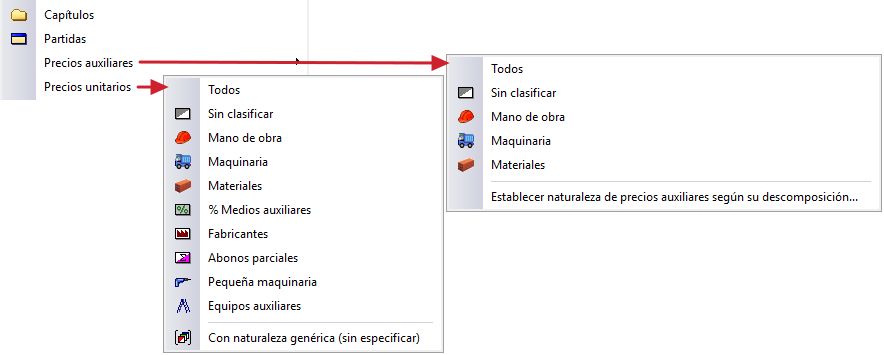
These are components that form part of the breakdown of a "Concept with breakdown" in a cost database, an "Item" in a bill of quantities, or an "Auxiliary price" in both a cost database and a bill of quantities. They can have any of the following types: labour, machinery, materials, auxiliary resources, unclassified and other. - Auxiliary prices
These are breakdown concepts used in various "Items" to avoid repeating price justifications. They do not take indirect costs into account. They can be used either as an "Item" or as an "Auxiliary price", but not both; otherwise, the program will display the warning "Item used as auxiliary price" on its icon. - Parametric
They define their code, summary, text, breakdown and other information in a variable manner using tables and arithmetic and logical expressions based on parameters. They can only be created in a cost database. - Percentages
They are calculated as a percentage of the amount of other items, such as overheads, small consumables, auxiliary materials or indirect labour. They can only be used in an "Item" or "Auxiliary price". Their code must contain a "%" or "&" character. - Partial payments
This allows items to be classified under "Price list nº 2" without affecting their price. It adds up the basic prices from the item breakdown that precede them, right up to the previous partial payment.
| Note: |
|---|
| In both a cost database and a bill of quantities, each item is unique but may appear in multiple breakdowns. The data associated with the item (unit, summary and price) are the same across all its occurrences; therefore, if any of these details are changed in one breakdown, the change will be reflected in the others. However, the quantity can be changed independently in each breakdown without affecting the others. |