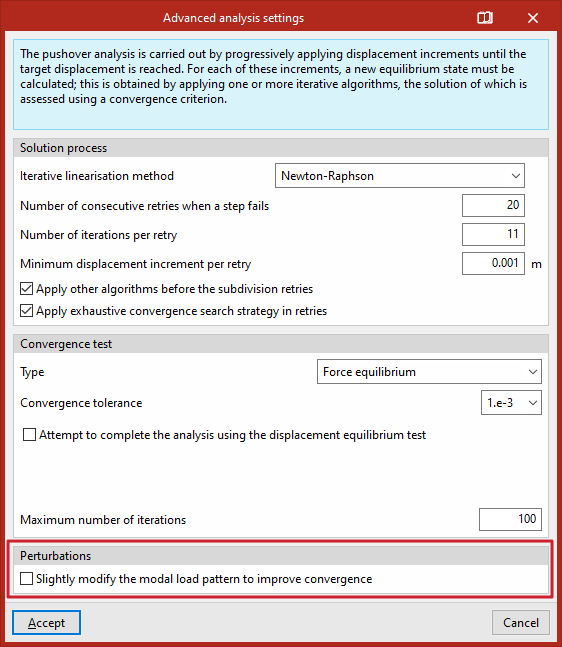

Advanced settings for pushover analysis
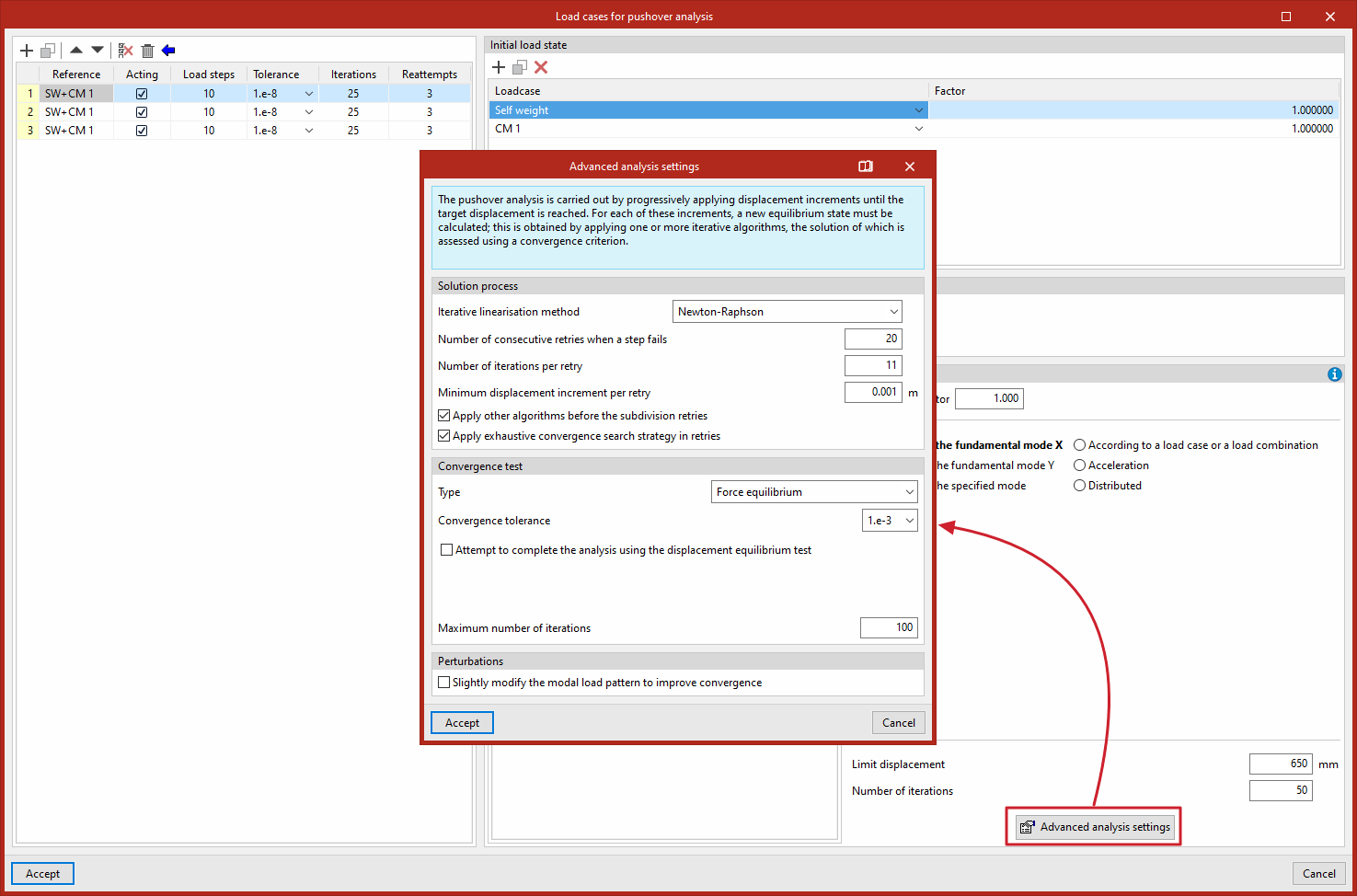
The advanced settings for the pushover analysis can be modified for each lateral load pattern via the "Load cases" option, which is available in the "Pushover analysis" group on the top toolbar, within the "Analysis" tab (under the "Structure" sub-tab):
Convergence strategy
The pushover analysis is carried out by progressively applying displacement increments until the target displacement is reached. For each of these increments, a new equilibrium state must be calculated; this is obtained by applying one or more iterative algorithms, the solution of which is assessed using a convergence criterion.
Given the iterative nature of the solution strategy, the choice of iteration algorithm and the convergence test determines the convergence path of the analysis. Different models or even different directions of analysis may require different strategies; it may even be necessary to modify the strategy at a specific stage of the process.
The pushover analysis algorithm used by the program attempts to reach the target displacement using the user-defined iterative linearisation method. If the convergence test is not satisfied at any stage of the analysis, the algorithm may switch to other secondary methods and/or subdivide the increment size.
Resolution process
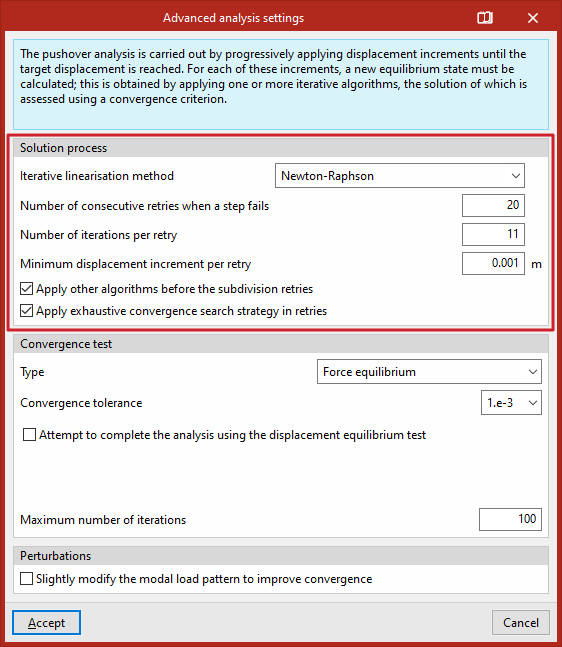
The section entitled "Solution process" begins by defining the "Iterative linearisation method". The iterative linearisation method controls how iteration is performed within a load step to satisfy the equilibrium relationship R(u) = Fe - Fi(u) = 0. The available methods are:
- Newton-Raphson
This method is suitable for small or medium-sized models (< 100,000 degrees of freedom (DOFs)). It is the most conservative method. It minimises the residual between iterations because it performs factorisation of the system’s tangent matrix at each iteration, which allows the analysis to progress more accurately when many steps are chained together or the system has a response that is highly sensitive to small perturbations. However, performing the factorisation at each iteration makes it slower than other methods and, at the same time, more sensitive to oscillations.
- Modified Newton-Raphson
This method is suitable for large models (> 100,000 degrees of freedom (DOFs)). It performs the factorisation of the system’s tangent matrix only at the start of the step and thereafter works with an approximation, which makes it faster than the Newton-Raphson method and stable against oscillations. It has linear convergence.
- Krylov-Newton
This method is suitable for large models (> 100,000 degrees of freedom (DOFs)). It factors the tangent matrix at the start of the step and uses the previous residuals to correct the direction of the displacement. It is very robust when the tangent matrix is ill-conditioned.
- Newton-Raphson (linear search, step size 0.5)
- Newton-Raphson (linear search, factor 0.8)
These methods are suitable for small or medium-sized models (< 100,000 degrees of freedom (DOFs)). They work in the same way as the Newton-Raphson method, but in this case, a search is performed in the direction of the displacement increment vector to minimise the residual. This is useful when the Newton-Raphson method oscillates without converging.
For any method, the following must be specified:
- The "Number of consecutive retries when a step fails".
- The "Number of iterations per retry".
- The "Minimum offset increase per retry".
You can also tick the relevant boxes for "Apply other algorithms before subdivision retries" and/or "Apply an exhaustive convergence search strategy during retries".
Convergence test
The convergence test calculates the Euclidean norm of the estimated parameter, taking into account all the degrees of freedom in the model. It is used to determine whether the iterative linearisation method has reached an approximate equilibrium within the specified tolerance range.
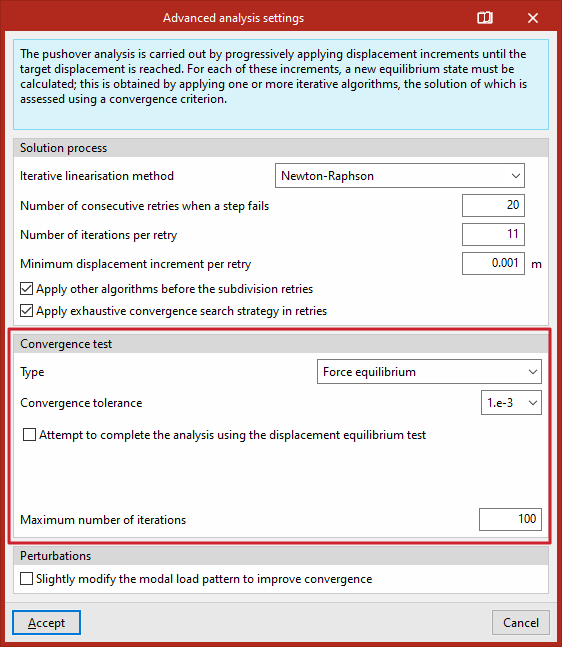
In the "Convergence test" section, you can define the "Type" by selecting one of the following:
- Balance of forces
This test is usually sufficient to ensure the overall accuracy of the solution obtained. If selected, the program checks that the change in displacement between iterations is less than the specified tolerance. This test uses a single tolerance for the degrees of freedom of translation and rotation. The internal units used are metres and radians.- When selecting this test, you must choose the "Convergence tolerance" from the available options. The "Attempt to complete the analysis using the displacement equilibrium test" option is also available (for which you must select the "Convergence tolerance (displacements)" and enter the "Step subdivision factor").
- Displacement equilibrium
If this test is selected, the program checks that the residual force between iterations is less than the specified tolerance. The internal units used are tonnes. This test is recommended in situations where displacement equilibrium is reached before force equilibrium, which is usually reflected in an irregular displacement-shear force curve and significant variation in forces and moments.- When selecting this test, you must choose the "Convergence tolerance" from the available options.
- Balance of forces and displacements
If this test is selected, the program checks that both the balance of forces and the balance of displacements are satisfied. The results are as accurate as possible, but it can be difficult to get the model to achieve the target displacement.- When selecting this test, you must select the "Convergence tolerance (forces)" and the "Convergence tolerance (displacements)".
- Balance of forces or displacements
If this test is selected, the programme checks that the balance of forces or the balance of displacements is satisfied. It should only be used as a test to analyse model convergence issues.- When selecting this test, you must select the "Convergence tolerance (forces)" and the "Convergence tolerance (displacements)".
- Energy balance
This test should be used as a last resort. If this test is selected, the program checks that the change in energy between iterations is less than the specified tolerance. The tolerance is expressed in units of energy (tonnes × metres in this case). In some deformation modes, this test may return a false equilibrium (when the displacement increment vector is orthogonal to the residual vector).- When this test is selected, the "Convergence tolerance" is selected; the option "Attempt to complete the analysis using the displacement equilibrium test" is offered (for which the "Convergence tolerance (displacements)" is selected and the "Step subdivision factor" is entered).
In addition, the "Maximum number of iterations" is entered for each test.
Disturbances
Finally, in the "Disturbances" section, you can tick the relevant box to "Slightly modify the modal load pattern to improve convergence".