


Joist views
The "Views" option, located within the "Joists" menu on the "Results" tab, allows you to configure how the data obtained from the joist floor slab analysis is displayed.
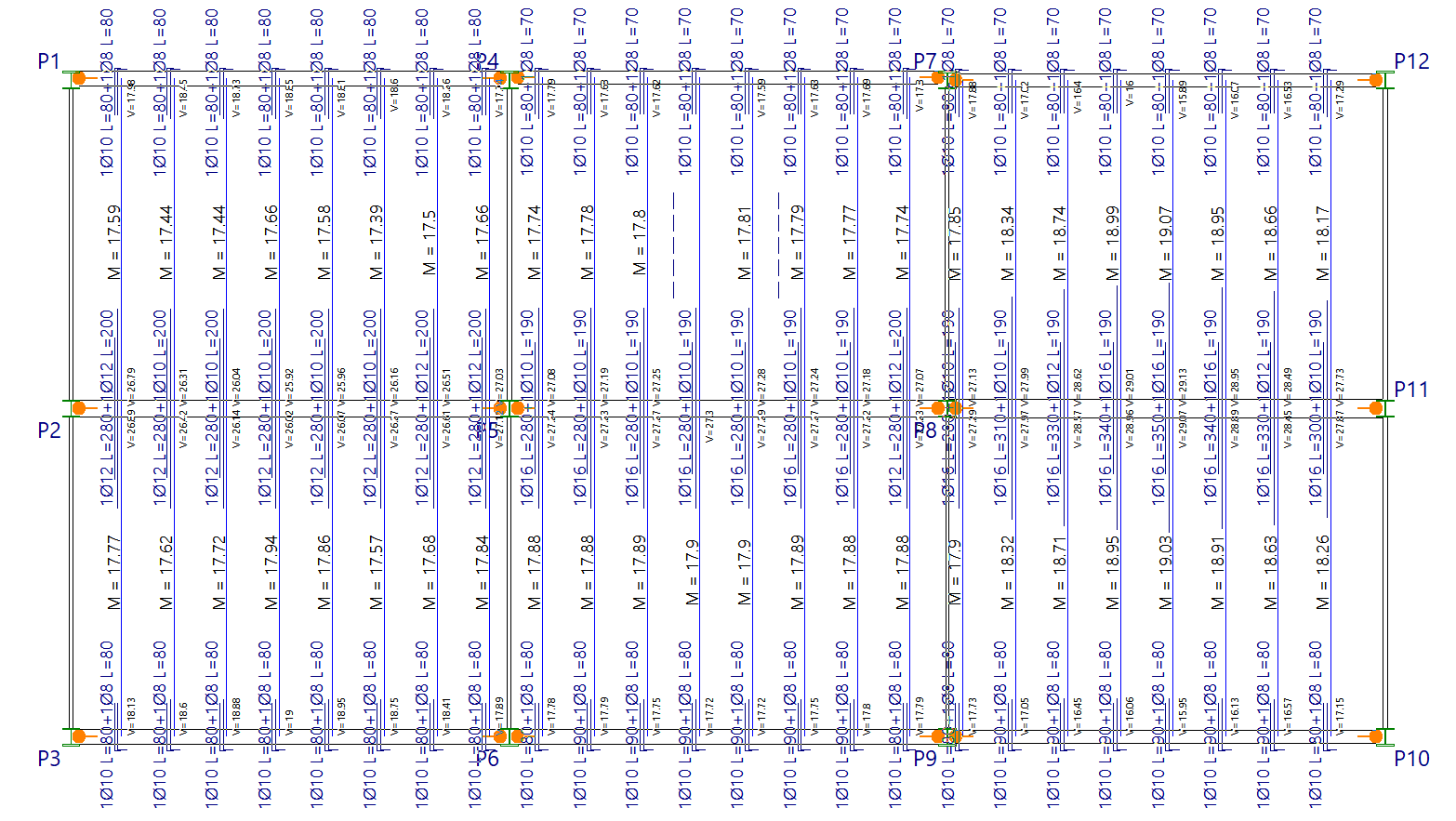
These include the values of the moments and shear forces to be resisted, the types of joists used, the positive and shear reinforcement required for each rib, and the negative reinforcement provided.
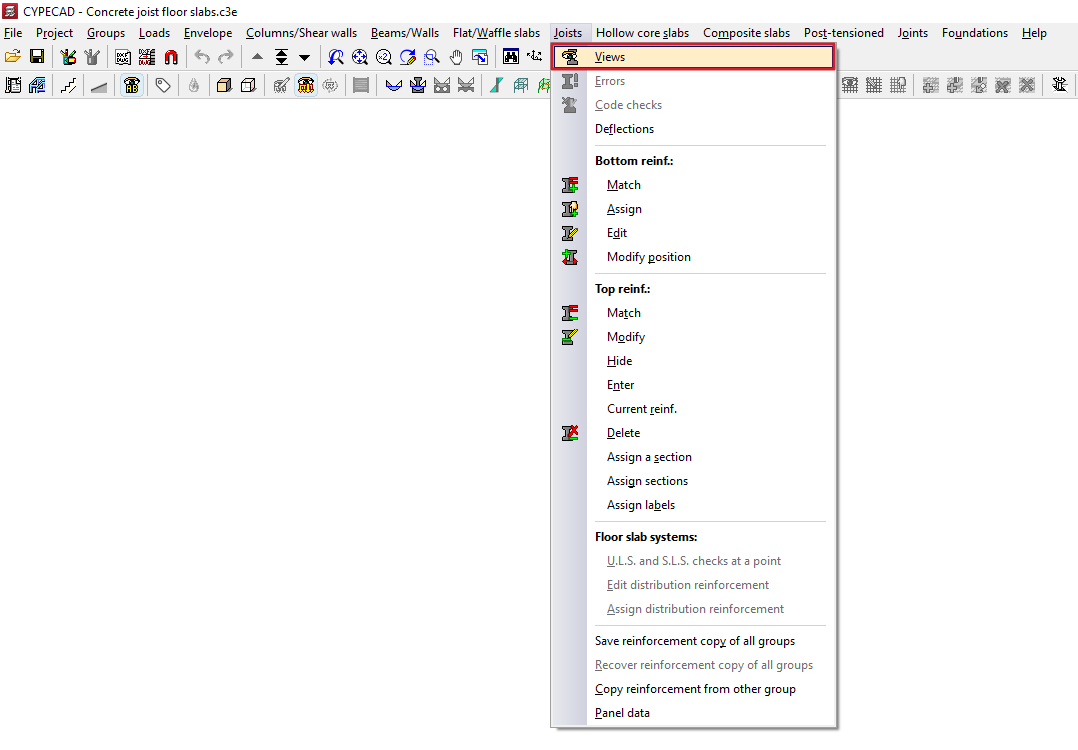
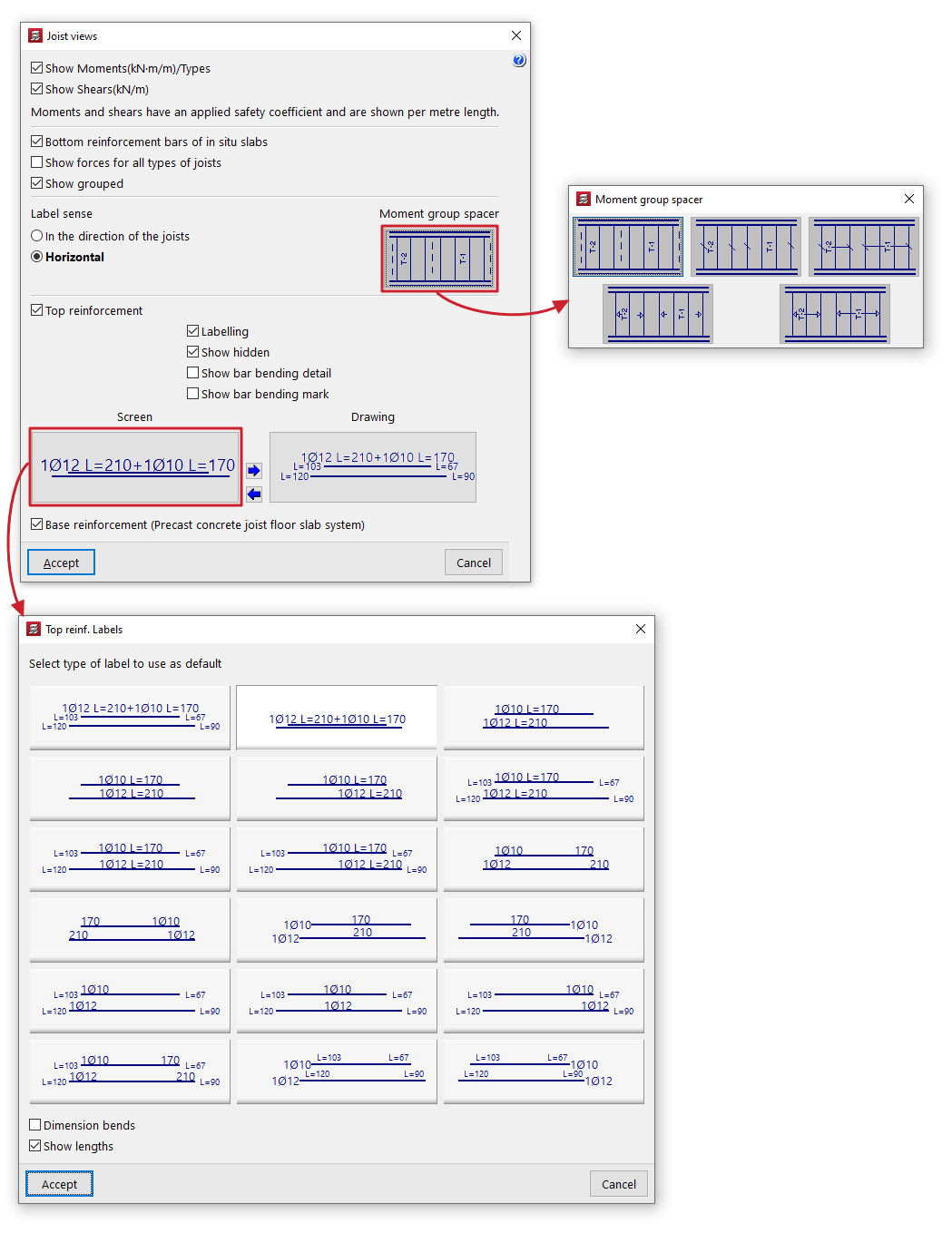
Clicking on this option opens a pop-up window containing the following tools:
- Moments (kN·m/m)/Visible types
If this option is disabled, and if the "Show forces in all joist types" option is disabled, the following are labelled on the floor plan next to each rib:- The maximum bending moments per metre of width in generic joists (entered using the "By geometric characteristics" option). These are indicated by the label 'Mf'.
- The type of joist in precast reinforced or prestressed joist floor slabs (selected via the "Library" option).
- The diameter and length of the bottom reinforcement in cast-in-situ joist floors.
- The section in steel joist, JOIST and timber floor structures.
- Shear forces (kN/m) Visible
If this option is disabled, and if the option "Show forces in all types of joists" is disabled, the following are labelled on the plan view next to each rib:- The value of the increased shear force per metre of width at the bearing edge for generic joists (entered using the "By geometric characteristics" option). These are indicated by the label 'V'.
- The type of lattice in the reinforced precast joists (inserted using the "From library" option).
- The diameter and spacing of the shear reinforcement in cast-in-situ joist floors.
- Bottom reinforcement bars of in-situ slabs
Selecting this option draws the layout of the bottom reinforcement bars (positive reinforcement) for in-situ joist floor slabs. - Show forces in all types of joists
If this option is enabled (along with the options "Moments (kN. m/m)/Visible types" and/or "Shear forces (kN/m) Visible"), the increased bending moments per metre of width and/or the value of the increased shear force per metre of width at the support edge are labelled on the plan next to each rib for all types of joists. - Show grouped
If this option is enabled, the forces in the elements are grouped so that only one label is displayed for each group of elements with the same data. The chosen "Moment group separator" symbol is placed between the groups of elements.
If this option is disabled, the forces are labelled on each element. - Label sense
This selector allows you to adjust the orientation of the labels for moments and shear forces in some versions. This can be set to "In the direction of the joists" or "Horizontal". - Moment group spacer
Clicking this option opens a pop-up window where you can select the symbol to be used as a separator for groups of joists with the same data from those available. - Negative reinforcement
Selecting this option displays the layout of the negative reinforcement for joist floors. You can also configure the following:- Labelling
When this option is enabled, labels indicating the diameters and lengths of the negative reinforcement are displayed. - View hidden
After aligning negative reinforcements, those that will be drawn in the drawing are shown in blue, whilst the aligned reinforcements that will not be drawn in the drawings are shown in magenta. If the "View hidden" option is enabled, it is possible to view the magenta-coloured reinforcements on screen, i.e. those that will not be drawn in the drawings. - View bar bending details
If this option is enabled, a bending diagram is drawn next to the bar in inclined sections. - Show bar bending mark
If this option is enabled, on inclined sections the bending point is marked with a small line perpendicular to the axis of the bar. - Labelling in "Screen" and in "Plan"
In both cases, the program allows you to select the default labelling type for negative reinforcements from those available in the pop-up window. It also allows you to specify whether you wish to "Dimension tabs" and/or "Show lengths" of bars by ticking the relevant boxes. - Copy label selection
These options allow you to copy the label selection on the screen to the label selection in the drawings, or vice versa.
- Labelling
- Distribution reinforcement (precast concrete joist floor system)
Selecting this option displays a detail of the slab showing the bidirectional distribution reinforcement to be used in the aforementioned floor systems, including its diameter and spacing.
Joist errors
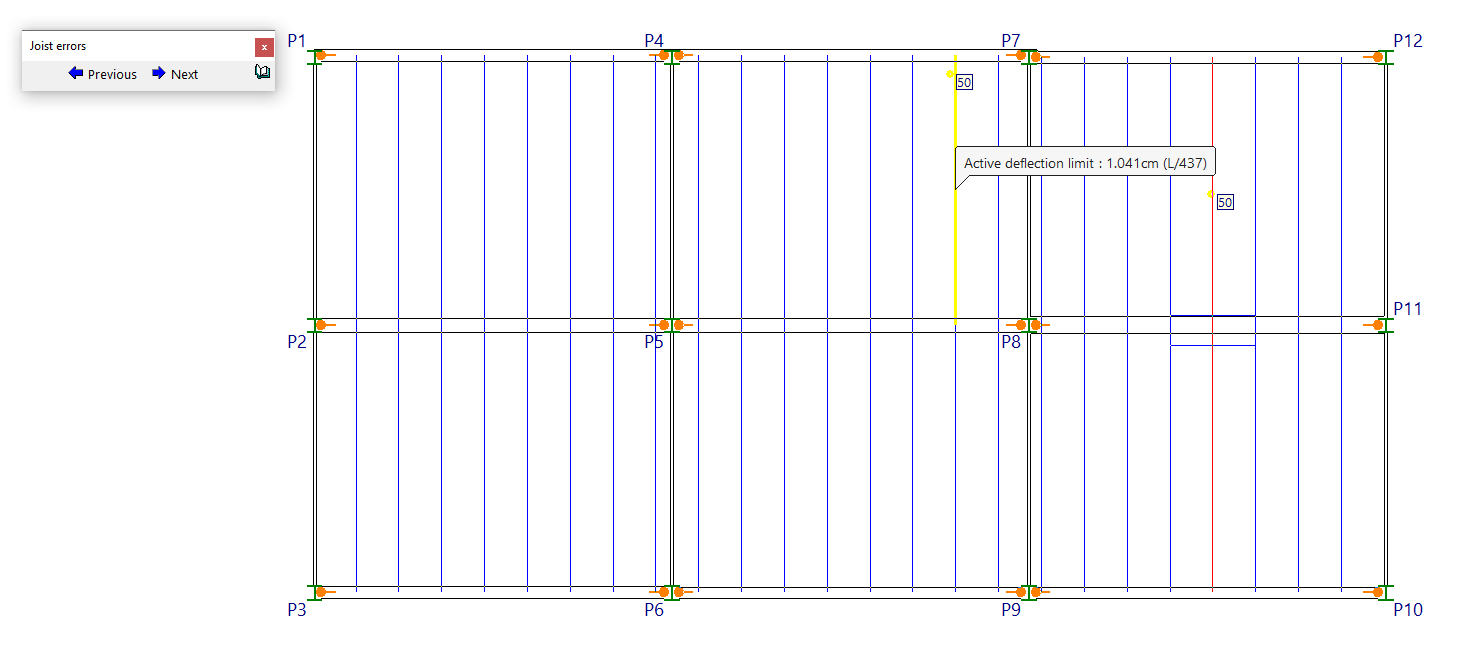
The "Errors" option, within the "Joists" menu on the "Results" tab, allows you to view the errors obtained following the analysis for each of the joists.
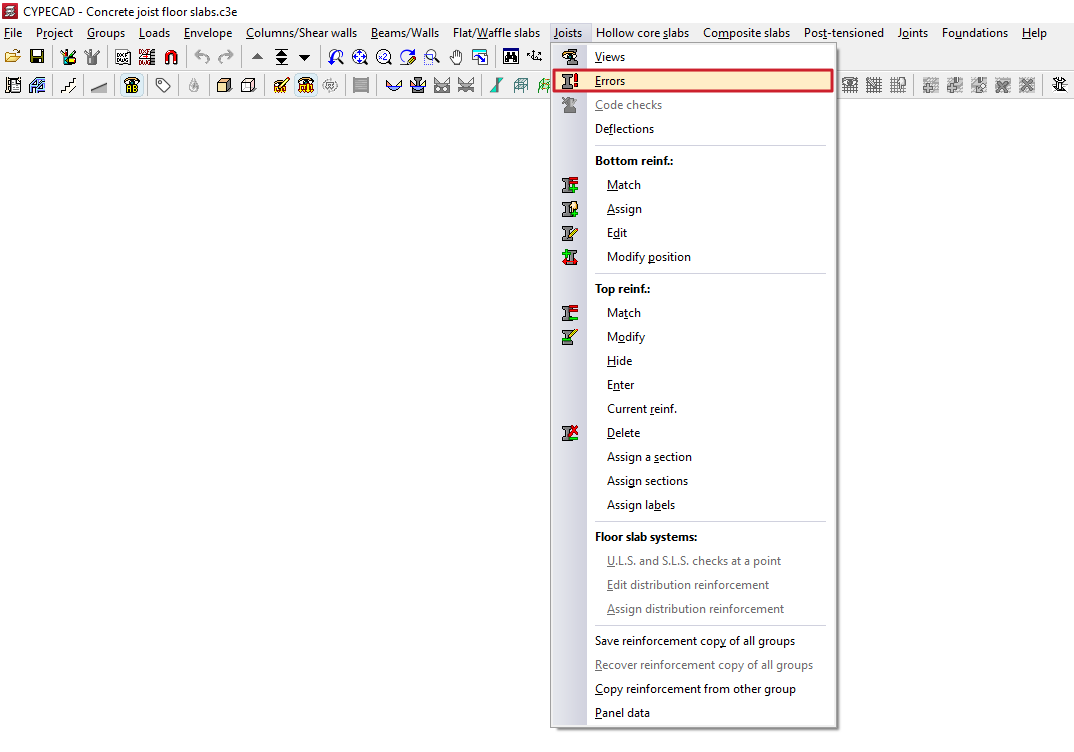
Once you have clicked on this option, any joists with deflection or shear errors, or any other issues, will be highlighted in red.
For more information about the specific error, left-click on the joist and read the message that appears. If the joist group has no errors, the text "No errors" will appear.
The "Previous" and "Next" buttons in the dialogue box allow you to navigate between the other floor joists on the floor that contain errors.
Description and solutions for joist errors
Below is a detailed list of the various errors that may occur in joists, along with recommended remedies:
| Error | Description | Solution |
| Dead load instant. deflection limit | The deflection limit has been exceeded. | Increase the floor slab depth, place a double joist or change the panel layout. |
| Live load instant. deflection limit | The deflection limit has been exceeded. | Increase the floor slab depth, place a double joist or change the panel layout. |
| Total instant. deflection limit | The deflection limit has been exceeded. | Increase the floor slab depth, place a double joist or change the panel layout. |
| Total long-term deflection limit | The deflection limit has been exceeded. | Increase the floor slab depth, place a double joist or change the panel layout. |
| Active deflection limit | The deflection limit has been exceeded. | Increase the floor slab depth, place a double joist or change the panel layout. |
| Positive moment at joist support | There is only positive moment at the support | There is only one positive moment at the support |
| Insufficient floor slab depth to resist the flexure | The top reinforcement works in compression. | Increase the floor slab depth or place a double joist. |
| The width of the rib does not allow for the reinforcement due to compatibility problems with the bar spacing and cover | The bottom reinforcement does not fit in the in situ rib width. | Increase the floor slab depth or the thickness of the rib. |
| No joist is found to cover the maximum positive moment | The maximum moment exceeds the maximum defined in the manufacturer's joist sheet. | Depending on the case, increase the stiffness of the beam where the joist bears, pin the panel at its edges, or study the continuity of the bottom reinforcement. |
| There are no sections in the series that do not fail for this floor slab and form geometry | This occurs in steel joists probably due to having inserted an excessive rib spacing with respect to the width of the form, in such a way that it is not possible to support it on the flanges of the section. | Place the appropriate rib spacing for the form or vice versa. |
| No section has been found in the series that does not fail for the calculated forces | The forces exceed the maximum that can be resisted by the joists of the series. | Change the section series. |
| The resistance checks fail | One or more resistance checks fail. | Review all the checks carried out using the "Check" option and make any necessary changes. |
| The fire resistance checks fail | One or more fire resistance checks fail. | Review all the checks carried out using the "Check" option and make any necessary changes. |
| The depth of the section is greater than the maximum allowable depth | The depth of the section is greater than the maximum allowable depth defined in the data of the floor slab. | Increase the floor slab depth. |
| No reinforcement has been found that meets the geometric and mechanical minimums | There is no reinforcement in the in situ joist reinforcement table that will meet the cited minimum ratios. | Edit the reinforcement table as required. |
| There is no entry in the bottom reinforcement table meeting the requirement that the partial additional reinforcement must be smaller than the rib length | A base reinforcement has been assigned to the in situ ribs, and the additional reinforcement calculated is longer than the joist. This is not allowed. | Increase the base reinforcement ratio, the rib width, or the floor slab depth. |
| There are no joists that do not fail when their bottom reinforcement is extended to their ends | The length of the calculated additional reinforcement is greater than that of the joist. This is not allowed. | increase the floor slab depth or place a double joist |
| There are no joists with sufficient base reinforcement to allow for the partial additional reinforcement to have a length smaller than that of the joist's | Trying to find sufficient base reinforcement to allow for the additional reinforcement to have a length smaller than the joist's. | Increase the floor slab depth or place a double joist |
| Insufficient section for negative moment | The compressed zone does not resist the stresses produced by the negative moment. Not even infilling will resolve this problem. | Increase the floor slab depth. |
| Excessive negative moment | The forces exceed the maximum that can be resisted by the manufacturer's joist sheet. The value of the moment is shown. | Increase the floor slab depth or place a double joist |
| Required top reinforcement area | Increase the floor slab depth or place a double joist | Increase the floor slab depth or place a double joist |
| Top reinforcement outside table rang | The top reinforcement defined in the tables is not sufficient, but the program calculates the necessary reinforcement anyway. | We recommend increasing the depth of the floor slab or installing double joists rather than modifying the reinforcement table. |
| Infill greater than twice the depth | To avoid the bottom reinforcement working in compression, since the concrete is at its limit, an infill is provided, but the program emits a warning when the infill exceeds this length. | Increase the floor slab depth. |
| Infill greater than 20% of the clear span | To avoid the bottom reinforcement working in compression, since the concrete is at its limit, an infill is provided, but the program emits a warning when the infill exceeds this length. | Increase the floor slab depth. |
| Fixed or continuous ends in this type of joists are not designed | Although steel joists are automatically pinned at the edges, in the case of cantilevered joists, the program gives continuity to the interior panel to achieve local equilibrium. The negative moment is not designed for. | Modify the defined conditions or the type of floor slab. |
| The calculated shear cannot be resisted | Increase the floor slab depth or place a double joist | increase the floor slab depth or place a double joist |
| Top reinforcement outside table range | The lateral cover is greater than the width of the support beam. | Increase the floor slab depth or place a double joist |
Joist checks
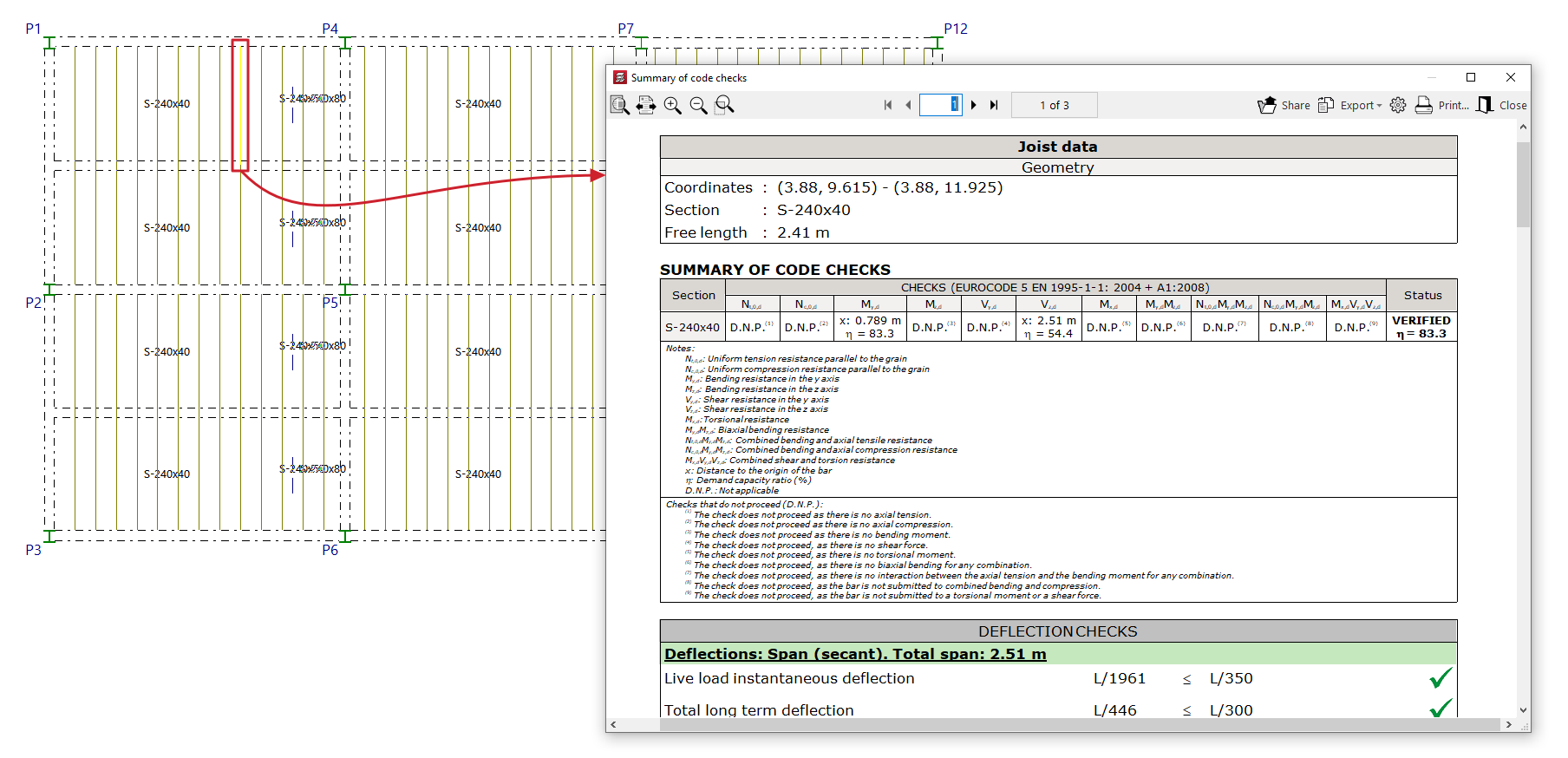
The "Code check" option, located in the "Joists" menu on the "Results" tab, allows you to display a list of check results for the steel or timber joists on screen once the analysis has been completed.
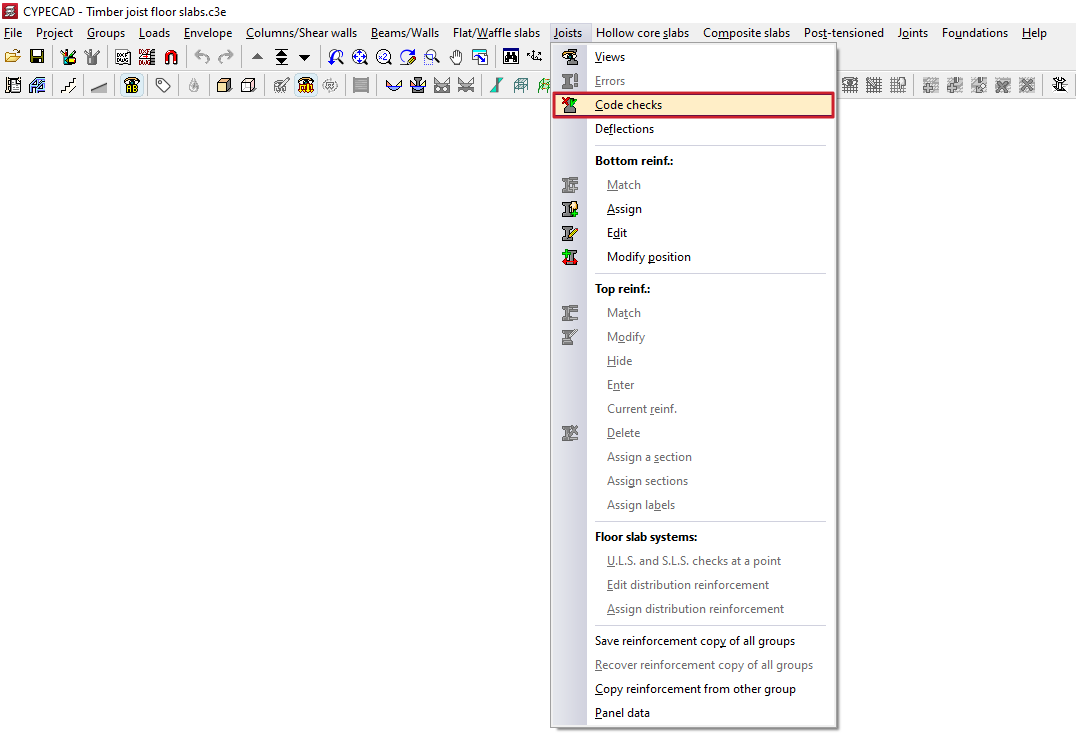
After clicking on this option and selecting a joist, a pop-up window opens displaying a report in which:
- details are provided on the "Geometry" of the joist,
- a "Summary of checks carried out" (including "Deflection checks") is displayed,
- and details are provided of the various "Strength checks" carried out on the joist in accordance with the selected standards, indicating the extent to which they have been met.
This report can be exported or printed in various formats.
Joist deflection
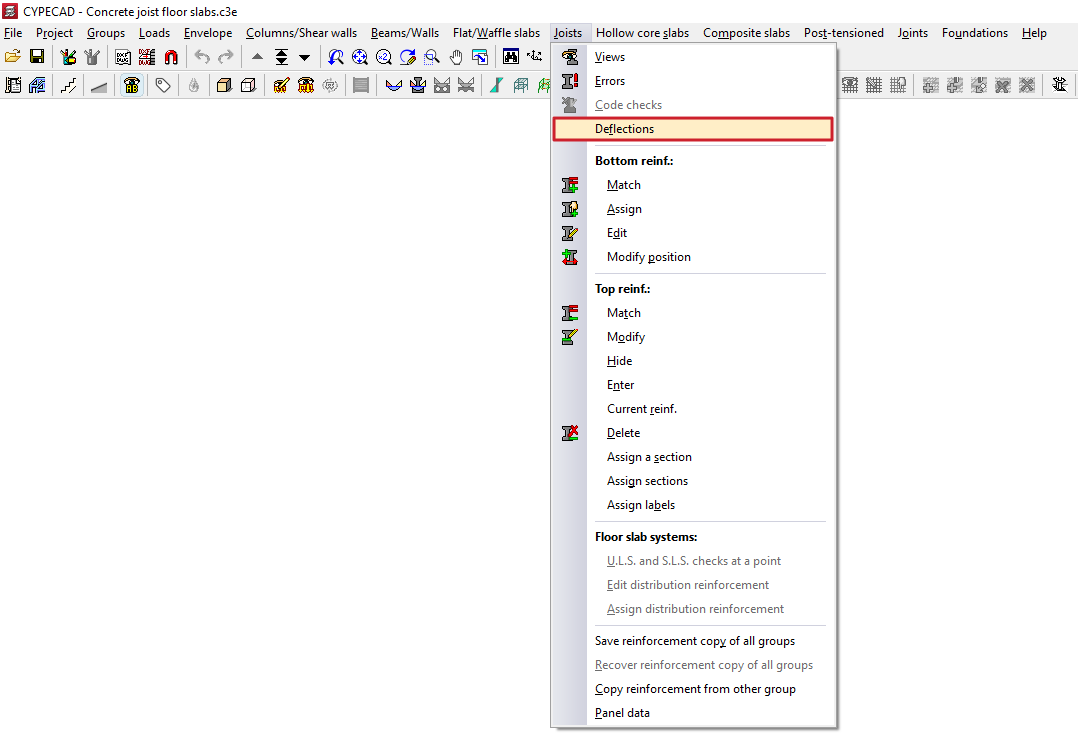
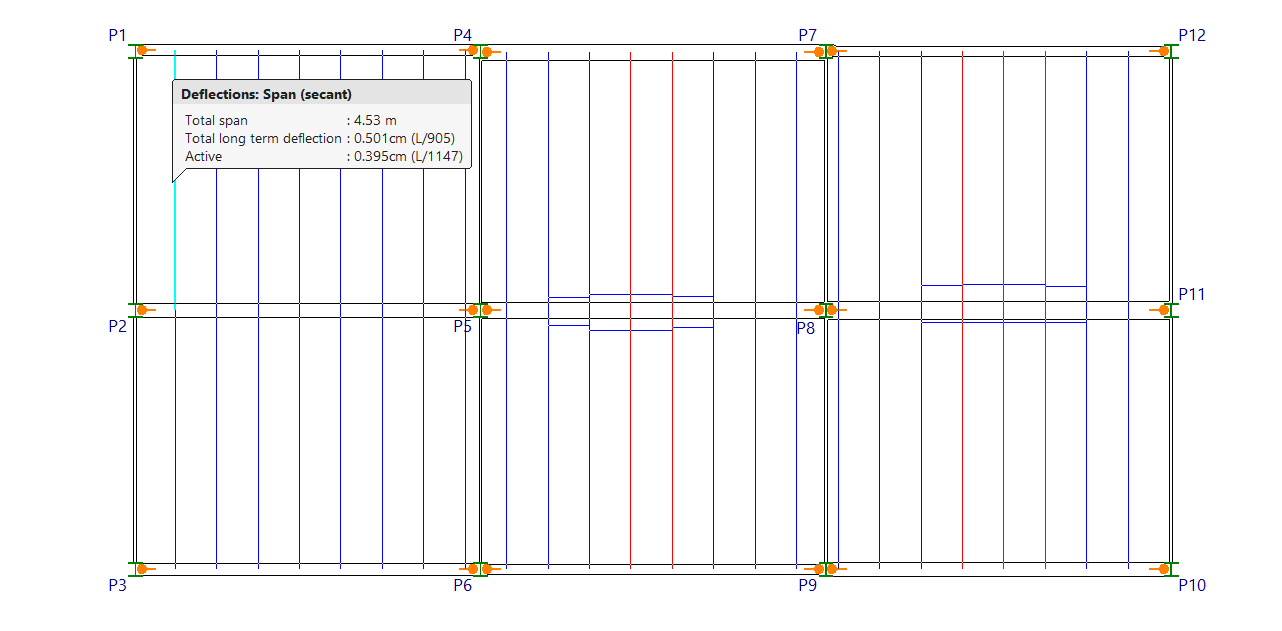
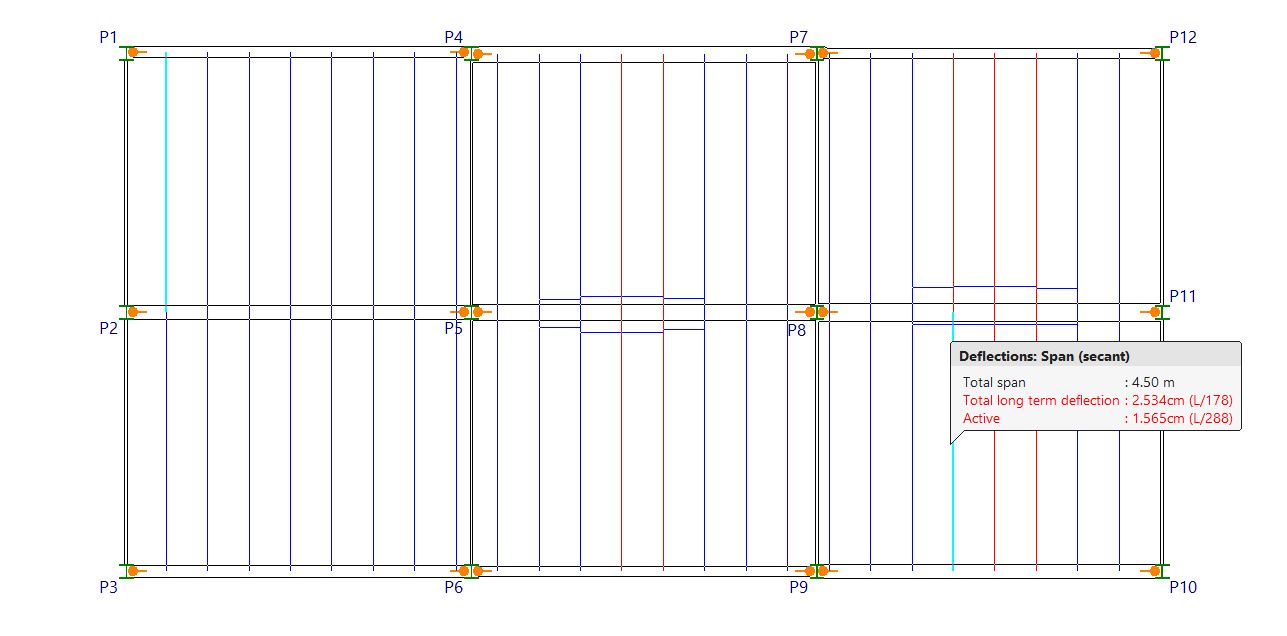
The "Deflection" option, within the "Joists" menu on the "Results" tab, allows you to view on screen, following the analysis, the deflections of each joist and any errors relating to the deflection checks.
When you click on the option, hovering the pointer over each joist displays a box showing the type of beam (either a "Span (secant)" or "Cantilever (tangent)”), as well as the “Total span”, the “Total at infinity” arrow and the “Active” arrow. Both absolute and relative values are shown.
If any deflection limit is exceeded, the text will be displayed in red.
In addition, joists with deflection errors or other issues will be highlighted in red on the floor plan.
Matching, editing and assigning positive moments for joists
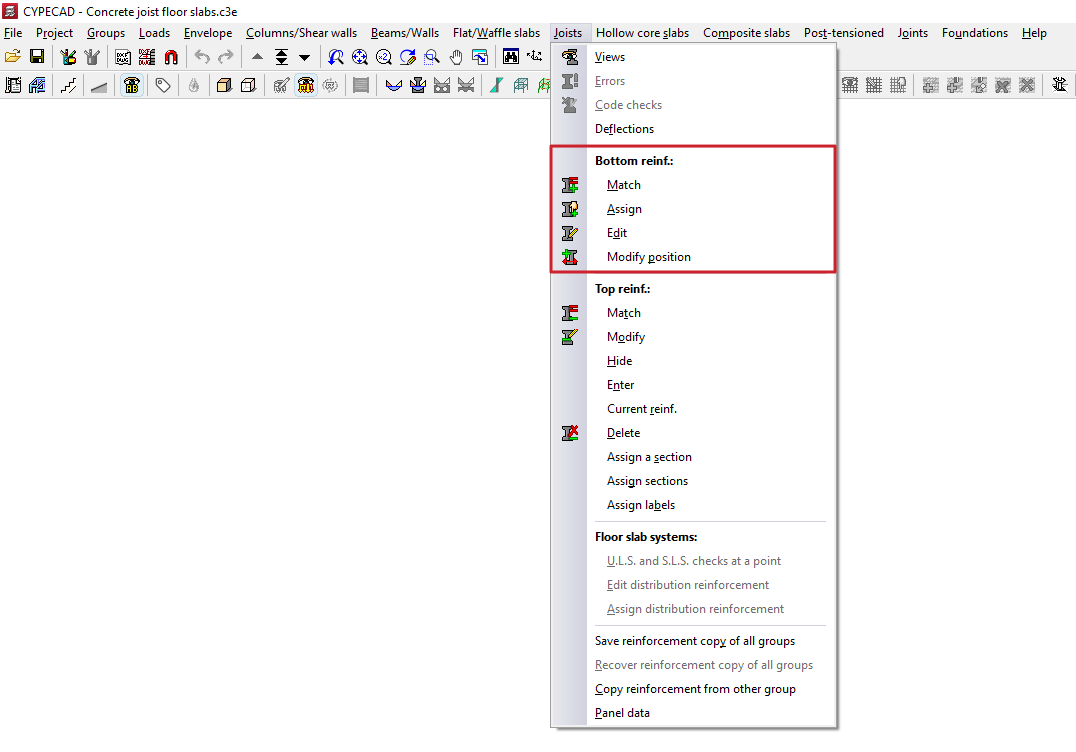
The tools in the "Bottom reinforcement" section of the "Joists" menu, within the "Results" tab, allow you to modify the positive bending moments and shear forces in the joists, the positive reinforcement, or the types of precast joists, obtained and arranged by the program following the structural analysis.
Changes made using the tools in this section are not retained in subsequent redesigns; therefore, they should only be used during the final adjustment stage prior to printing or exporting the data.
Each of the available tools is described below.
Match
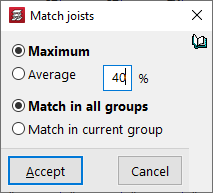
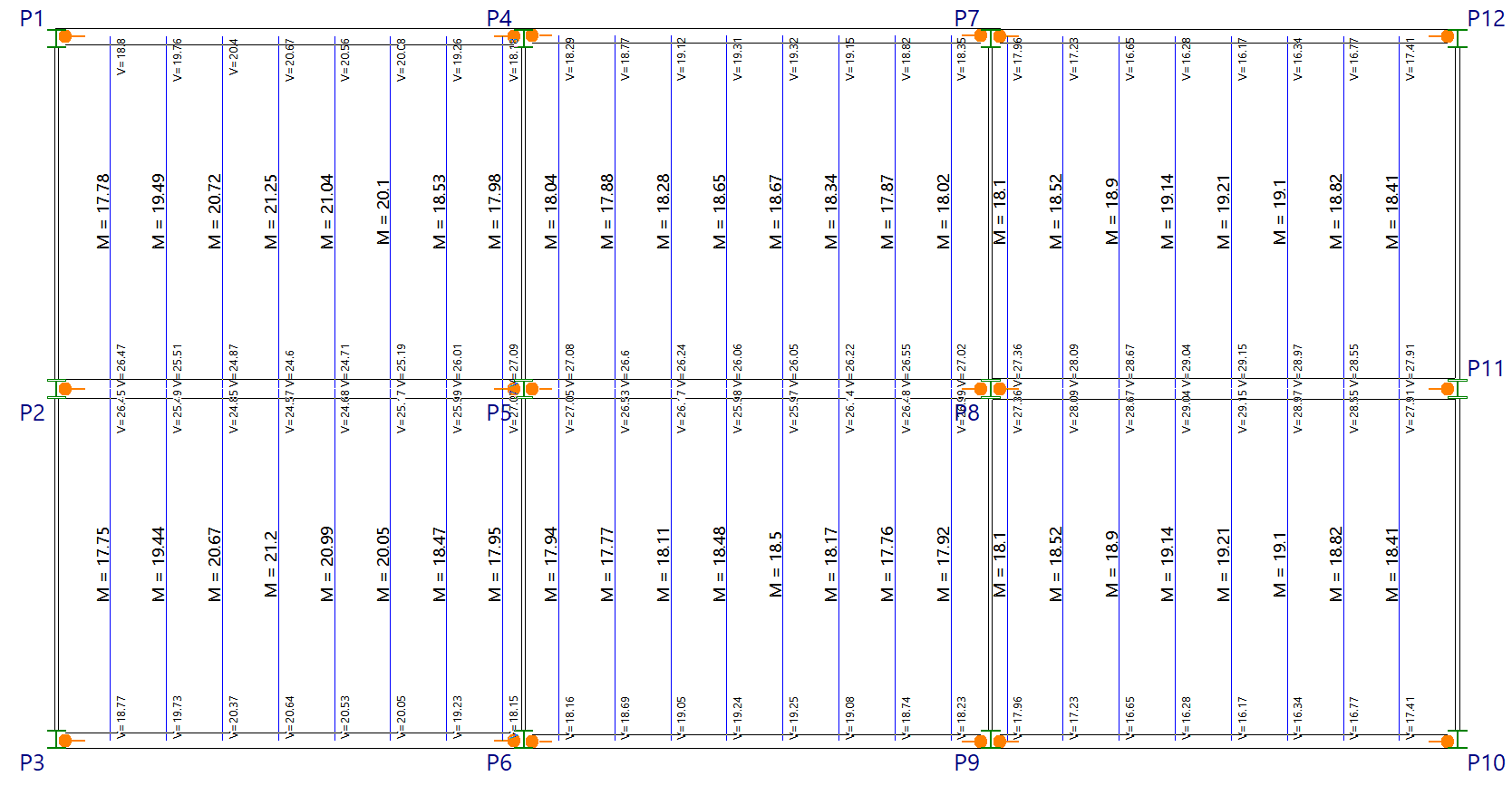
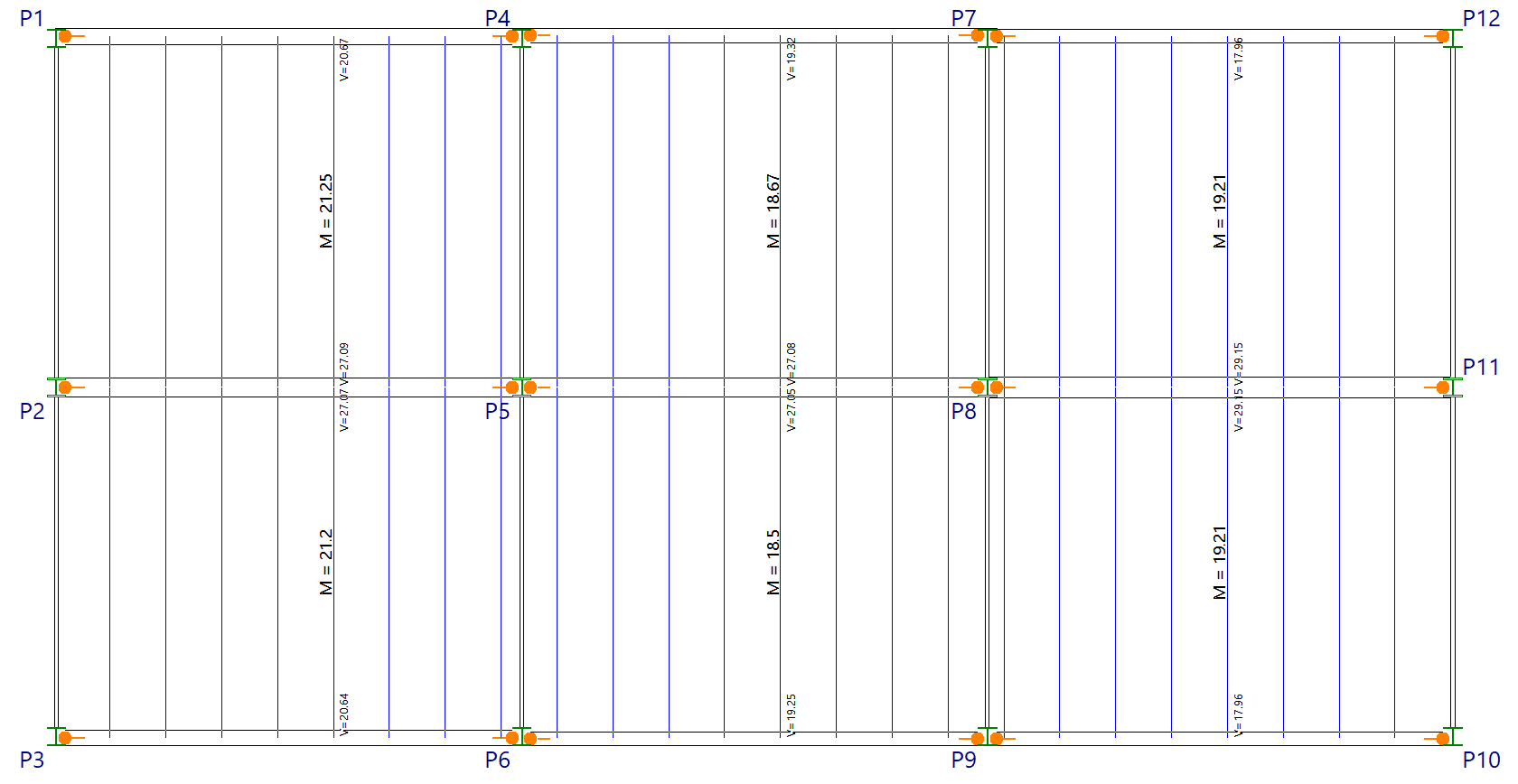
The "Match" option allows you to run an automatic equalisation process for the positive moments of joists (in generic concrete joist floors, entered using the "By geometric characteristics" option), for precast joists arranged (in reinforced or prestressed joist floors entered using the "From library" option) and the positive moments of the in-situ concrete joists. In these cases, the moments of each joist are taken as the basis for the matching.
This process groups similar joists together to streamline assembly, making construction easier and ensuring more consistent results without the need to adjust each joist manually.
The joists are grouped in such a way that all those belonging to a group satisfy the following expression: (Maximum moment of the group - Minimum moment of the group) < (%) * Maximum moment of the group, where % is the "Matching percentage" specified by the user in the "Match joists" pop-up window that appears when this option is selected.
Once the joists in each group have been identified, the various force combinations for each joist are balanced.
The equalisation of force combinations is carried out at each of the points at which the joist has been discretised, depending on the option selected in the pop-up window that appears when this option is clicked, and depending on the type of force:
- For bending moments:
- If the option to match the bending moments to the "Maximum" moment has been selected, the maximum value from all the combinations of each of the joists forming the group will be taken for each point. Matching the maximum moment is on the safe side, so it may be the more advisable option.
- If the option to match the bending moments to the "Average" moment has been selected, the average value of all the combinations for each of the joists in the group will be taken for each point.
- For the shear force, the maximum shear value from all combinations of each of the joists forming the group shall always be taken for each point.
It is also possible to "Match across all groups" of floor plans on the project, without having to switch floor plans, or simply to "Match within the current group".
Assign
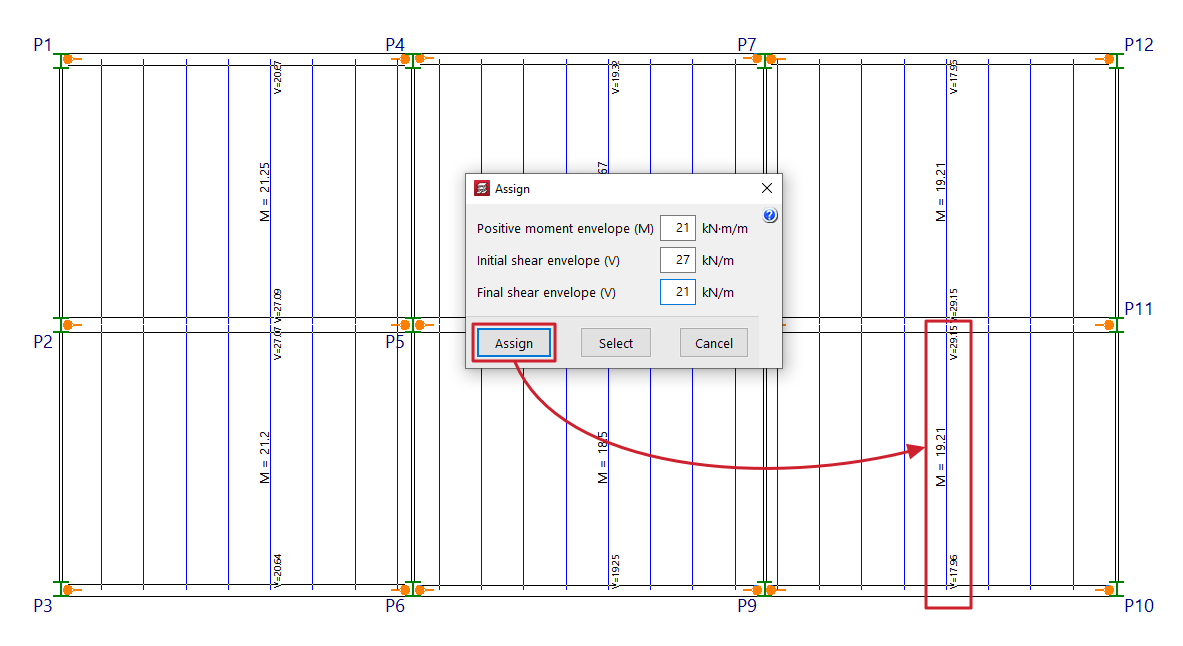
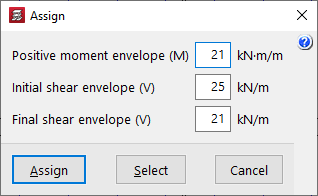
The "Assign" option allows you to modify the analysed positive moments and shear forces in the joists, the layout of positive moments, or the type of joist layout, by applying the data in bulk to all selected elements.
To do this, define the data to be assigned in the pop-up window. Next, click on "Assign" and select the floor joists to which you wish to assign this data (by left-clicking on a point on the floor slab to select the starting joist and then clicking on another point to select the ending joist; the selected joists are highlighted in a different colour). In the pop-up window, you can also use the "Select" option to copy the data from a joist selected on the floor plan or "Cancel" to close the window.
Edit
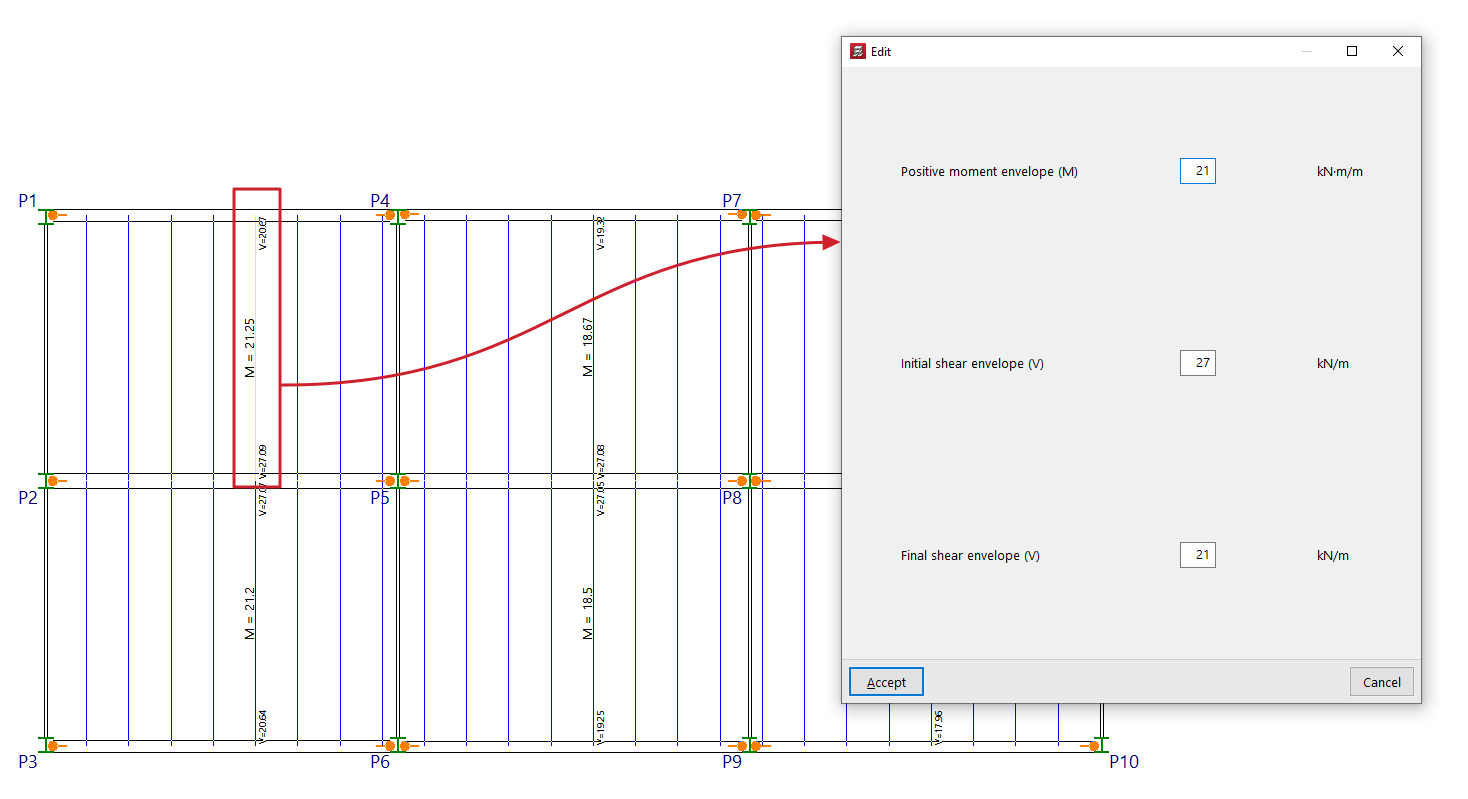
The "Edit" option allows you to change the analysed positive moments and shear forces, the layout of positive elements, or the type of joist used for an individual joist.
To do this, left-click on the joist whose data you wish to change.
Editing and/or assignment options
For prefabricated joists, you can edit or assign:
- the "Type of joist",
- the "Shear layout"
- and the"Partial additional reinforcement".
For standard concrete joists, you can edit or assign:
- the "Positive moment envelope (MF)",
- the "Initial shear envelope (V)",
- and the "Final shear envelope (V)".
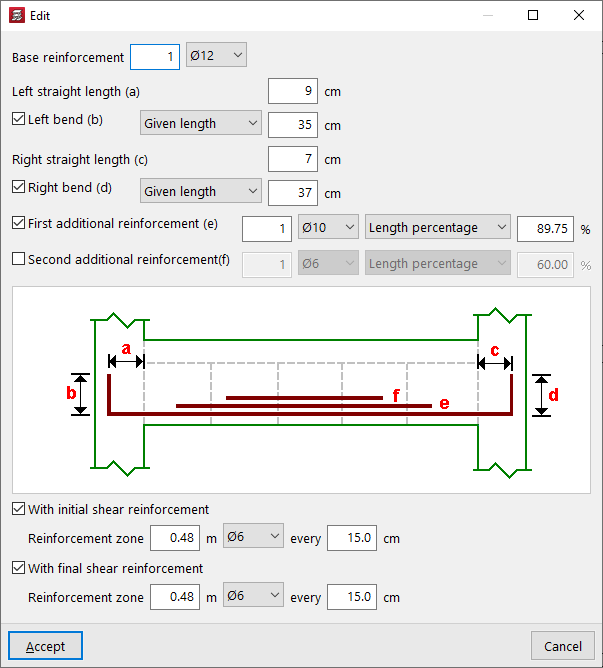
The following parameters can be adjusted for in-situ concrete joists:
- the "Base reinforcement", specifying the number and diameter of the bars, and including the following details:
- its "Left straight length (a)", with an optional "Left bend (b)" (across the "entire width" or to a "specified length");
- and its "Right straight length (a)", with an optional "Right bend (b)" (across the "In entire depth" or to a "Given length");
- Optionally, a "First additional reinforcement (e)" and/or a "Second additional reinforcement (f)" for positive reinforcement may be provided (over the "Full length", a "Specified length" or a "Percentage of length");
- Furthermore, the joist can be defined as "With initial shear reinforcement" and/or "With final shear reinforcement", specifying the "reinforcement zone", the diameter and the spacing.
- The diagram provides a visual aid to help understand each of the defined parameters (a, b, c, d, e, f).
In the case of steel and timber joists, it is possible to edit or assign the "Selected section".
Modify position
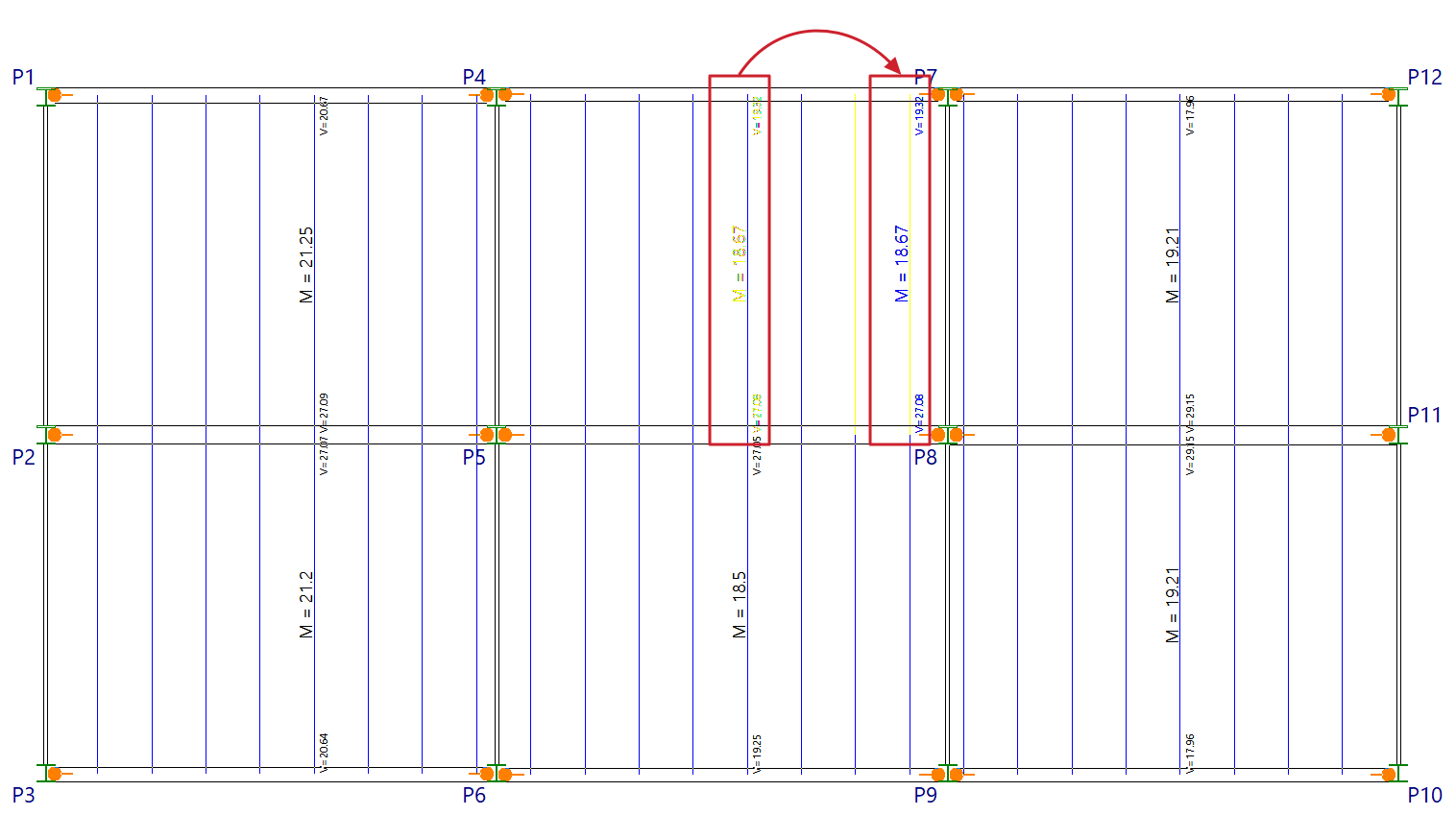
The "Modify position" option allows you to reposition the text, labelling the positive moment, the positive moment reinforcement, or the joist type on the drawing.
To change the position of the label, click on the panel. When you are between the joists where you want to place the label, click again. As you move the cursor across the panel, the appearance of the two joists between which the label will be placed changes when you left-click.
This option only allows you to adjust the position of the text within each group of moments, trusses or joists. If these groups have not been generated, you must run the "Align" option.
Matching, editing and assigning reinforcement for top reinforcement in joist floor slabs
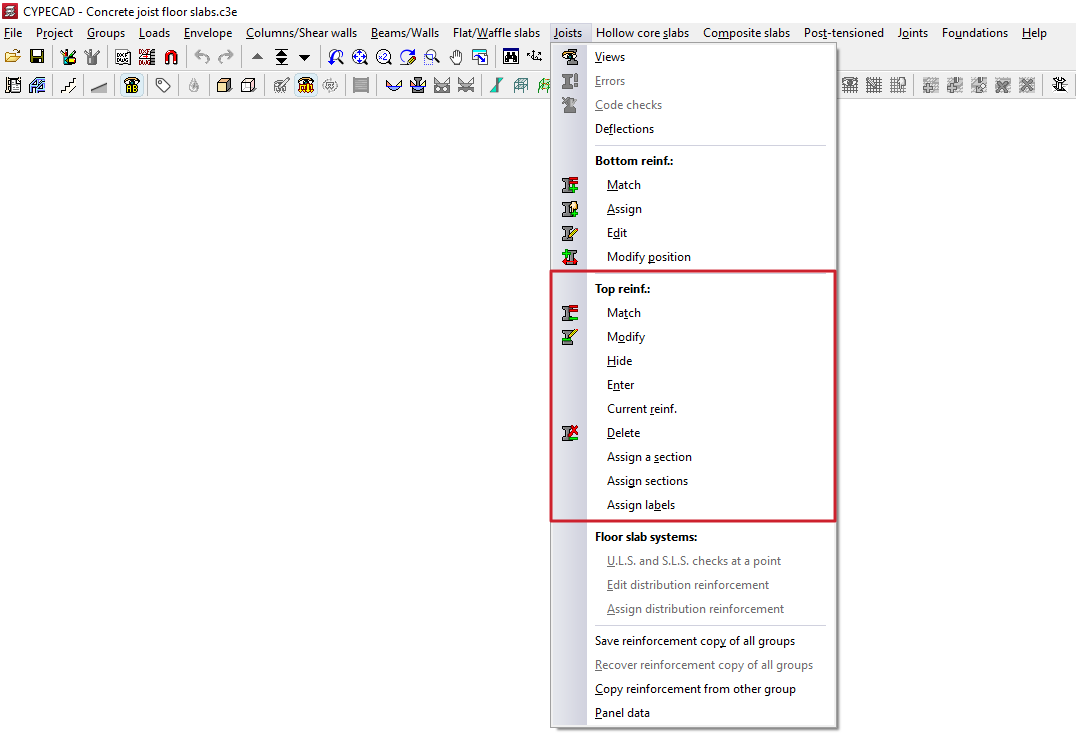
The tools in the "Top reinf." section of the "Joists" menu, within the "Results" tab, allow you to modify the negative reinforcement obtained in the joist floors following the structural analysis.
Changes made using the tools in this section are not retained in subsequent redesigns; therefore, they should only be used during the final adjustment stage prior to printing or exporting the data.
Each of the available tools is described below.
Match
The "Match" option allows you to match the lengths of the reinforcement bars in the top reinforcement.
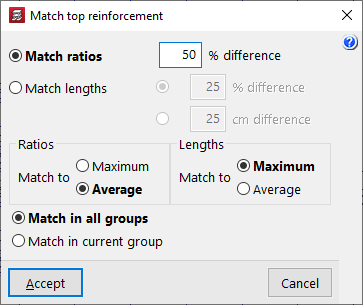
In the pop-up window that appears when you click this option, you can configure the alignment. This can be by amount or by length:
- If "Match ratios" is selected, the reinforcement bars for continuous joists are grouped together where the actual steel quantity does not differ from the percentage specified. Next, depending on the option selected, all the top reinforcement is adjusted to match the highest actual quantity in the group, or the average quantity of the group is analysed, and the nearest higher reinforcement from the corresponding table is taken. Once the diameters of the top reinforcement are the same, the lengths of the reinforcement are adjusted to the longest length or the average length of the group, again depending on the selected option.
- In the "Ratios" section, select one of these two options:
- Match to "Maximum"
All negative values are set to the highest actual value in the group. - Match to "Average"
The average value for the group is analysed, and the nearest higher value from the corresponding table is selected.
- Match to "Maximum"
- In the "Lengths" section, select one of these two options:
- Match to "Maximum"
All the lengths of the negative arrays are set to the longest length in the group. - Match to "Average"
The average length of the group is analysed, and all the lengths of the negative frames are set to this length.
- Match to "Maximum"
- In the "Ratios" section, select one of these two options:
- If "Match lengths" is selected, the top bars for continuous joists with the same reinforcement are grouped together where their partial lengths (on both sides) do not differ by more than the specified percentage or value. The partial lengths of the reinforcement are matched to the longest length or the average length of the group, depending on the option selected.
- In the "Lengths" section, select one of these two options:
- Match to "Maximum"
All the lengths of the top reinforcements are set to the longest length in the group. - Set to "Average"
The average length of the group is analysed, and all the lengths of the top reinforcements are set to this length.
- Match to "Maximum"
- In the "Lengths" section, select one of these two options:
It is also possible to "Match across all groups" of floor plans on the project, without having to switch floor plans, or simply to "Match within the current group".
Modify
The "Modify" option allows you to change the number, diameter and length of the reinforcement bars in the top reinforcement. It also allows you to add or remove layers or reinforcement groups.
To do this, select the reinforcement to be modified by drawing a box on the plan view.
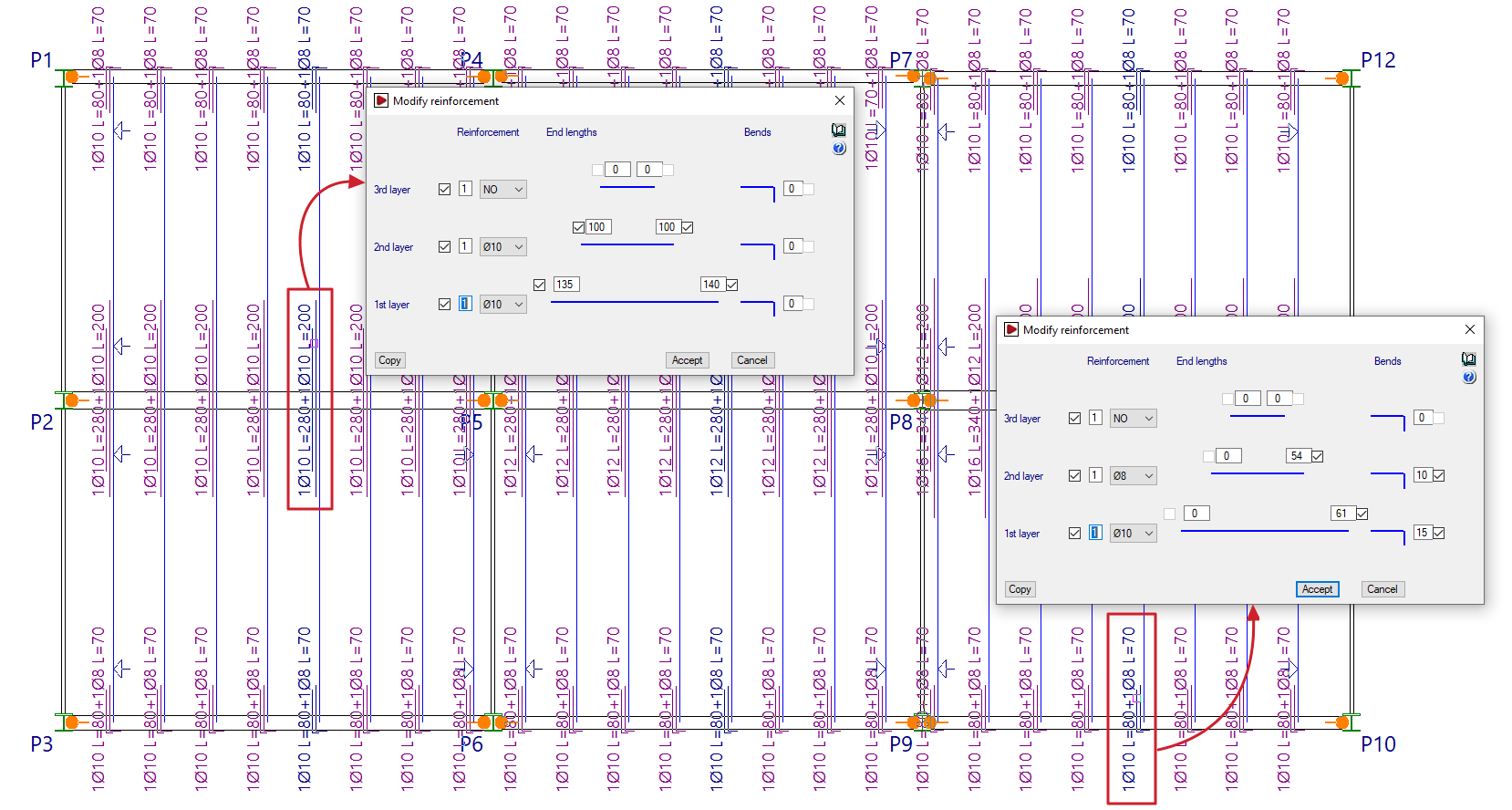
In the "Modify reinforcement" window that appears, you can modify the "Reinforcement" in the "1st layer", "2nd layer" and "3rd layer" by specifying their number and diameter. You can also enter the "End lengths" (or the lengths of the reinforcement bars on either side of the beam axis), or the length of the "Extensions" (which the program adds in cases where the negative sections meet a slab edge).
The lengths of bars anchored in a straight extension are measured from the nearest beam centreline, whilst the lengths of bars anchored at the end indicate the length from the bend point.
The "Copy" option allows you to extract data from a selected top reinforcement on the floor plan, whilst "OK" applies the data entered in the window to the reinforcements selected when using the option.
Hide
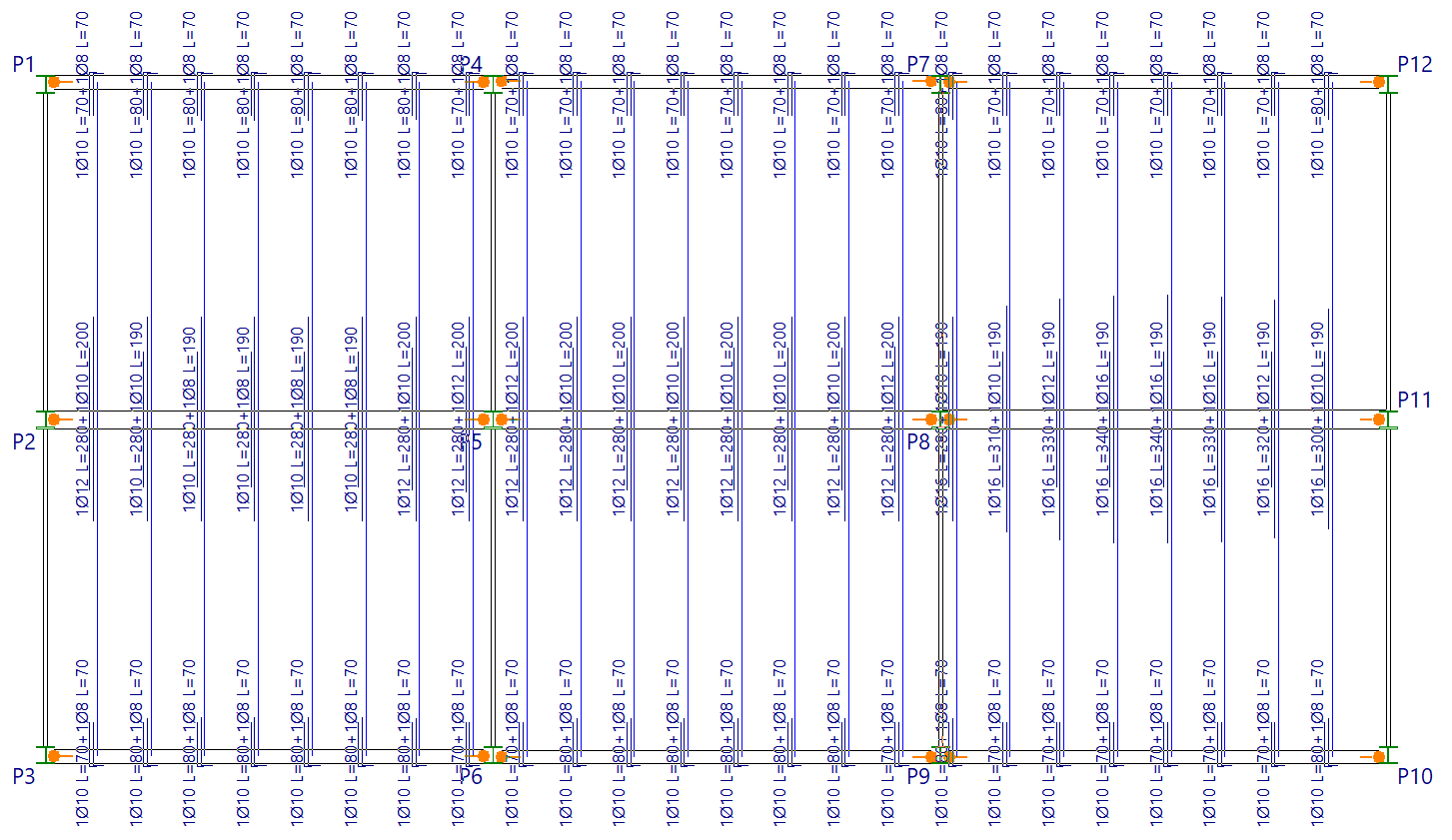
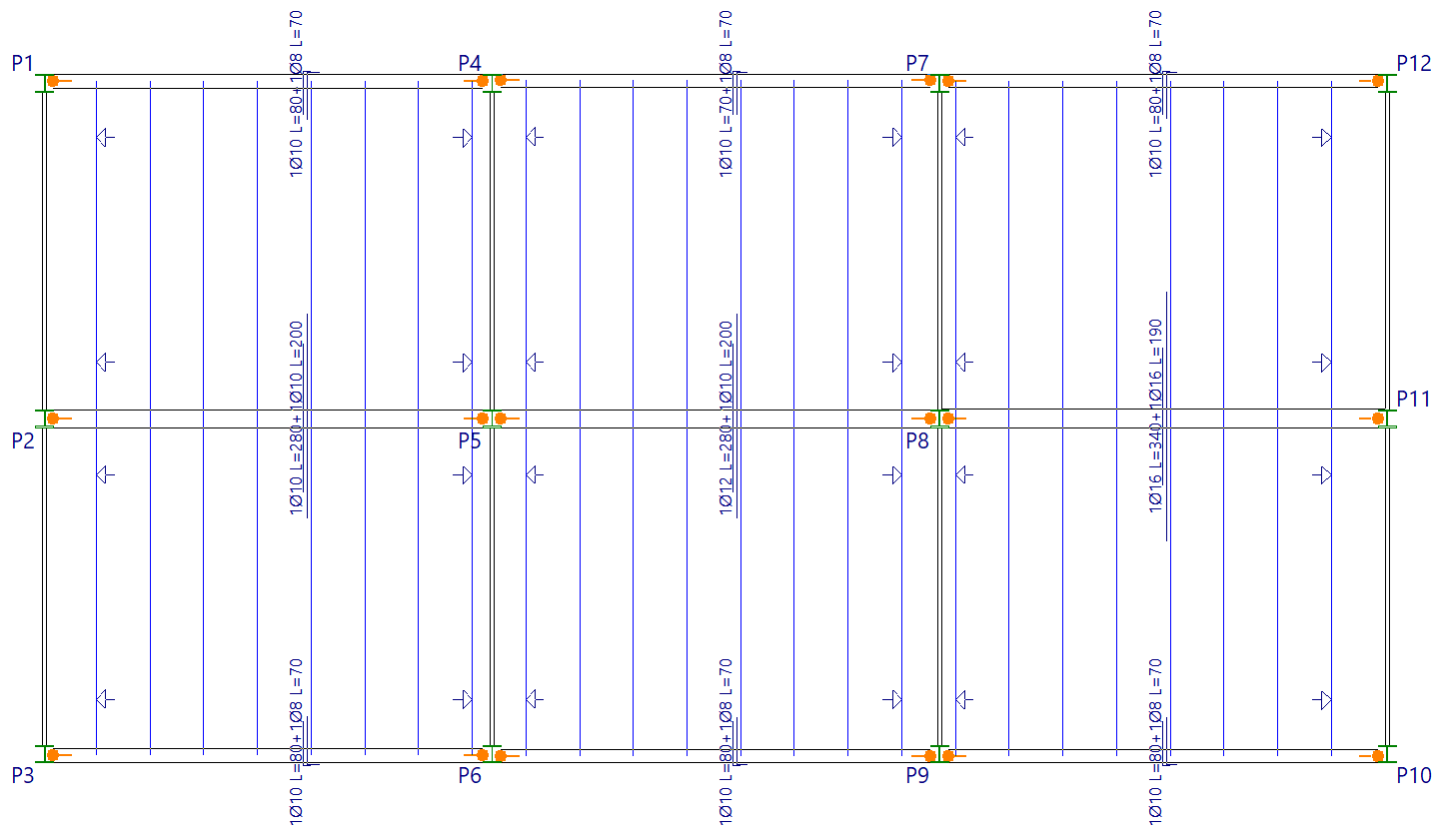
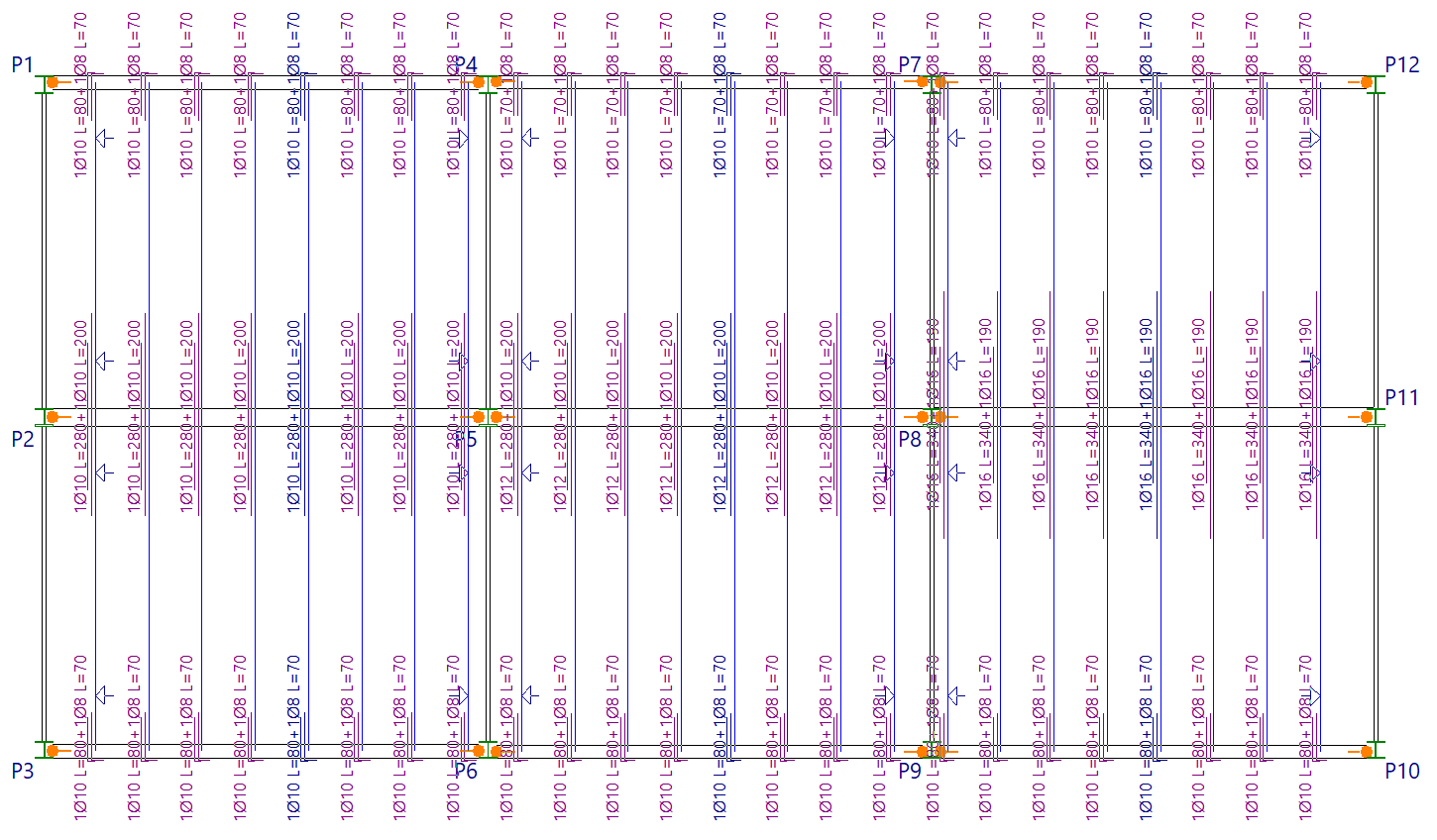
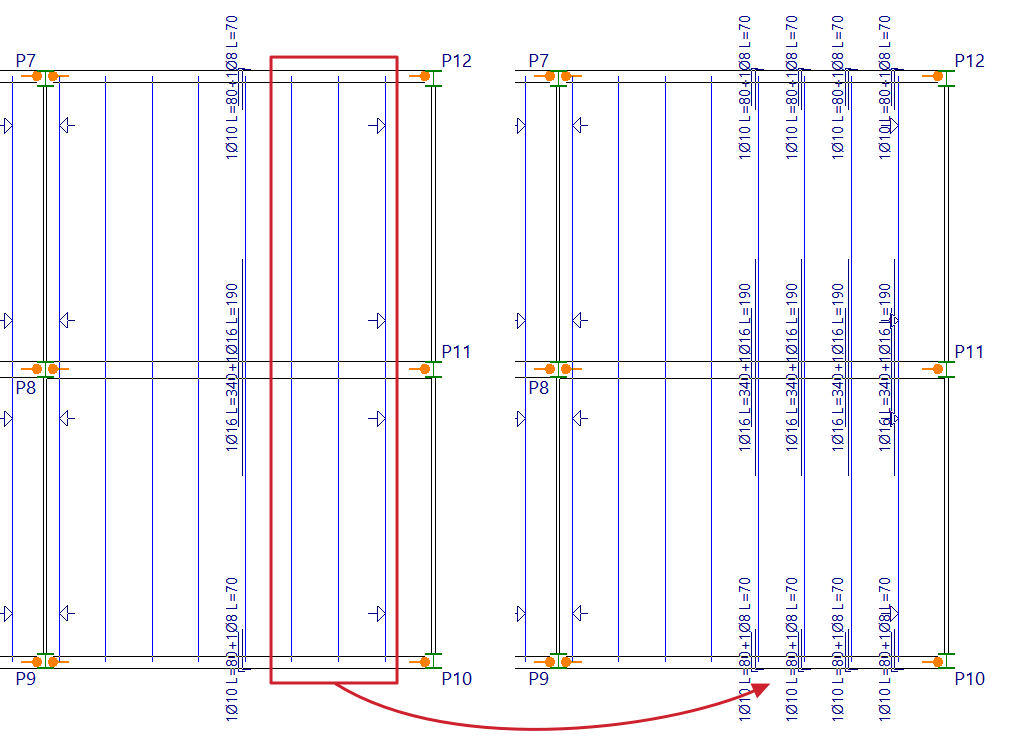
After selecting the "Match" option, the program automatically determines which negatives are to be labelled on the layout: those to be labelled appear in blue, whilst those that will not be labelled are shown in magenta.
If you wish to display components on the drawings other than those automatically selected by the program, you can use the "Hide" option to select which components to show or hide on the drawing.
Enter
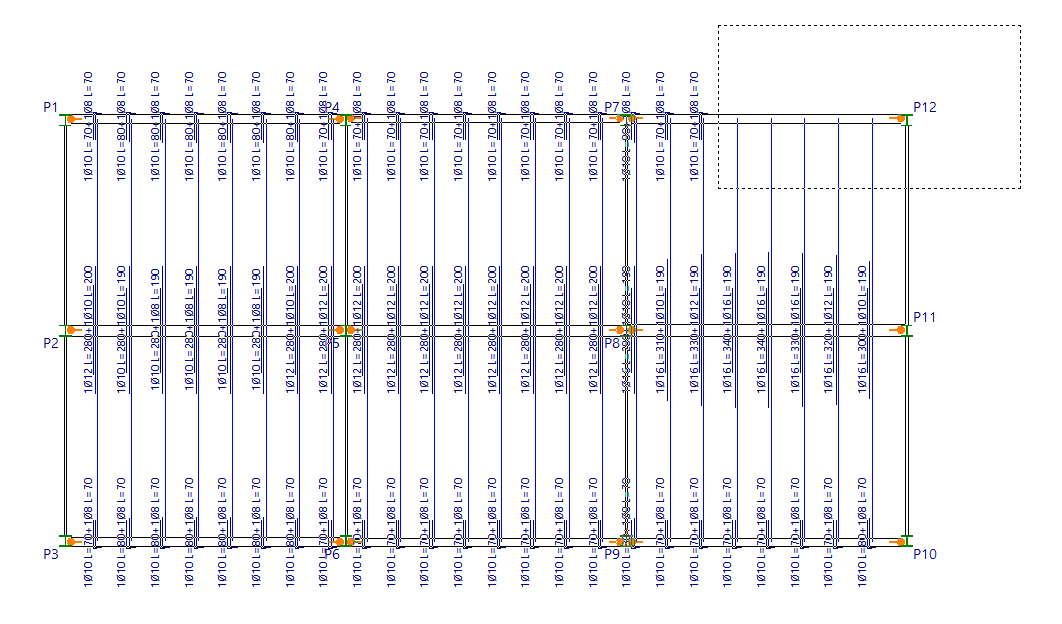
The "Enter" option allows you to insert negative reinforcement bars above the joists.
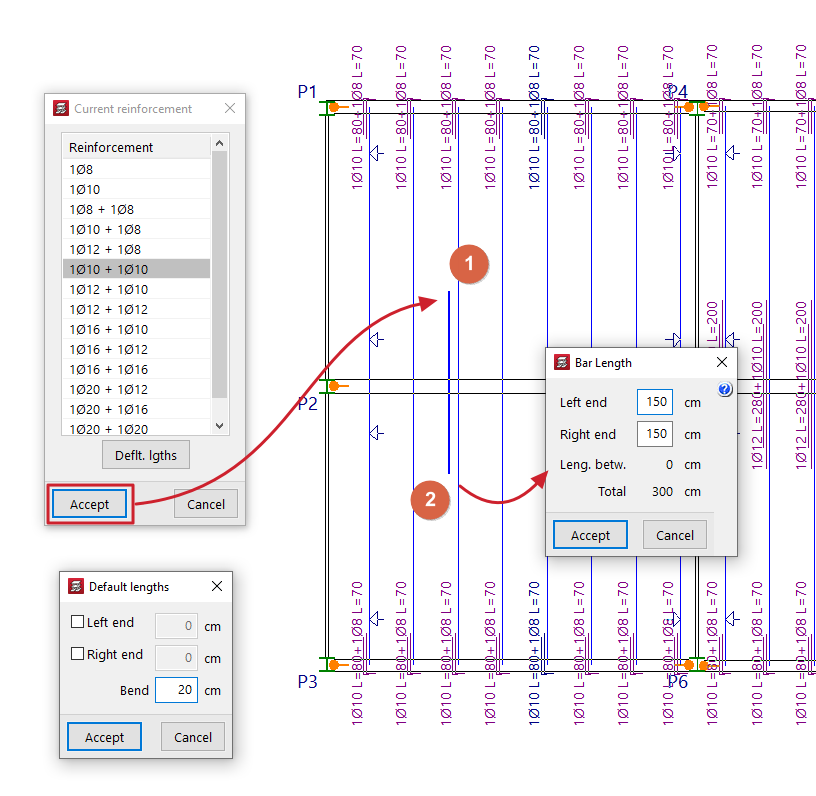
When you click on the option, right-clicking allows you to select the "Current reinforcement" from those available in the negative reinforcement table defined in the project.
Next, left-click on two points on the plan view near a joist to position the assembly, either on both sides of an intermediate support, or near an edge support and at another point beyond the edge of the floor slab. In the box that appears, you will need to confirm the lengths of both ends, or of one of the ends and the length of the brace, as appropriate. When you click "Accept", the specified reinforcement will be drawn.
You cannot insert bars where assembly packages have already been defined: in this case, you must use the "Modify" option if you wish to add new bars or edit their data, or first delete the existing top reinforcement packages in order to use the "Enter" option.
Current reinforcement
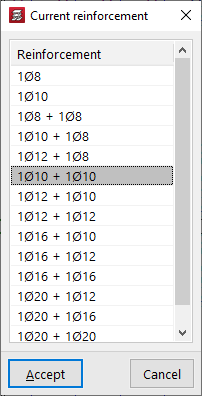
Selecting the "Current reinforcement" option opens a window displaying the reinforcement table for the formwork defined in the project. The reinforcement selected here will be the default value that appears when using the "Enter" option.
Delete
The "Delete" option allows you to remove reinforcement bars from drawings.
To do this, the bars to be removed are selected using a selection box on the plan view.
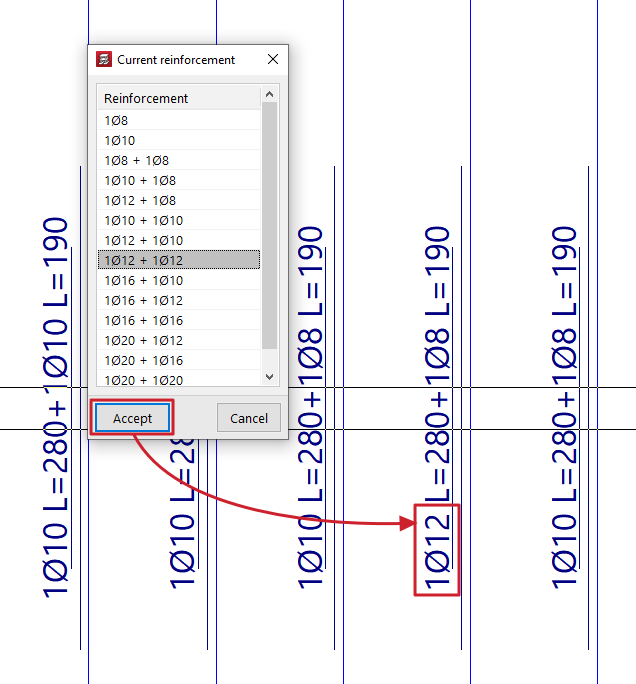
Assign a section
The "Assign a section" option allows you to change the diameter of a single bar in the selected negative reinforcement.
Clicking the right mouse button opens the "Current reinforcement" window, which allows you to select the standard diameter to be assigned from those available in the negative reinforcement table defined for the project.
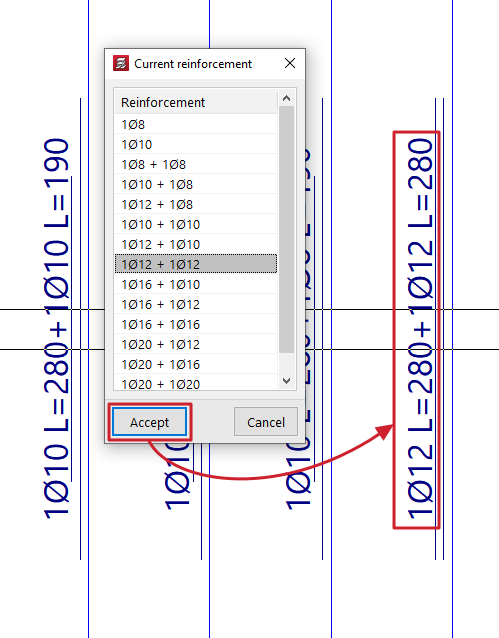
Assign sections
The "Assign sections" option allows you to change the diameters of the selected group of negative reinforcement bars.
Right-clicking opens the "Current reinforcement" window, which allows you to select the reinforcement package to be assigned from those available in the negative reinforcement table defined in the project.
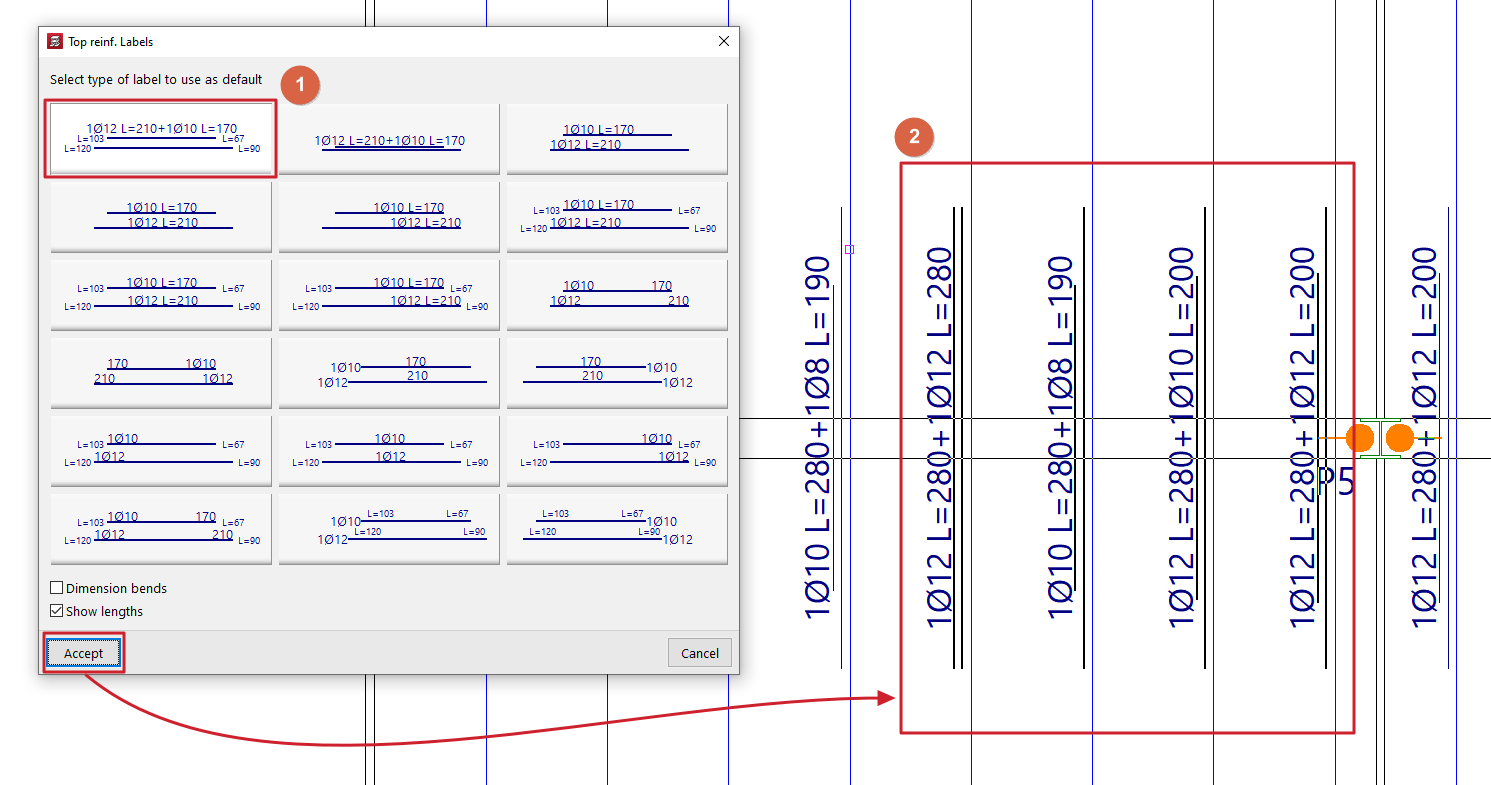
Assign labels
The "Assign labels" option allows you to assign the type of labelling for joist negative assemblies on screen. This change affects the drawings but not the on-screen display. If the project is redesigned, these changes will not take effect. If you want these changes to be permanent and apply to all floors, you must use the "Views" option.
Options for copying floor slabs
The following options are available in the "Slabs/Waffle slabs", "Joists", "Hollow core slabs" and "Composite slabs" on the "Results" tab, allowing you to save and retrieve copies of the slab reinforcement for all groups, or to copy slab reinforcement from one group to another.
Selecting these options only affects the type of floor slab in the relevant menu where they have been selected.
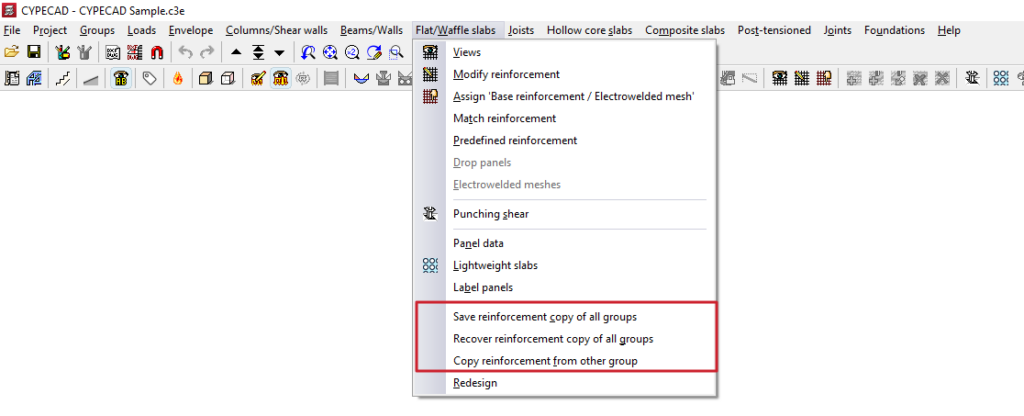
Save reinforcement copy of all groups / Recover reinforcement copy of all groups
These options allow you to save and restore backup copies of the reinforcement layout for the relevant type of floor slab in all groups, should it be necessary to redesign the structure, thereby preventing the loss of work carried out on the reinforcement.
The process is as follows:
- In a previously analysed project, the user makes manual modifications to the reinforcement in the parts of the model that require them.
- The "Save reinforcement copy of all groups" option is used to save the reinforcement with these modifications. Any modifications made to the reinforcement after this copy has been saved will not be saved.
- Subsequently, modifications are made to the projects that require a reanalysis (for example, by adding new elements to the structure).
- The project is reanalysed. During the reanalysis process, the program will have automatically made modifications to the floor structures of all groups, thereby losing the changes made manually.
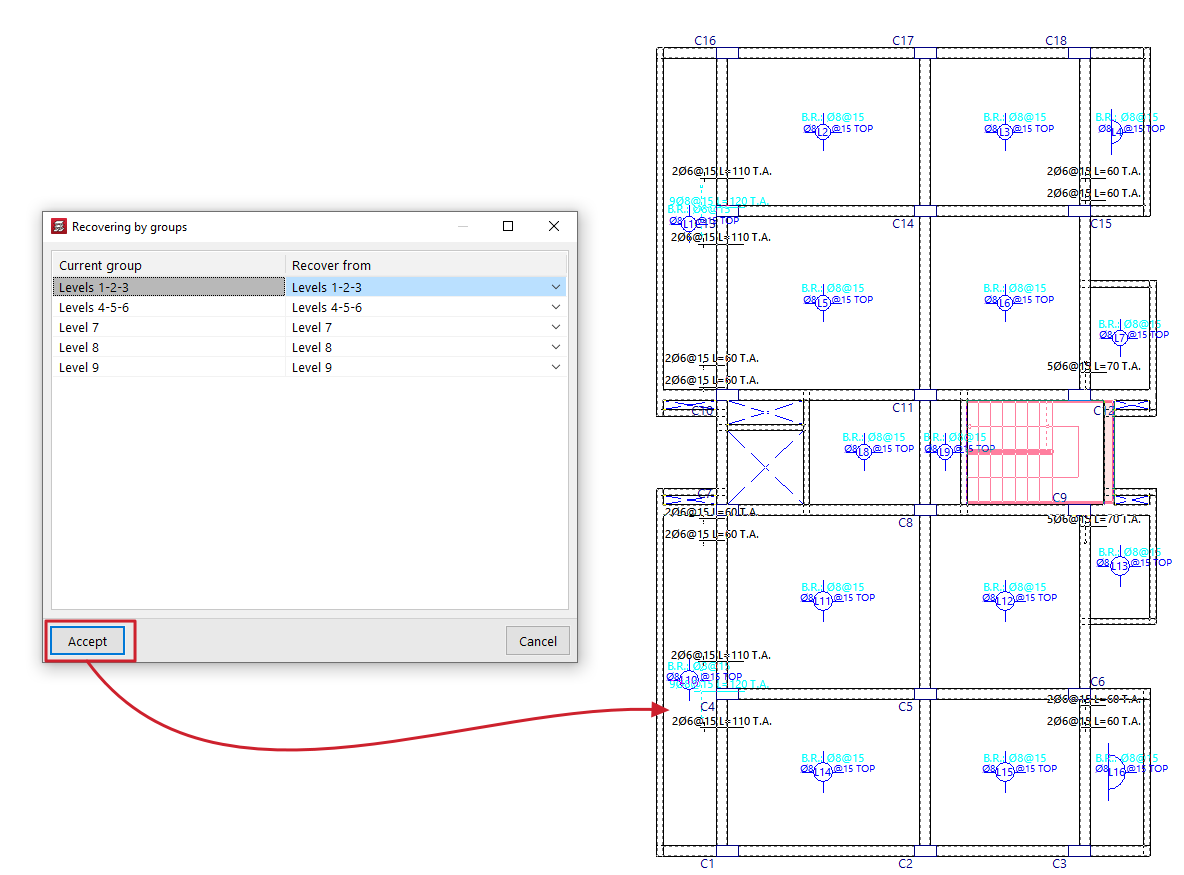
- At this point, use the "Recover reinforcement copy of all groups" option. In the window that appears, you must specify, for each ‘Current group’, the reinforcement you wish to restore (in the ‘Restore from’ column) from those available in the previous save.
Copy reinforcement from another group
This option allows you to copy the layouts from one group of floors to another.
This is particularly useful in cases where there are floors with identical layouts and loads: you would simply need to make the changes to the reinforcement for one of them, and then copy the reinforcement.
To make a copy, follow these steps:
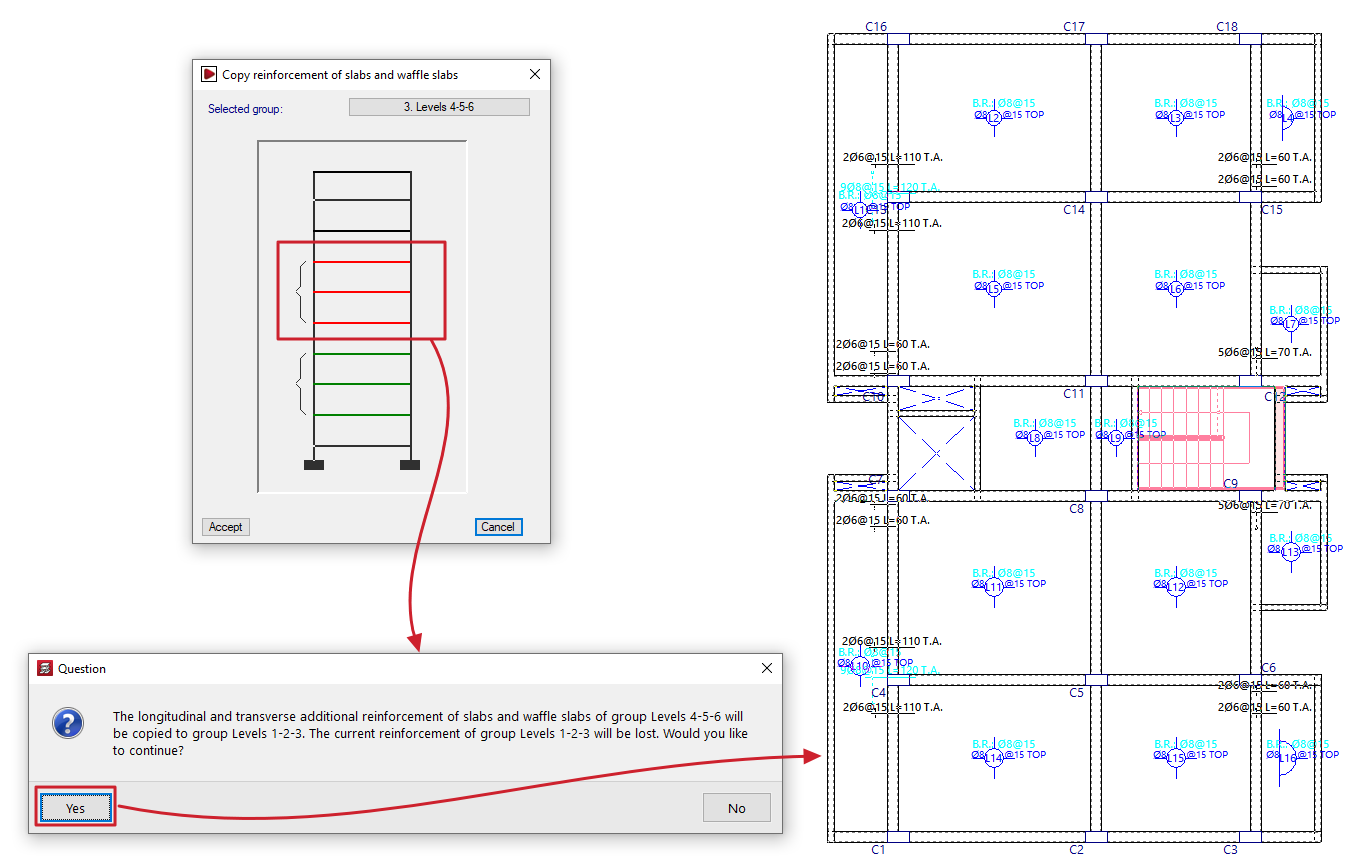
- Firstly, you need to select the target reinforcement (the reinforcement into which you wish to copy the structure of another reinforcement).
- Next, click on the "Copy reinforcement from another group" option in the relevant menu.
- Next, in the window that opens, select the group of floors from which you wish to copy the layout.
| Note: |
|---|
| If the target floor plan has a different layout from the standard floor plan, the reinforcement will only be copied in areas where there is a floor slab. In openings, the reinforcement is cut off, and no stirrups are placed. Furthermore, both the angle and the intersection point of the mesh must match. For this reason, when defining a group of floors, it is recommended to always copy the immediately preceding group. It is important to check any bars that have been cut, adding the corresponding stirrups or making any other necessary adjustments. |
Table of contents
Complete your tour of CYPECAD by exploring the other available sections:
- Introduction
- Introduction and creating new jobs
- General data configuration
- Defining floors and groups of floors and inserting columns, shear walls and starts ("Column input" tab)
- Inserting beams, walls, floor slabs, foundation elements and special elements, and structural analysis (the "Beam Input" tab):
- Checking analysis results and editing elements (the "Results" tab):
- Options on the "Contour plots" tab
- Printing documents and exporting data
- More information:
- General features of CYPECAD
