


Introduction
CYPETEL Wireless is a program created to perform indoor signal coverage studies of wireless telecommunications systems, such as Wi-Fi, Bluetooth and Zigbee networks.
To get started, a geometric model in IFC format is imported from a BIM project hosted on the BIMserver.center platform. The program can be used to configure the working frequencies, define the attenuation of signals in the building elements, establish the height of the working drawing in the spaces, and position transmitters and receivers.
After the analysis, the program displays the results in the form of contour plot and contour line diagrams overlaid on the floor plans and in the 3D view. It also offers tools to consult results, print reports and drawings, generate bills of quantities, and share project information through BIMserver.center.
Work environment
The program has a simple work environment, divided into two tabs: "Floor plans" and "Bill of quantities"
"Floor plans" tab
The default tab activated at start-up is the "Floor plans" tab. It displays:
- At the top are all the tools needed to complete the project, divided into groups for the configuration, the library of building elements, the definition and entry of emitters and receivers, editing and the analysis.
- On the left-hand side, the floor plans of the model, the tree of building elements and the 3D model are displayed.
- In the central right-hand part of the start screen is the modelling area, which is used to enter, edit and display all project elements in 2D.
"Bill of quantities" tab
On the other hand, the "Bill of quantities" tab also shows:
- A top toolbar containing the tools for creating and editing the bill of quantities, as well as the management and report creation tools.
- A specific area for structuring the bill of quantities, in the central part.

Results output
The analysis results can be obtained in the following ways:
Viewing results on screen
After the analysis, the results can be displayed directly on the screen by means of contour plots or contour lines, both on the floor drawings and in the 3D view. The program indicates the highest and lowest power zones depending on the proximity to the emitter or wireless access point. From "View results" at the bottom left of the interface, the display option between contour plots or contour lines can be changed.
| Best practice: |
|---|
| To regenerate the 3D view, click on the "Redraw" option located on the top toolbar of the 3D model. |


On the other hand, when selecting the "Consult results" option in the "Analysis" group, CYPETEL Wireless shows the results in the tooltip or informative text that appears when the cursor is positioned on an element in the system, such as the reception points or transmitters, as well as the checks carried out on them.

Results reports by element
Using the "Consult results" option in the "Analysis" group and clicking on the reception points, the corresponding report of results for each element can be accessed.
These reports show a summary of the analysis results of the selected element and detail the calculation expressions used, as well as the magnitudes obtained.

Job reports
The program can print the reports directly or generate HTML, PDF, TXT, RTF or DOCX files.
The reports are obtained via the "Reports" option in the "File" menu or in the top toolbar.
- Report
Displays information on the analysed results for the system entered, organised in the following sections:- Floor plans
For each floor, a table with the minimum and maximum received power (dB) for each type of space is displayed, as well as a drawing for displaying the results by means of contour plots. - Emitters
Displays a table showing the power (dB) to which each emitter is set, indicating its reference and location.
- Floor plans

Drawings in DWG, DXF or PDF format
The program can print the drawings of the job on any graphic peripheral configured on the computer, or create DWG, DXF or PDF files.
Editing the drawing allows the following options to be configured:
- Scale
- Reference
- Floor plans
- Details
The drawings can be obtained via the "Drawings" option in the "File" menu at the top of the interface.


GLTF file compatible with BIMserver.center
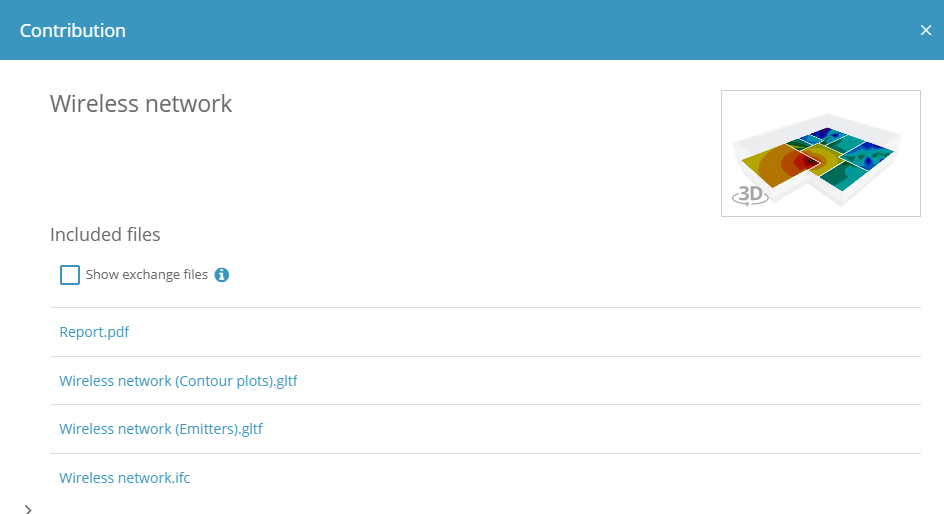
When exporting a job that has been analysed from CYPETEL Wireless to the project hosted on the "BIMserver.center" platform, the IFC file generated includes two .gltf files: one with the coverage contour plot diagrams in the 3D view and the other with the position of the emitters. This means that both can be visualised independently in:
- on the online platform;
- in the BIMserver.center app for iOS and Android;
- in virtual reality and augmented reality;
- in other CYPE programs.
The .gltf file corresponding to the emitters provides detailed information on the emitters, such as:
- Emitter reference.
- Emitter type.
- Installation height.
- Transmitting power.
Bill of quantities
In addition to generating "Bill of quantities reports", the system's bill of quantities can be exported to the standard FIEBDC-3 (.bc3) format so that it can be read by any compatible application.
To carry out the export, simply use the "Export BC3" tool in the "Import/Export" group of the "Bill of quantities" tab, assign a name to the file and activate the desired boxes to include associated information (graphic information, attached documents, specifications, technical information, etc.).
Integration into the BIMserver.center platform
Many of CYPE's programs are connected to the BIMserver.center platform and allow collaborative work to be carried out via the exchange of files in formats based on open standards.
Please note that, to work on BIMserver.center, users can register on the platform free of charge and create a profile.
When accessing a program connected to the platform, the program connects to a project in BIMserver.center. This way, the files of the projects that have been developed collaboratively in BIMserver.center are kept up to date.

| More information: |
|---|
| For further details related to using CYPE software via the BIMserver.center platform, please click on this link. |