Reglamento Argentino de Acción del Viento sobre las Construcciones.
Code implemented in CYPECAD.

Reglamento Argentino de Acción del Viento sobre las Construcciones.
Code implemented in CYPECAD.
South African National Standard. The structural use of steel. Part 1: Limit-states design of hot-rolled steelwork.
Code implemented in Metal 3D.
Norma Técnica E.030 (Peru). Static analysis method and correction due to base shear.
Peru’s E.030 code (seismic design) was already implemented in previous versions in CYPECAD and Metal 3D for the dynamic analysis method (spectral modal).
For this code, the 2013.c version includes in CYPECAD:
Règles NV 65. Règles définissant les effets de la neige et du vent sur les constructions et annexes.
Implemented in CYPECAD. This code was already implemented in the Portal frame generator.
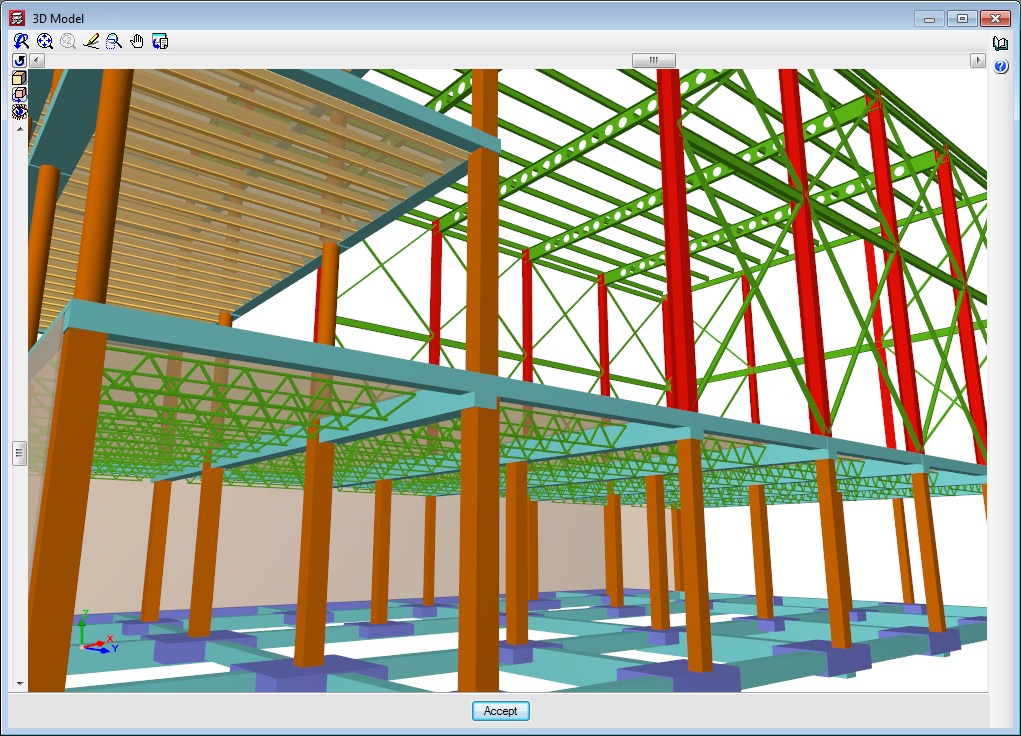
As of the 2013.b version, the export to IFC format (Industry Foundation Classes) includes the forms of joist floor slabs and lattice reinforcement of reinforced joists. These elements are not visible in the 3D view generated by CYPECAD but are exported to IFC in any of the four available formats (IFC 2x3, Archicad IFC 2x3, Revit IFC 2x3, Allplan IFC 2x3).
Norma ecuatoriana de la construcción. CapÃtulo 2.- Peligro sÃsmico y requisitos de diseño.
Implemented in CYPECAD and Metal 3D. In CYPECAD, users can choose to carry out a dynamic (spectral modal) or static (equivalent lateral force) analysis method. The base shear check is included in the dynamic analysis undertaken by CYPECAD.
Règles techniques de conception et de calcul des ouvrages et constructions en béton armé suivant la méthode des états limites.
This code was implemented in CYPE programs in the 2009.1.a version. The following new features have been implemented in the 2013.b version of CYPECAD:
More information on the detailed U.L.S. checks generated by CYPE programs, can be found in the Detailed ultimate limit state check reports page.
The 2013 version and successive versions will count with an advance export to IFC format (Industry Foundation Classes). Included in this export are the various components of the structural elements which are designed in CYPECAD. For example, joists, forms, infilled zones of the different types of floor slabs; the elements constituting the steel joints, etc. This way, users will be able to visualise in their CAD/BIM program, all the components of the structural elements which are designed in CYPECAD.
The first step in the process has been achieved in the 2013.a version, whereby the joists of the different types of joist floor slab are exported to IFC format (reinforced, prestressed, in situ, steel and open-web joists). The export of these elements to IFC format also implies they are represented in the 3D views provided by CYPECAD.
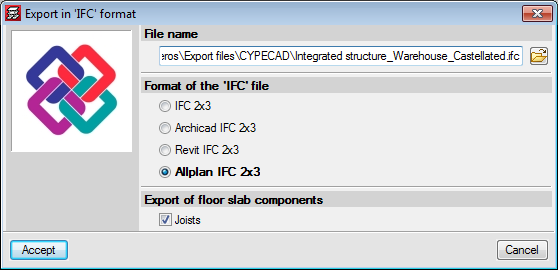
Within the Export to IFC dialogue box (File > Export > IFC), users can activate the export of the joists and choose amongst four IFC format variations for generating the export file:
In the export process, CYPECAD assigns different colours to the materials of the structural elements which are exported (concrete, steel, aluminium, timber, masonry walls, generic bars from integrated 3D structures). When exporting to Archicad, textures are also generated for each material.
Eurocode 1: Actions on structures – Part 1-4: General actions – Wind actions. SS EN 1991-1-4:2005 /NA:2009.
Implemented in CYPECAD.
British Standard. Loading for buildings. Part 2: Code of practice for wind loads.
Implemented in CYPECAD.
R-001 2011 (Dominican Republic)
Reglamento para el Análisis y Diseño SÃsmico de Estructuras
Implemented in CYPECAD and Metal 3D.
ABNT NBR 15421:2006 (Brazil)
Projeto de estruturas resistentes a sismos - Procedimento.
Implemented in CYPECAD and Metal 3D.