
Second-order elastic analysis
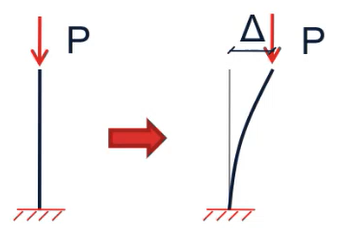
The program can consider second-order effects (P-δ and P-Δ) arising from geometric non-linearity in stress-strain analysis, modal analysis and pushover analysis.
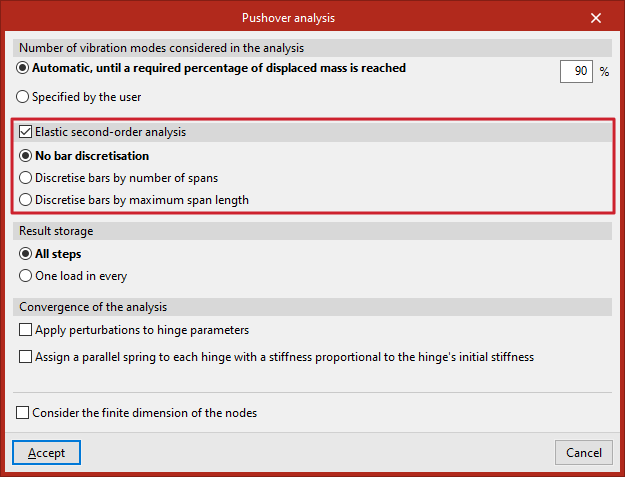
To do this, you must tick the "Second-order elastic analysis" box in the "Analysis" window (in the "Stress/Strain", "Modal" or "Pushover" sections). When doing so, you must select one of the following options for the settings:
- No bar discretisation
- Discretise bars by number of segments
- Discretise bars by maximum segment length
| Note: |
|---|
| To use this feature, your license must include the "OpenSees" module. |
Implementation and approach used
For each load step, a geometric matrix [Kg] is generated, which is added to or subtracted from the stiffness matrix [K] depending on whether the axial force in the beam is positive or negative:
[K] + [kg]
To generate the geometric matrix, the program uses Friedman-Kosmatka shape functions. These functions (φ) are cubic for the translational degrees of freedom (w) and quadratic for the rotational degrees of freedom (θ).
Comparing results
Below are examples of the variation in results obtained for different structures when second-order effects are taken into account using this feature:
Capacity curves (pushover analysis)
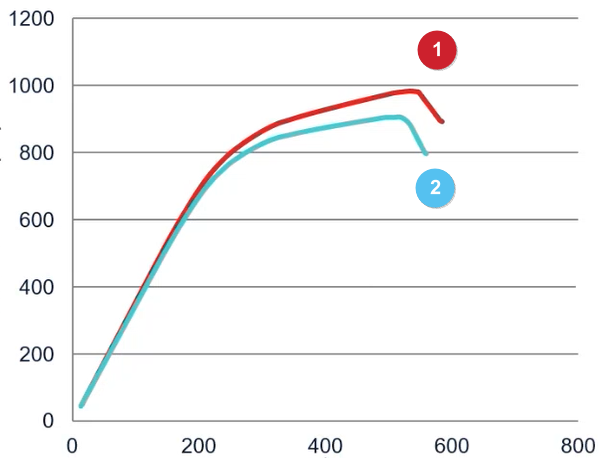
This example compares the results of a pushover analysis with and without considering second-order effects in a structure subjected to dead loads.
For the same displacement, greater force is required without second-order effects (1, in red) than with second-order effects enabled (2, in blue). Therefore, in the latter case, the structure is more flexible and the values of the capacity curve decrease.
Strain and displacement amplification in a compressed bar (stress–strain analysis)
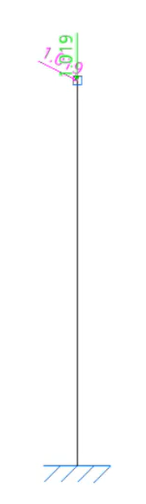
This example compares the results of a non-linear stress-strain analysis of a beam model in which a non-linear load combination has been defined, comprising a vertical load compressing the beam and a lateral load.
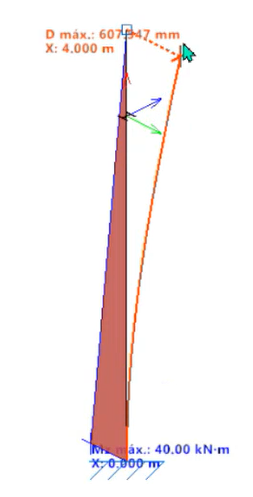
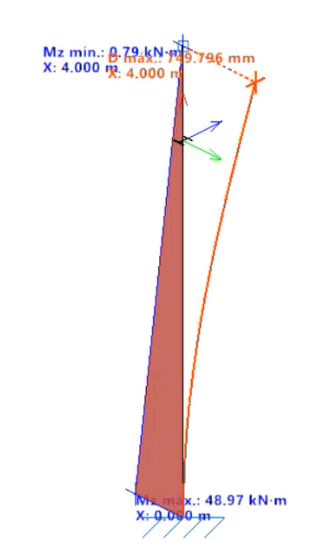
Taking second-order effects into account increases the moments at the base and the displacements at the top:
- No second-order effects:
- Dmax (head) ≈ 607 mm
- Max. torque (base) ≈ 40 kNm
- With second-order effects:
- Dmax (head) ≈ 750 mm
- Mz max (base) ≈ 49 kNm