
Update history​​

CYPECAD

By checking this option in "BIMserver.center" > "Share" or "Export" > "IFC", new unique identifiers (GUIDs) will be generated for the structural elements and therefore they will be considered as new project elements.

This option is useful in certain cases, such as when modelling a project with identical structures. Each element can now be generated with its own globally unique identifier (GUID) for each independent structure.

This allows users to draw each structural element independently within the project and avoid having to redo the job.
As of version 2024.e of CYPECAD, both the effective covers of floor slabs and waffle slabs and the clear covers can be edited.

The clear covers entered are used to correctly arrange the punching shear studs, to perform fire resistance checks more accurately and to determine the position of the reinforcement bars to be exported to the BIM model.

When reading older jobs, the clear cover is automatically assigned by deducting 5 mm from the effective cover.

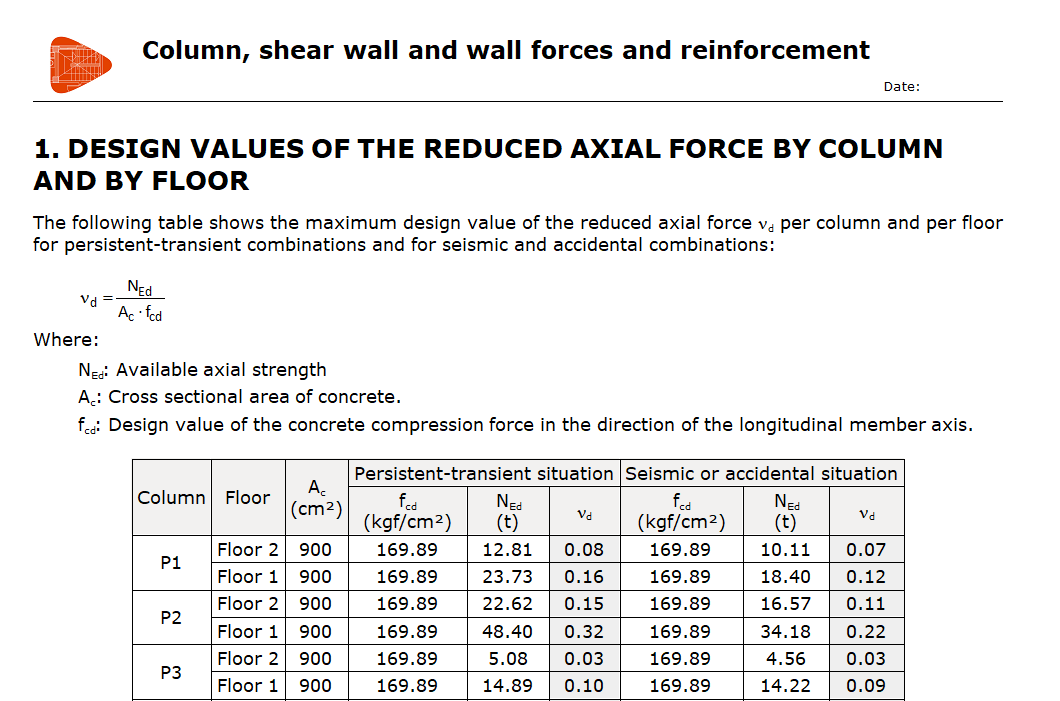
In CYPECAD version 2024.e, in the "Column, shear wall and wall forces and reinforcement" report, the "Design values of the reduced axial force by column and by floor" chapter has been added, which shows the maximum design value of the reduced axial force, for the persistent-transient combinations and the seismic and accidental combinations.

This chapter is enabled for the following standards: Eurocode 2, Spanish structural code "Código Estructural" (Spain), BS-8110 (UK) and NTC (Italy).

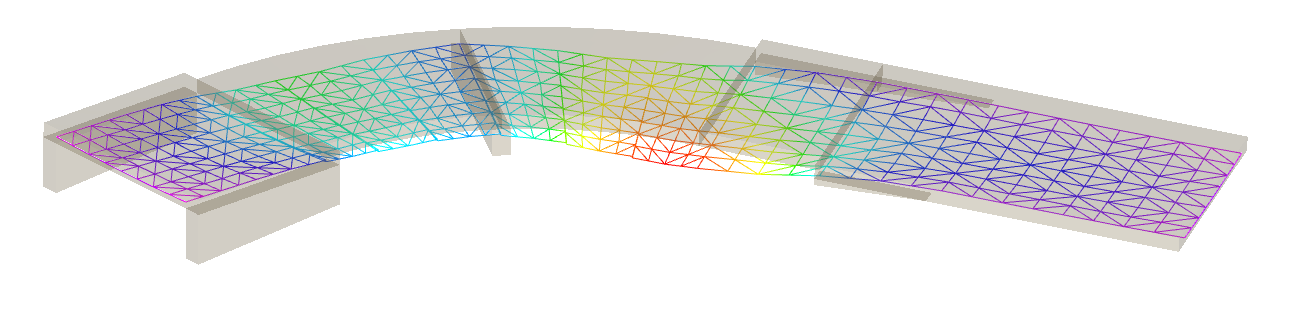
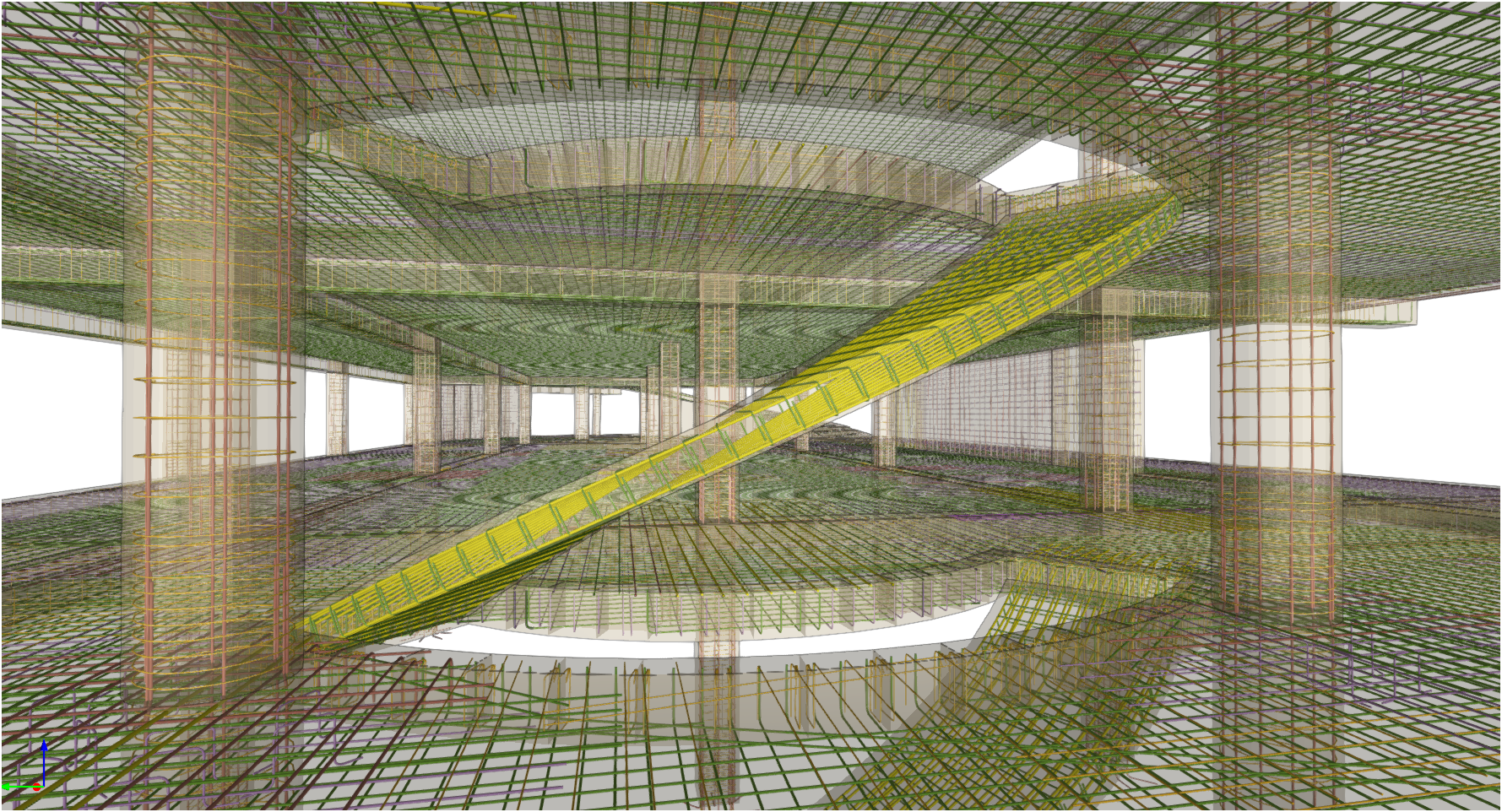
The export of rebars from curved spans of staircases and ramps to the BIM model has been implemented.

In the current version of the program, CYPECAD exports the reinforcement of the following element types:

  • Concrete walls
  • Columns
  • Shear walls
  • Beam frames
  • Staircase
  • Ramps
  • Foundation elements (footings, pile caps, centring and tie beams)
  • Floor slabs (waffle slabs, joist slabs, hollow core slabs, composite slabs and flat slabs)
  • Corbels

These rebars can be viewed in StruBIM Rebar, along with rebars exported from the StruBIM Shear Walls program.

They can also be viewed in CYPECAD from the "Results" tab (Groups > 3D view with details).

In the "Edit reinforcement" option from CYPECAD's "Stairs" and "Ramps" menus, the bars of the longitudinal reinforcement can be divided at a point, generating the necessary overlap to guarantee the transmission of forces from one bar to the next. The division can be carried out manually or the program can choose to do it automatically, respecting the maximum length of the bars defined. Bars that have been previously divided can also be joined together.

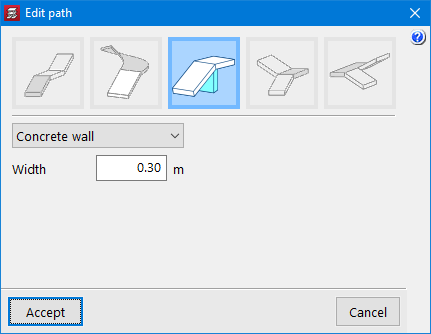
In CYPECAD version 2024.e, intermediate supports can now be used between two consecutive spans for ramps.

Like lateral supports, intermediate supports transmit the load to the elements on the floor below or to the elements on the floor above, depending on the support option chosen.

CYPECAD version 2024.d includes the following improvements and corrections to the program for some specific cases:

  • Pre-stressed ceramic slabs for floor slabs manufactured by Cerámica Pastrana, S.A. have been added. By incorporating the technical data sheets of these products in the program, they are now available for use in the "Selection of hollow core plates".

  • The design of portal frames has been modified to consider paragraph 5.6.3(3) of Annex 20 of the Spanish structural code "Código Estructural" as well as Eurocode 2, Part 2-2. In order to meet the criteria indicated in these sections, in the case of fire resistance equal to or greater than R90, an extension of the negative reinforcement is applied up to 0.3 times the span length.

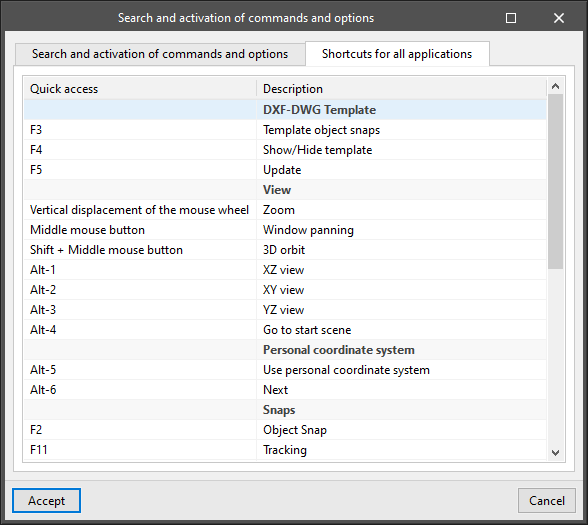
  • The updating of DXF/DWG templates by pressing the F5 key has been improved. In the previous patch, there was a new implementation for updating the templates, if new layers appeared, these were automatically made visible. This was made for updating via 'Edit templates > Import templates - Update file'. The same now applies when pressing the F5 key on the main screen.

  • The “Diagrams of pressures acting on the wall > Pressure diagrams list” has been improved. Previously, when adding a "Generic pressure diagram" after having entered another one without accepting the panel, the data of the first one was lost.

  • An error that could occur in the "Recover reinforcement copy of all groups" option has been solved. This occurred when the angle of the longitudinal reinforcement of a slab was greater than 180º. Now, when an angle greater than 180º is entered, in a flat slab or a waffle slab, it is automatically modified.

  • The entry of grid lines has been improved. Templates defined in "Column definition" can now be snapped.

  • An error that could occur in some situations when displaying the 3D view of concrete walls with continuous reinforcement on some floors has been fixed.

  • The 3D view of the reinforcement of circular frames, or frames where the origin coincides with the end, has been improved. Due to a programming error, in these cases, every time "3D view with details" was launched, the order of the beams in these frames was inverted and the reinforcement was shown alternately, correctly positioned and incorrectly positioned.

  • The "Electrowelded meshes > Check" has been improved. The checking process has been optimised to reduce processing time. More optimisations of this kind will be carried out in future versions.

  • The entry of generic column sections has been improved. The ability to enter points by snapping the elements of a template, which was lost in version 2024.c, has now been restored.

  • An error that could occur very rarely during the analysis process when a wall was in contact with flat slabs and the direction of this wall was not parallel to the direction of the reinforcement of one of the slabs involved, has been solved.

  • The ratio analysis for primary beams according to Eurocode 8 requirements 5.4.3.1.2(5)P and 5.5.3.1.3(5)P has been improved.

  • An error has been corrected in the units shown for air density in the wind action report according to Eurocode 1-4.

  • The steels and bar diameters commonly used in Thailand for the ACI 318M-11 (USA) concrete standard have been incorporated.

As of version 2024.d, CYPECAD has implemented the reading of the fixed points of columns included in the IFCs generated by REVIT. For this reading to be carried out correctly, REVIT must use column families created with a fixed point which is the origin of the coordinates of this IFC.

More information on how to create or use these families can be found at https://learning.cype.com/en/faq/how-can-the-fixed-points-of-revit-columns-be-read/. In the same link, users can also download the parameterised column families supplied by CYPE for different Revit versions.

Croatian national annex to Eurocode 1: Actions on structures. Part 1-4: General actions - Wind actions.

Implemented in CYPECAD and Portal frame generator.

Normative and Technical Document of the Republic of Kazakhstan. Loads on structures. Part 1-4: Wind actions (according to SP RK EN 1991-1-4:2005/2011) (modified on 30.12.2021).

Implemented in CYPECAD and Portal frame generator.

Slovenian national annex to Eurocode 3: Design of steel structures. Part 1-3: General rules. Supplementary rules for cold-formed members and sheeting.

Implemented in CYPECAD and CYPE 3D.

CYPE Mentor